|
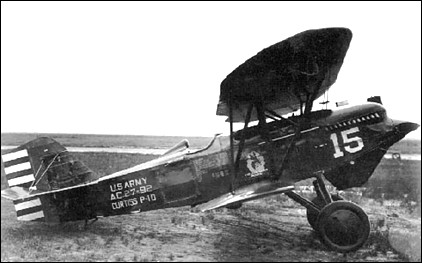
| On 7 March 1925, Curtiss was awarded a contract for 15
production examples of the XPW-8B as the P-1, this
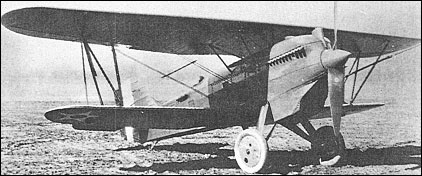
being the first fighter to which the company assigned the name Hawk. Externally similar to the XPW-8B, the
P-1 was of mixed construction with wooden wings and
steel-tube fuselage with fabric skinning, and was
powered by a 435hp Curtiss V-1150-1 12-cylinder
water-cooled engine. The final five aircraft were completed
as P-2s, three of these later being converted to
P-1A standards. Follow-on contracts were placed on 9
September 1925 for 25 P-1As (which had a 7.62cm
longer fuselage); on 17 August 1926 for 25 P-1Bs (with
V-1150-3 engine, larger wheels and modified radiator),
and on 3 October 1928 for 33 P-1Cs (with wheel brakes).
All these sub-types carried an armament of two 7.62mm guns. In the meantime, the USAAC had
ordered advanced trainers utilising the same airframe,
these comprising 35 AT-4s (180hp Wright V-720), five
AT-5s and 31 AT-5As (220hp Wright R-790), and, in
1929, these were re-engined with the V-1150-3, all 35
AT-4s becoming P-1Ds and four AT-5s and 24 AT-5As
becoming P-1Es and P-1Fs respectively. These conversions
were essentially similar to the P-1B apart from
having only one gun. Four P-1s were supplied to Bolivia,
one P-1A went to Japan, and eight P-1As and eight
P-1Bs were supplied to Chile.
| MODEL | P-1B |
| WEIGHTS |
| Take-off weight | 1330 kg | 2932 lb |
| Empty weight | 955 kg | 2105 lb |
| DIMENSIONS |
| Wingspan | 9.63 m | 32 ft 7 in |
| Length | 6.91 m | 23 ft 8 in |
| Height | 2.72 m | 9 ft 11 in |
| Wing area | 23.23 m2 | 250.05 sq ft |
| PERFORMANCE |
| Range | 966 km | 600 miles |
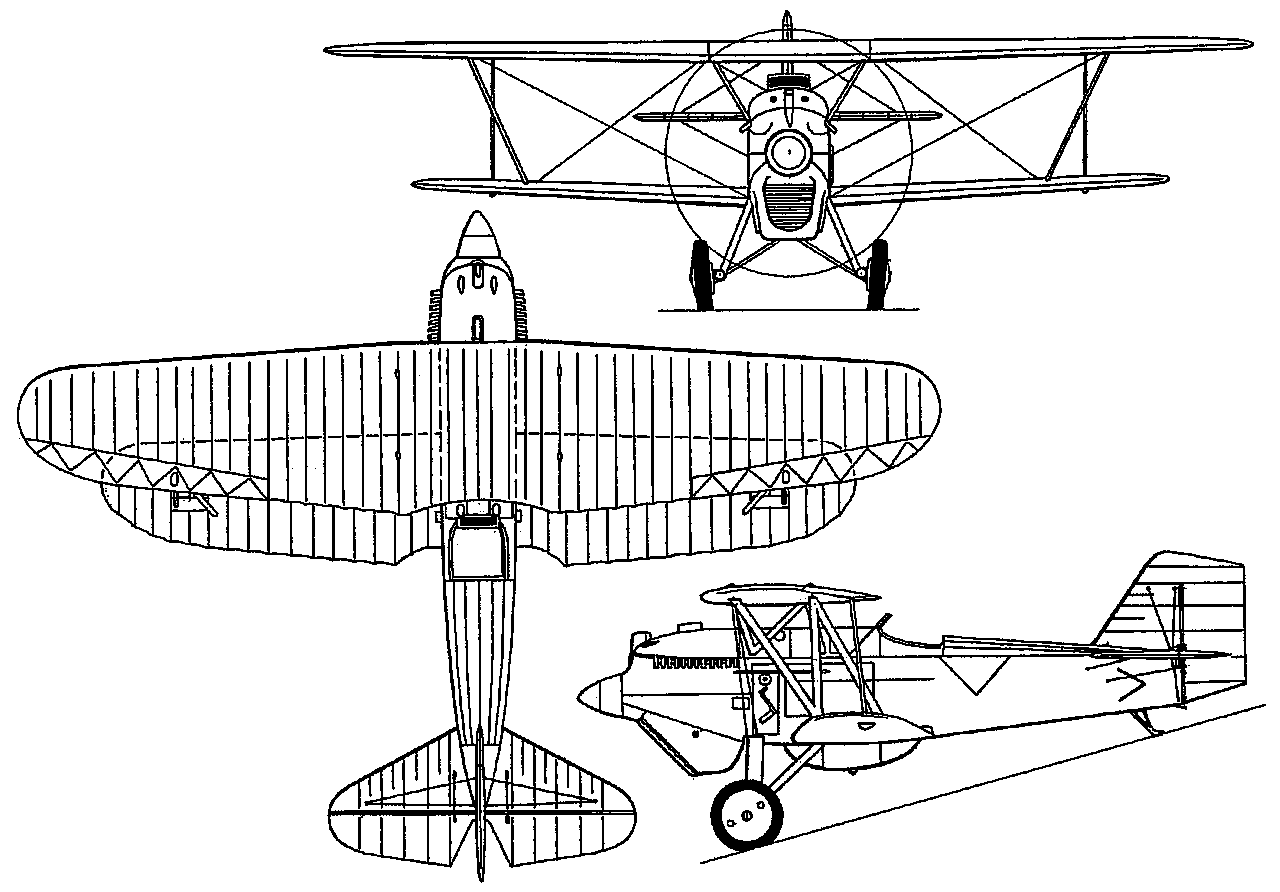
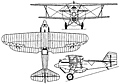 | A three-view drawing (1280 x 892) |
| Bill Wilcox, e-mail, 28.04.2013 19:37 I have a photo of Jimmy Doolittle standing in front of the lower pictured aircraft wearing Curtiss coveralls. The photo is autographed to "Sally, Billy, and Skip" at the bottom. WW reply |
| Rod Elliott, e-mail, 10.12.2008 16:04 I am looking for scale drawings of a Curtiss P-1. If you know of any such drawings please let me know. reply |
|
Do you have any comments?
|
| 
COMPANY
PROFILE
All the World's Rotorcraft
|




Построить дом можно и своими руками. Но, сказать по правде - это не будет очень быстро, тем более, если у вас нет достаточного опыта. Ð'виду отсутствия опыта дом будет строится медленно и возможно допущение определенных ошибок. Лучше доверить строительство профессионалам.
reply