|
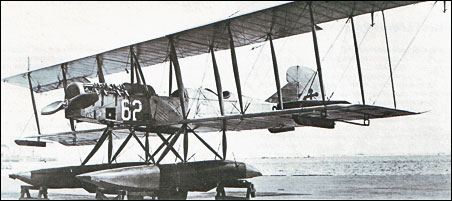
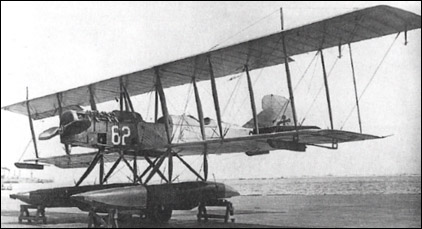
| At the beginning of 1915 there appeared the prototype Curtiss Model R, which was in 1935 given the retrospective designation Model 2, an enlarged version of the Model N with equal-span staggered wings. It was flown both as a land-plane and float seaplane. Pilot and observer of this military reconnaissance biplane were housed in one long open cockpit and the Model R could be distinguished from the Model N by its inter-plane ailerons and lack of a fixed fin.
The R-2 introduced unequal-span wings with ailerons attached to the upper wing, a vertical tailplane which in-cqrporated a fixed fin and horn-balanced rudder and there were separate and widely spaced cockpits for the two crew members. The Curtiss V-X engine of the prototype was retained. The R-2 went into production at the end of 1915 and was built in some numbers, 12 going to the US Army and the latter making only limited use of the type. The US Army R-2s were flown in support of the expedition against the Mexican insurgent leader Pancho Villa, but although their serviceability was poor they flew a number of reconnaissance and liaison missions.
The one-off R-2A was an equal-span variant and established an American
domestic altitude record of 2740m, carrying pilot and three passengers, in August 1915. Two R-3 seaplanes, resembling the R-2 but with increased wing span, were brought by the US Navy in 1916.
| MODEL | Curtiss R-2 |
| ENGINE | 1 x 119kW Curtiss V-X inline piston engine |
| WEIGHTS |
| Take-off weight | 1403 kg | 3093 lb |
| Loaded weight | 826 kg | 1821 lb |
| DIMENSIONS |
| Wingspan | 14.00 m | 46 ft 11 in |
| Length | 11.70 m | 38 ft 5 in |
| Wing area | 46.90 m2 | 504.83 sq ft |
| PERFORMANCE |
| Max. speed | 138 km/h | 86 mph |
| Baron Von Stark, e-mail, 17.05.2016 06:40 My uncle found a name plate to a Curtiss model R 2 no# 40 that crashed in iowa. He found it attached to a piece wood that belonged to the plane in 1948. He sent it to the Smithsonian institute and to Curtiss - Wright Corporation to verify it was authentic. Where could I find out more about this name plate and whats the value? Thanks. reply | | Jose Toste Rego, e-mail, 29.11.2013 16:54 Our Curtiss R-6 is almost ready.It have one side uncoverd ( the left one) and the right one choverdes with solartex grey. Do you want a photo?
Regards reply | | R. S. Lindley, e-mail, 10.04.2012 22:52 Saw Col. Long's message. I have several photos of the R-2s that were used at Camp Kelly, Tx circa 1917 as used by the 1st aero sq. and one of their offshoots, the 13th aero. Would that be of any assistance? reply | | Jose Toste Rego, e-mail, 14.06.2011 22:01 If you can send me a photo of the R 6 it will be very important to me.I'm trying to get some information about the ten R 6 that came to Azores Island - S. Miguel -in WW 1 in 1918. I intend to make a scale model 1:3 or 1:4 of the very first plane in the Azores and it was the R6.
Best regards reply | |
| | Tom, e-mail, 12.12.2010 07:01 Dear Mr. Long, I understand that the Airplane you are looking for was a "derivative" of the Jenny. There is one being built now in the Philippines for an American owner. I know that he would "Trade it" for something of "Like Value" if your Museum. Does that help? Tom at deadstick51@gmail.com reply | | Col Joe Long, e-mail, 16.09.2010 23:26 I am heading up the creation of the New Mexico Veteran's Museum. I desire to display a re-creation of the aircraft taht was used in the punative expedition of Pancho Villa into Mexico in 1916. This article says the planes used were R-2's. However in various other places I have seen JN-3s and JN-4's were used. Can anyone tell me how I can determine which is correct?
Thanks.
Joe Long reply | | tim mcdaniel, e-mail, 14.07.2010 02:51 i have cutiss r 6 propeller made by matthews bro manufac co #1077 9ft 6in by 5ft 7in stamped us navy with anchor an letter k in a circle also stamped R 6 i think it cameoff of a curtiss reply | | Mark Anderson, e-mail, 14.06.2010 04:12 Charles:
Would be interested to see which photos you have as I have copies of seven photos taken at the crash site.
Mark Anderson reply | | Charles S. J. Davis, e-mail, 16.05.2010 06:17 I have successfully researched the aircraft mentioned in the above message. The information initially received was in error and was later determined and confirmed to be a Curtiss Model R.6 which had crashed on the slopes of Mauna Kea on the Island of Hawaii on May 9, 1918 while piloted by Major Harold Melville Clark and observer Sergeant Robert Gray. Both survived the crash to walk out hungry and tired two days later. Several photographs have been published depicting the crash scene. I am in possession of the original photographs which are pasted into two scrap books of which the front and back covers consist of the wing fabric of this plane. The page fasteners consist of the strut wire and tensioning bolts from the aircraft wings. A medallion (Data Plate) is pasted to front outside front of one of the books identifying the aircraft as a Curtiss R.6 No. 5801. It appears that the photographs and the actual plane momentos were taken from the crashed aircraft sometime after the event and later memorialized into the two scrap books. I am in the process now of trying to determine what happened to the propeller which was also removed from the plane during this expedition along with some mechanical devises shown behing held up like trophies in some of the photographs. I believe these items are of significant aeronautical history in the state of Hawaii since the crash ended the first ever inter-island flight recorded in Hawaii and was accomplished by a most famous aviator. Clark Airbase in the Philippines was so named after this flier and a base I've visited several times during the 1960's during my four years in the service in the far east. An amazing piece of history uncovered through much internet work and perseverence - much to the chagrin of my wife I might add. reply | | Charles S.J. Davis, e-mail, 04.01.2010 05:47 Today, I acquired an old scrap book containing multiple photogrphs of an aircraft appearing to be of this particular design. The plane had crashed into a jungle on the Island of Kauai, Hawaii about 1921 or so. The photos show the photographer and several others in and around this aircraft. I have obtained the I.D. tag showing the aircraft to be a Curtiss Model R.6, Serial Number 5801. I'm trying to research the aircraft and found this site, made the entry and hope that someone will shed somne light on the story behind the plane. While the data shows it to be an R.6, the photos tend to indicate the pontoons under the lower wing where the wheels would be - Not a single center and two-outriggers. Anyone interested? reply |
|
Do you have any comments?
|
| 
COMPANY
PROFILE
All the World's Rotorcraft
|