|
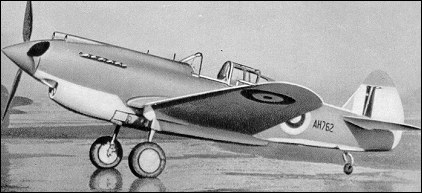
| One of the early production Curtiss P-36 aircraft was given an 864.4kW Allison V-1710-19 (G-13) engine (and designated XP-40) instead of the standard R-1830-17 engine. Apart from the essential modifications to the airframe to accommodate the Allison supercharged engine and its coolant radiator and oil cooler, it was the basic airframe of the P-36, free of development problems and ready for immediate production once the USAAC decided it was the aircraft they needed. They did; ordering an initial production batch of 524 P-40, these acquiring the name Warhawk. On 22 November 1944 the USAAF received the 15,000th Curtiss fighter built for service in World War II. It was a P-40N, the final new production version.
Despite this long production run, the P-40 Warhawk was not an outstanding fighter aircraft. It was, however, rugged and reliable and was used in all theatres of war for a variety of purposes. It was also typical of many early wartime fighters, with armament and engine changes causing the long development progression. Increased armament and equipment needed more power to maintain performance: once this had been achieved, with perhaps a margin of reserve power, more arms or increased armour or fuel tankage again eroded performance.
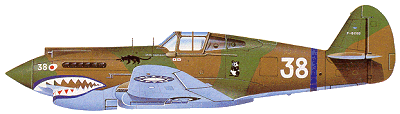
P-40 served with the RAF as Tomahawks; with Gen Chennault's AVG or "Flying Tiger" group in China; with the RAAF, SAAF, Soviet Union and Turkish Air Force. Improved P-40D and P-4OE served with the RAF as Kittyhawks, with the RCAF and Soviet Union; and still later versions went to the RNZAF. USAAF usage of the P-40 was mainly in the Middle East and Pacific theatres, but by far the greatest proportion of P-40 built went to Allied nations under Lend-Lease agreements.
| CREW | 1 |
| ENGINE | 1 x Allison V-1710-81, 1000kW |
| WEIGHTS |
| Take-off weight | 4014 kg | 8849 lb |
| Empty weight | 2720 kg | 5997 lb |
| DIMENSIONS |
| Wingspan | 11.4 m | 37 ft 5 in |
| Length | 10.2 m | 33 ft 6 in |
| Height | 3.8 m | 12 ft 6 in |
| Wing area | 21.9 m2 | 235.73 sq ft |
| PERFORMANCE |
| Max. speed | 608 km/h | 378 mph |
| Cruise speed | 263 km/h | 163 mph |
| Ceiling | 11580 m | 38000 ft |
| Range w/max.fuel | 400 km | 249 miles |
| ARMAMENT | 6 x 12.7mm machine-guns, 1226kg of bombs |
| ron, e-mail, 21.07.2017 09:56 Some call the Browning 0.50 Cal, Ma Duece. I wonder if they realize there was the Browning M2 0.30 Cal, and the M2 20mm Hispano besides the Browning M2 0.50 Cal. reply | | Ron, e-mail, 16.02.2015 01:56 The early P-40 had twin Browning .50s in the cowl with about 450 rpm each RoF, and 4 LMGs in the wings with an advertised RoF of 1200 rpm (actual RoF could be much less: 850 rpm bench test). reply | | Ron, e-mail, 08.07.2014 00:06 It is said that the P-40 had a rate of fire for the synchronized 0.50s around 425-450 rpm each in the cowl. If true, it's because it was prop driven. this is better than the 300 rpm for the P-39's reduction gear driven cowl guns. reply | | james taylor, e-mail, 24.03.2014 03:54 hey guy at the tommaso_messina=yahoo.it, 04.07.2012
Messrs.Company
the one that wants a set of plans for the p-40 i got a set from the bob homan plans but ive forgoten where he is located at its been so long ago ok just googel it and he will print you out a set and he can make them as real as you want them im sure i built my grandson one from his plans and it turned a out beasautiful only i built the tiger shark version witch is the sasme one only markings are different , reply | |
| | jim, e-mail, 24.03.2014 03:42 yes i lived right up the street from cutis wrightes aircraft co here in louisville ky , the plant was on crittenen drive it set about 2 blocks from my house then i was little kid ive set and watched them take off and land all day long , they were fast little dudes too very beautiful planes , after the war was over they made cutris wrights plant into the old international havester farm tractor plant , grummon aircraft co was here in louisville ky too just off preston hyway , where the old mothers cookie co was after the war , jt reply | | aidan, e-mail, 24.01.2013 03:23 how many p-36s did the US f ing make reply |
| tommaso messina, e-mail, 04.07.2012 01:28 Messrs.Company
I ask you to know,if is possible to have the original building plans of the P-40 KITTYHAWK MK-1a,such wingribs,fuselage formers,gear struts and tailwheel etcc,because I wish to build a smaller all metal replica.Hoping in your kind reply. Best Regards Tommaso Messina reply | | Sven, 06.05.2012 04:13 Sorry to rain on your parade but the P51s laminar flow wing is the answer. Put a better engine into the P40 and you still have a drag bucket with a big engine, the benefit of which decreases with speed.the wing is everything. reply |
| Jim Jenkins, e-mail, 05.05.2012 19:00 Does anyone have pictures of the P40 at Harris Neck, Ga? reply | | Klaatu83, e-mail, 31.03.2012 22:18 An interesting point. There is no question that the Merlin-powered P-40F definitely did offer a big improvement in performance over the Allison-powered P-40 versions, particularly at higher altitudes. However, one thing the P-51 had over the P-40 was range. The Merlin-powered P-51 could escort bombers from Britain to Germany and back, something no P-40 could have done.
In the Desert Campaign P-40s proved themselves to be capable tactical fighters (dive bombing, strafing and ground attack) and, in the hands of experienced pilots, were able to hold their own against Me-109Fs at low to medium altitudes. However, they invariably initiated combat at a disadvantage because the Me-109Fs were always able to attack the P-40s from above.
"What if the P-40 was given the same engine as the P-51? it would've been better than the P-51 was."
"The P-40F was given a rolls-royce engine, but it was only a single staged supercharger engine. On the other hand the P-51 was given a two-staged supercharger engine." reply | | Red Baron, e-mail, 05.01.2012 03:51 -Grey Neely Jr. & Norm.
Whats so special about the P-51? all it had was speed and range over most of the other planes. It sucked until the british gave it the rolls-royce engine.
What if the P-40 was given the same engine as the P-51? it would've been better than the P-51 was.
The P-40F was given a rolls-royce engine, but it was only a single staged supercharger engine. On the other hand the P-51 was given a two-staged supercharger engine. reply | | Steven, 03.12.2011 17:36 It had 6 miller, which means it had the same amount of gun power as the P-51D. reply | | Dennis, e-mail, 01.06.2011 07:58 It was the most used fighter during WWII, serving on all fronts and in all Allied Air forces. The Russians had many noteable aces. And to top it all off it is the most fighter looking thing to come out of the U.S. during WWII reply | | Steve, e-mail, 27.05.2011 19:20 If the USAAF wanted a low-altitude /close support fighter, why did they also want a liquid-cooled engine? Fitting the P-36 airframe with the R-2600 would seem to have been the proper solution to that problem with the available hardware. reply | |
| | ken miller, USAF. class 61E, e-mail, 06.05.2011 16:35 How many 50 cal. machine guns did the P-40 have? reply | | a.machiaverna, e-mail, 09.04.2011 04:23 The P-40 design was not fully developed until 1944. The Allison V1710 lacked a turbosupercharger. The P-40Q with a turbosupercharged engine would have been one of aviations elite fighters. More manueverable than a P-51, even in its early versions, the P-40 was a great airplane in the hands of a seasoned pilot, despite its shortcomings. reply | | Ben Beekman, e-mail, 23.02.2011 03:43 Some interesting information is provided by Wm. Green in his book "Famous Fighters of the Second World War" (Hanover House, 1960). According to Green, the American Volunteer Group (AVG) started out with 90 P-40B's, making up three squadrons plus spares. From Dec. 1941 to July 1942 the AVG destroyed 286 Japanese planes for a loss of 8 pilots KIA, 2 pilots and 1 crew chief killed during an air attack and 4 pilots missing. Top scorer was Robert H. Neale who destroyed 16 enemy aircraft. Eight other pilots claimed 10 or more victories. The AVG was down to 20 P-40B's by March 1942 when 30 P-40E's were ferried to China from Accra, Africa. As Green says, this is a good indication of "the P-40's capabilities in resolute hands". reply | | Greg, e-mail, 12.12.2010 21:32 @ Norm,
every production P-40 had a supercharger. what they lacked was a 2-stage supercharger. also, the P-40K Allison V-1710 made more horsepower the ANY Packard-Merlin put into a P-40. the P-40K was faster then the P-40F /L, and just as fast as the stripped down P-40N. reply | | Norm, e-mail, 12.12.2010 04:56 The main problems with both the p-39 and the P-40 was that they were built to the specifications of INFANTRY OFFICERS. These guys had no use for a plane that could duke it out at 25,000 feet. They wanted planes to SUPPORT INFANTRY! If it could fit into the foxhole that was a winner. As a result the supercharged versions of both of these planes did not see combat until well after the start of the war. Had both been put into action from the start with supercharged engines the P-47 etc would have been in the background. By the way, the P-40F had a rolls-royce engine. Curtiss got screwed when the engines were sent to, guess who?-North American for its P-51. So they had to revert back to the Allison engine.
As an aside, Claire Chenult didn't get a P-36, as a gift from the chinese, it was a P-26.
I submit that if the Brits had put the early P-40s, that they had on hand in 1940, into combat for the Battle of Britian, they would have torn the Germans a new one. reply | | Aaron, e-mail, 01.11.2010 18:31 Walter,
The Bendix B-16 was a very popular compass durring WW2. It was used on a many different aircraft. The P-40 and P-51 just to name a very few. To know exactly what aircraft that particular compass came from, you would have to check with manufacturing records using the serial number. reply |
|
Do you have any comments?
|
| 
COMPANY
PROFILE
All the World's Rotorcraft
|


 Sven
Sven


The USAAF ordered 210 P-36s from Curtiss.
reply