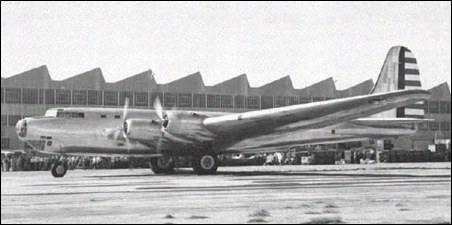
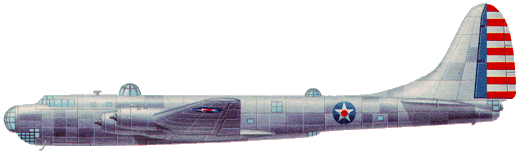
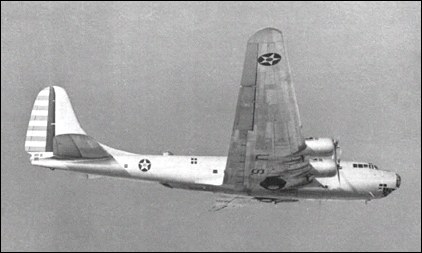
The Douglas XB-19 was originally designated XBLR-2 (eXperimental Bomber Long-Range 2) and was the largest bomber built for the Army up to that time (1938).
The XB-19 was essentially used as a test bed for very large bomber construction techniques and flight characteristics. The Douglas Aircraft Company actually wanted to cancel the project because of the expense and extended construction time which made the aircraft obsolete before it ever flew. However, the Army Air Corps insisted the aircraft be completed for test use.
The XB-19's first flight was 27 June 1941, more than 3 years after the construction contract was awarded. In 1943, the original radial engines were replaced by Allison V-3420 in-line engines and the aircraft was redesignated XB-19A. After testing was completed, the XB-19A was used as a cargo/transport aircraft until 1949 when it was scrapped.
Douglas XB-19 on YOUTUBE
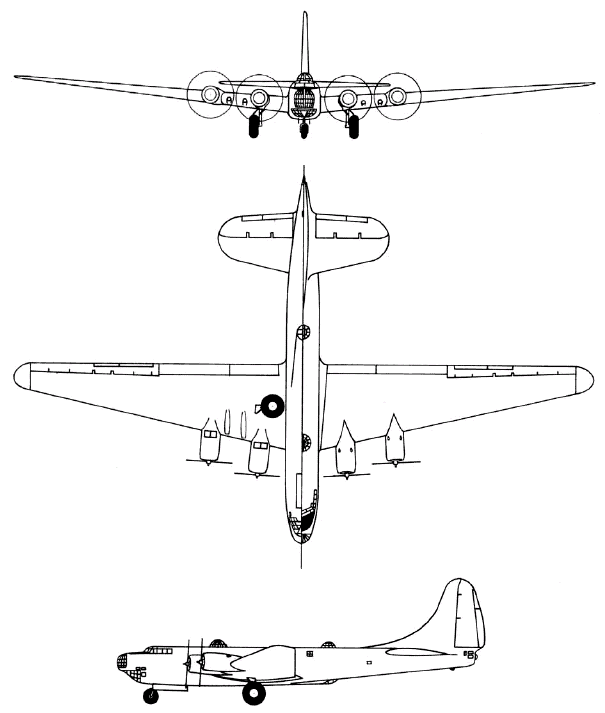
3-View
A three-view drawing (605 x 713)
Specification
CREW
16
ENGINE
4 x 2000hp
WEIGHTS
Take-off weight
73467 kg
161968 lb
DIMENSIONS
Wingspan
64.62 m
212 ft 0 in
Length
40.23 m
132 ft 0 in
Height
13.03 m
43 ft 9 in
PERFORMANCE
Max. speed
360 km/h
224 mph
Ceiling
7015 m
23000 ft
Range
8372 km
5202 miles
ARMAMENT
2 x 37mm cannon, 5 x 12.7mm + 6 x 7.62mm machine-guns , 16330kg of bombs
Why was this bomber not manufactured in quantity during WW-II? Because the B-19 was a pre-war aircraft that took so long to build that, by the time it was finished, it was already obsolete. By June 1941, when the B-19 first flew, the Boeing B-17 Flying Fortress and Consolidated B-24 Liberator were already in production, and both of those bombers were more modern and better suited to the actual combat conditions of WW-II.
My father, Bill Hitt, was asst. chief inspector at the Santa Monica plant. He took my cousin.Lorin Heath and I to see the B-19 take off for the first time as we watched from the west end of the runway.
I have read that due to the size of the mail gear it was planned to change from the very large wheels and tires to do as done later and use multiple smaller wheels. The cost of the originals was very great. I remember reading that the orginally scheduled test pilot backed out as the escape hatch was too far from the front seat and Army Major the became the test pilot.
The B19 was stationed at Patterson Field and was in Air Dock 2.newspapers on the base and was barred from the hanger for several weeks. Later I was allowed to go into the hanger but with some restrictions. In the early 1980s I was in Texas tocheck on the construction of a Hush House located on Kelly AFB and I heard this airplane and I knew that noise could only be the B19. I pulled off the highway and the B19 flew over me. The evening paper reported that it was on its way to the scrap yard. Ken Bloomhurst wasn'tkidding when he said the dishes rattled on the shelves. We lived inside the landing pattern so we didn't get the same reaction.Old school buddy was telling the truth about the dishes rattling.
I believe the maiden flight, not a test flight, of the B-19 was from California to Dayton, Ohio. I was with my family at the Dayton airport when it landed. My uncle, Edward F. Harbison, was chief inspector for Douglas and gave the final approval for the first flight. Uncle Ed is my mother's brother. I have an envelope addressed to me that is postmarked and was carried on the maiden flight to Dayton. I was 10 then and lived in Dayton. Ed Harbison is pictured in Life and /or Look magazine aboard the B-19 on it's maiden flight. A wheel from the B-19 was saved after the plane was scrapped and was on display at the National Museum of the United States Air Force at Wright-Patterson AFB, Dayton, Ohio.
This is only to thank all of you though most of you are gone and sadly forgotten by all except for your loved ones. My mother and sister-in- law worked at Douglas during the war as riveters. But I do remember seeing the Lockheed P-38 flying overhead during the war - what a sight that was to see! Thanks to all.
The B-19A was at Tinker Field, Okla. for an open house just a few short weeks after VE Day. It had the Allison 3420 engines. It was at that event I first saw a Lockheed P-80 Shooting Star. Both impressive aircraft!
When the B19 arrived at March Field in the summer of 1941 my father somehow arranged to take me on to the base to see it. I was just about to turn 11 years old. I was awed by the size of the plane, but what really got me was the size of the wheels. About 10 years ago my wife and I were visiting the Air Force Museum at Wright Patterson, and much to my surprise, I saw a huge wheel which I immediately recognized as from the B19.
I was with my mom,dad and my brother Don when I saw the B-19 fly over the San Fernando Valley in about 1941. My dad heard about the plane.We lived not to far from Lockeed. The plane seemed to move very slowly across the sky because it was so large. I can still remember it very clearly as it was yesterday, I was 8 years old
We lived in Los Angeles, about 4 miles south of downtown. When the B-19 made its first flight - I believe it was June 27, 1941 - it flew from Santa Monica to March Field in Riverside. Imagine the thrill this 11 year old got when the plane flew almost directly over our home. This plane had Wright R-3350's. There was another XB-19A with Allison V-3420 engines.
My Great-Granddad was Maj. Stanley Umstead. The test pilot often seen with the cigar in his mouth. We still have a steering yoke from the B-19 in the family. I'll be thrilled to have it one day!
As a kid growing up. I lived between Wright Field and Patterson Field. I remember the B-19 flying around the area many times. It was the largest plane at that time. It went very slow, I don't know how it remained airborne. I can remember my Mother being unhappy, every time it flew over, all of the dishes rattled in the cabinets.
So a group of people I'm helping to restor a B25 think they have two blades off the prop of the xb19 because of there size and brand (cant think of the name) but they can't find any information on the blades
One of the others who commented mentioned a ltter delivered on that 1st flight. I just unearthed one of those letters that was written by an uncle who worked for Douglas during that first flight and sent to my father. Wonderful piece of aero history.
My father, C.E. Chestnut, worked on building the B-19. We lived in Santa Monica, and When I was about 4 I recall we were allowed to watch the craft take it's first flight. This was a BIG day for all involved all around. I think of that day quite often. I would like to hear from others who were there that day, not many of us left on earth.
I was fortunate to see the original flight of the B-19 at Clover Field in Santa Monica. My Uncle was head of quality control for Douglas. His name was William C Hitt. He later started Automated Industries. He was a pioneer in Ultra Sound Testing for aircraft parts. (wing spars, etc.)



 Anonymous


comment6,
reply