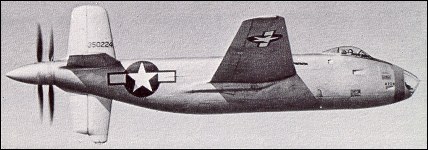
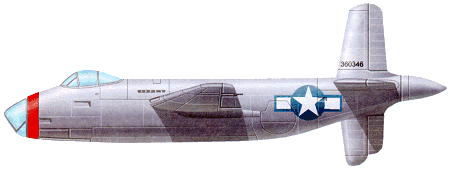
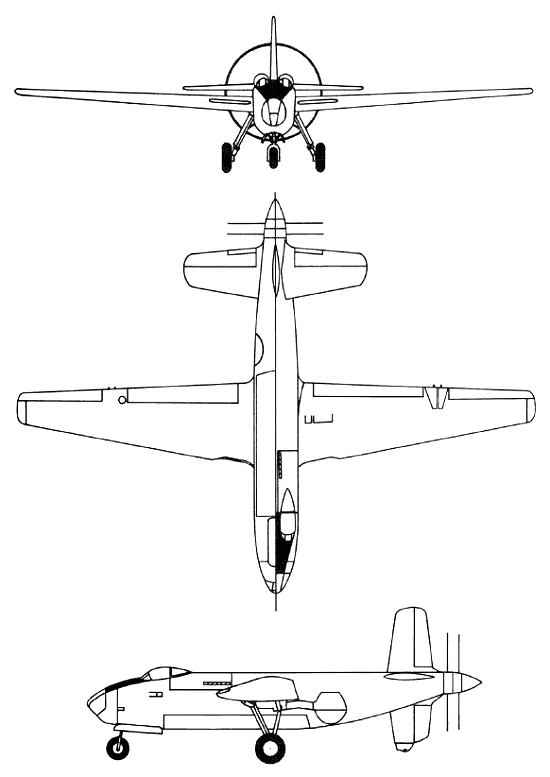
Under the initial designation Douglas XA-42 for an attack bomber, redesignated subsequently XB-42 as a bomber, Douglas designed and built two prototypes and one static test airframe under a contract received from the US Army Air Force on 25 June 1943. Named Mixmaster by the company, this unusual aircraft had a mid-set cantilever monoplane wing, cruciform tail surfaces and tricycle landing gear, whose main units retracted aft to be housed in the sides of the fuselage. The broad and deep fuselage provided accommodation for a crew of three, consisting of a bomb-aimer/navigator in the nose, with the pilot and co-pilot in a side-by-side cockpit well forward on the fuselage, each beneath an individual canopy; the fuselage also incorporated a large internal bomb bay, as well as housing the twin-engine powerplant in a compartment immediately to the rear of the pilot's cockpit. The two Allison V-1710 engines were used to drive, via shafting and a reduction gearbox in the tailcone, two three-bladed contra-rotating pusher propellers to the rear of the tail unit.
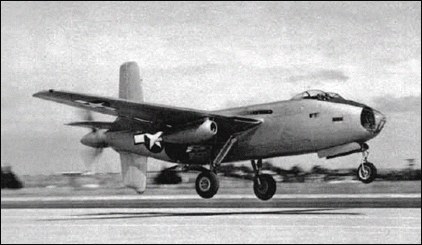
Despite its unusual features, when first flown on 6 May 1944 the Mix-master more than lived up to expectations. The second prototype was flown for the first time on 1 August 1944, soon afterwards being modified by the addition of a single canopy over the pilot/copilot cockpit. This prototype was destroyed in a crash during December of that year, but by that time the USAAF had decided not to proceed with production of this design, awaiting instead the development of higher-performance turbojet-powered bombers. As an interim step to allow evaluation of turbine power, the first prototype was given a mixed powerplant comprising two 1025kW Allison V-1710-133 piston engines to drive the propellers, plus two 726kg thrust Westinghouse 19XB-2A turbojets mounted in underwing nacelles. Redesignated XB-42A, this aircraft was used for performance testing over several months before being retired at the end of June 1949.
I saw one of these being sitting at the Seattle Flight Museum restoration Shop ,At Paine Field.I was working at the time ,so I couldn`t stop.At least we know its still around.
"...it was nicknamed ," The Mixmaster," probably becausse of the counter-rotating props.s..."
That is quite true. "Mixmaster" was the brand name of a popular kitchen appliance of that time, something like today's "Cuisinart".
Like all the high-tech pusher airplanes of the mid 1940s, this one would never have been ordered into production because of the extreme danger of bailing out into the path of those whirling propellers. Ejection seats had not yet been invented. However, I believe the designers of this particular airplane at least provided an explosive charge to blow the props off in the event of an emergency.
During 1944-45 I was assigned to the Los Angeles Municipal Airport(LAX) as part of squadron VR3 of the Naval Air Transport Service. One of these aircraft was parked near out headquarters for some months. I never saw it take off but recall it was nicknamed ," The Mixmaster," probably becausse of the counter-rotating props.s We were told it was an experimental commercial aircraft, temporarily designated as " DC5." That was apparently a mistake.
I was on a trip between Maryland and western Georgia back in June when I found myself ovrtaking a pair of trucks hauling one of these aircraft down I-95 in Virginia. Later in the day (after we had stopped several times) I passed them again in the mountains on I-81. I can only guess that the aircraft and it's components were being transported to some air museum. It was very interesting to see and it took me almost a full day to track down what it was that I had seen. I guess this could only be classified as a rare sighting.
I think this was one of the neatest aircraft to come out of WW-II. More potential than the Mosy, room for engine mods-turbo-charger? Think about how much weight could be removed to make it even better? Four X .50s and all of their remote sighting and pointing equipment? It could haul a standard 8,000 pound bomb with the bomb bay doors open 5", sort of like the Mossy with bulged belly to take the 4,000 pound "Cooky". Think of the great things a new designed of the plane 8-10,000 pound bomb would do!
I think this aircraft was built at the main Douglas plant in Santa Monica @ Clover Field. My grammer school was about one mile from takeoff runway and I saw the plne takeoff several times. The props had a sound different than any other aiecraft.