|
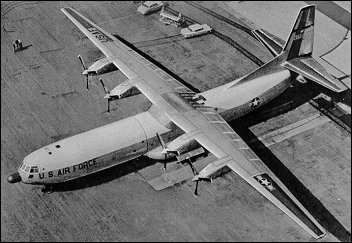
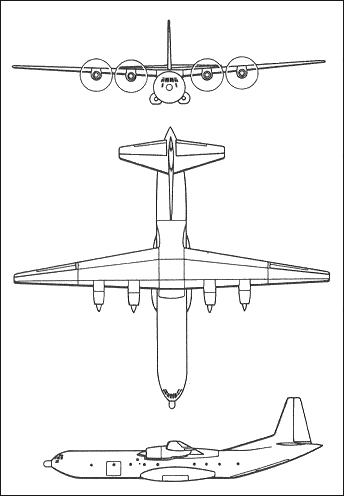
| The C-133 was a four-engined transport which - although not much bigger in overall dimensions than the earlier C-124 Globemaster II - could carry payloads equivalent to twice the normal cargo capacity of the C-124. The first production C-133 made its maiden flight on 23 April 1956 and deliveries to the USAF began the following year.
The first version was the C-133A powered by four 4,844kW Pratt & Whitney T34-P-7WA turboprop engines. A total of 34 were delivered. It was followed by the C-133B powered by 5,589kW T34-P-9W turboprops and with increased loaded weight and an enlarged main cargo door to permit easier loading of the Atlas ICBM, and Thor and Jupiter IRBMs. Fifteen were delivered to MATS, production ending in April 1961.
All had been withdrawn from service ten years later, although a few were thereafter used in civil roles.
| CREW | 4 |
| PASSENGERS | 200 |
| ENGINE | 4 x turbo-prop P+W T-34-P-9W, 4410kW |
| WEIGHTS |
| Take-off weight | 129700-136000 kg | 285941 - 299830 lb |
| Empty weight | 54600 kg | 120373 lb |
| DIMENSIONS |
| Wingspan | 54.8 m | 180 ft 9 in |
| Length | 48.0 m | 158 ft 6 in |
| Height | 14.7 m | 48 ft 3 in |
| Wing area | 248.3 m2 | 2672.68 sq ft |
| PERFORMANCE |
| Max. speed | 558 km/h | 347 mph |
| Cruise speed | 500 km/h | 311 mph |
| Ceiling | 6125 m | 20100 ft |
| Range w/max.fuel | 7000 km | 4350 miles |
| Range w/max payload | 3600 km | 2237 miles |
| Louis Cruse, e-mail, 17.02.2025 02:49 After Basic at Lackland and Jet Engine School at Chanute, I was assigned Jan 1963 to the 1607 OMS at Dover AFB and C-133As. Yes I worked with Dennis Eck and Bobby Reardon and Paul Leach, Grave Shift in Purple Six (Ford Van that we drove all over the flightline and the hangers) My first "Boss" was SSgt Van Sparrentak, and later SSgt John Smale, but I don't remember many other names. Got a C-133 Run Card, after an EXCELLENT Engine Conditioning School, and spent many an hour sorting out engine component issues on As at Dover, and As and Bs at Travis, Ft Campbell, and a couple other CONUS bases. LOVED IT ! And worked with a damn good bunch of Jet Mecs. Later, volunteered for SEA, and worked on J-57 /RF-101s at Kadena, Oki, and Udorn RTAFB in Thailand. Early out got cancelled so spent 3 mos at Laughlin on J-85s in T-38s. Aug 66 Honorable Discharge. Then my Bride and the GI Bill put me thru College . . . and I was an "Engine Man" of one kind or another until I retired from Military Advanced Technology Dept at AiResearch /Garrett /AlliedSignal /Honeywell in 2002 , with 4 US Patents , and spending a lot of the US Govt money to design, fab, test whiz-bang one of a kind engines, with lots of parts and materials that had never been made before. Blew up lots of stuff . . . but every now and then . . . something WORKED . . . and sometimes we even knew WHY ! Live in Scottsdale AZ, now, still married to the same wonderful woman for 62 years. I was a service Brat . . . but the USAF and their schools, and working on those C-133s steered me to an interesting and different work Career. THANKS ! And Col Cal Taylor's wonderful C-133 Book "Remembering and Unsung Giant" is worth every minute reading.
Balls Eight (56-2008) is at Wright Pat . . . and the Dover Museum has a Travis B Model, and the Travis Museum has a Dover A Model. Pima Air Museum in Tucson has a C-133, but don't know if an A or a B. Mojave Arpt, out by Edwards AFB, has two stripped C-133s, in their boneyard (see Google Maps). Keep Em' Flyin ! reply | | John Urban, e-mail, 30.06.2024 04:18 I was a C-133 pilot from the time I graduated from Undergraduate Pilot Training in 1964 until I checked out in the C-5’s in 1972. The plane was my first choice and I never regretted it. Unfortunately, the day I reported to Dover AFB for co-pilot training, the 133’s were grounded due to a recent Wake Island crash. After an extended period where Capt Doug Benefield re-ran the airplanes stall series at Edwards. He found that if the planes were stalled at approximately 60% power on, he went from nose up, wings level to 105 degrees of bank and severely nose down in a second and a half. It took him almost 15,000 feet of altitude to recover. When he briefed us at Travis AFB he said he would not take the power on tests beyond that point, but he (or others at Edwards, Dover and Travis) did stall each air frame so as to install special stall strips on either wing so the birds would stall with relatively wings level. No further planes were lost to unexplained stalls. We did loose two more birds, however, one to an explosive decompression starting at the side cargo door, and another due to propeller electrical problems.
Because the airplanes were so large, they were called on to do some rather unusual missions. For example they transported a propeller shaft and screw for a US Aircraft Carrier (2 missions) to the Pacific, tracking antennas for the Apollo missions to middle Australia, and a particular fun one to Sembach, Germany that I flew as aircraft commander. We had a classified load that needed to be taken to old German bunkers located in the woods about a mile and a half off Sembach. Unfortunately, the load could not be moved on the ground, so we had to BACK THE AIRCRAFT up 1.5 miles up a narrow old Luftwaffe taxiway to the bunker.
In the course of my flying career in the C-133, both A and B models, I accumulated over 6500 flight hours and was a flight examiner. As such I drew missions into short fields, narrow fields trips into places we had to avoid trees and bushes, had to do 3 point turns on runways (I think it was about a 5 point), and any other strange thing you could think of. It wasn’t all flying, however. I and my crew got to eat dinner with the Royal Governor of the Turks and Caicos islands when we landed with equipment they desperately needed. Of course we also ate C and K rations in southeast Asia, some of which were from World War II. We transported jewelry and brass from Bangkok to BX thrift shops in Okinawa and innumerable Hibachi pots home.
When my career as a C-133 pilot ended and I moved on to the C-5, it was with excitement and anticipation, but it was also with some sadness and regret. I loved that old bird, the people who flew and maintained her, the places we flew to and the missions we took, regardless of the problems we encountered. Yet we made it work, and the C-133 contributed more than it’s share. When I get feeling nostalgic, a quick trip to the AMC museum at Dover AFB helps me to get my perspective back. . . . But I still miss the old bird. reply | | Rick Gordon, e-mail, 18.12.2021 19:17 Excited to find this site. I'm an Air Force brat born on Dover Air Force Base in 1960. My father, Harry Gordon, was part of the C-133 crews as a flight engineer between 1958 and 1970. I'm not sure when he began flying status during that time, but we were there when the C-5's came in. I'm hoping somebody on here may have heard of or flew with my father. He passed away in 1996 at the age of 63. I have always had the deepest respect for all military personnel and have a special place in my heart for the crews of the C-133. For most of my childhood, we rented a farmhouse off base from a gravel company that was situated along and parallel to the landing zone. From our house, we could watch planes take off and land all day. My brothers and I would go stand under the flight path and watch the planes pass withing 100 feet of our heads as they headed for the runway. From an old oak tree behind our house, we could see that huge red and white checkered tower with the rotating beacon. The house is now gone as it was too close to the landing strip once the C-5 started using the base. It was first moved and later torn down as the made a lake out of the area along the St. Jones River (Swamp). I visited the old house back in 1989 or 1990 before it was moved. Everything looked a lot smaller then, lol. If anybody remembers my father, it would mean a lot to me if you could message me. It'd be an honor to get to know you. reply |
| gene wright, e-mail, 09.10.2020 22:20 I think it was in Sept 1956, a 133 came to Lockbourne and made landings. I was listening to the tower and they asked a lot of questions. The aircraft was from Wright-Pat. Flight tests I presume. That thing could climb. reply | |
| | bryan, e-mail, 10.01.2018 00:00 anyone know where to find a pdf of the dash 1. My cousins husband flew these at kdov reply | | Ed, e-mail, 05.01.2018 22:04 Please, I will like to know the original unit cost of the C-133A & C-133B Cargomaster II.
Thank you reply | | Gary Timms, e-mail, 10.12.2016 00:43 Joined the service August of 1960. First time I ever was on a aircraft was commercial from Seattle to Lackland AFB. Six months later I'm on the C-133A, Dover Delaware and crew member on C-133A's as Loadmaster. Five weeks at Lackland, on to Sheppard AFB and Air Freight school. Five of us were picked out of the class, sent to Loadmaster school and then on to Dover AFB. 1500 hours in the C-133A and then transferred to C-130A in Naha, Okinawa. Grew up in one year from high school. Best time, broke down on Christmas Island for a week. Worst time, broke down in Thule, Greenland for 16 days ..... in the winter..... in the dark. reply | | Carol Reppard, e-mail, 05.10.2016 17:24 My husband Sheldon (Charlie) C Reppard was an in-flight electrician on the C-133's with MATS out of Dover ABF 1957-64. Flew mainly between Dover and Chateraux France. Was on flights during operation New Tape. Would love to hear from anyone who might have known him. reppardc@gmail.com reply | | barbara wright, e-mail, 12.05.2016 06:19 there is a possability that my husband flew to Korea in 1962 out of McChord AFB, Tacoma Washington. Did they fly out of the west coast? and did they they fly out of McChord. reply | | charles w hargis, e-mail, 13.04.2016 00:43 yes i have a few comments ...my uncle bill was a pilot during wwii , korea , and vetnam flying transports but during vetnam he was also flighing top secret missions all over the world in the 1st C-133A ..but i was never told what those top secret missions where all about and was told by my dad to never ask bill what he was doing , but dad knew, cause dad and bill where very close brothers since wwii when they both where doing things that your never supposed to talk about ... bill was picking up missiles from JPL and delivering them to the cape for the mercury program ...one day at a family re-union bill and dad where joking around about the time bill got one off the ground that was completely assembled with the tail if this ICBM hanging out passed the rear and opened cargo doors ...so this became a problem right away right before lift off trying to get the nose wheel up causing the tail of this ICBM to be just inches from draging on the runway ...so bill says to the tower something like " advise security we're gonna hit max cruse speed before we leave the ground and use up all of your runway..so he did and got that thing in the air ..and in 1966 dad and uncle bill arranged to take me on an entire tour and an education of what really goes on in the space program of the day..so i got to see everything beyond any tour for the public from cape kennedy vehicle assembly building to driving around for miles out to the launch pads ... got see how they built the roads for the crawlers by driving down pilings solid one after the other just to hold the road bed that's app ied on top of all that..and then they still have to keep rebuilding it after so many uses from all the weight of the crawlers with a missile on it ....this inside tour of everything nasa went on all that week ending in a trip up to dover AFB where uncle bill was stationed at the time... bill was crazy like all pilots of his type ... we drove onto the dover AFB in bills hot rod mercury low rider ..and bill is dressed in his bright gay looking hawaiian shirt, shorts , straw hat and dark KD sunglass and pulls up to the gate roaring the pipes ..where the MP's went nuts on us , guns out aimed at us screaming , " indentfication " ...one boy ran up to the drivers side of the car and put his M16 in bill's face ...bill pulls down his glasses and says " you know who i am son " and the boy jumps to attention saluting bill and says " yes sir " ..so we went through everything on the whole base starting with the planes bill few in wwii, korea , and vetnam ..and some with guns and cannons ..some called "spooky" and " puff the magic dragon" things like that ..and then their is bill's airplane , the C-133A way over on the other side of the base with some more boys guarding it with M16's...there is also a chainlink and rasor wire fenced off area by bill airplane stacked with sealed up canisters ...i say " what's that bill?" bill says " my spare engines" ..bill got brand new engines installed for every mission !!! ..we go all through the airplne even crawling out in the wings ..we get up into the cabine and bill pops open the hatch on top and says " i want you to go up there and run down and touch the tail and run back " alright ..i get up there and the ground starts moving and the surface of the plane refects the sky and clouds that are moving ..and i get to experiance for 1st time "vertigo" and i am freaking out ...and hell i had on rubber sole sneekers and no way to slip and fall ..but the mind wouldnt believe it ...' bill i cant do'er ..and i pussed out in him ...not cool ...and bill and dad didn't think so highly of me form then on ...my dad ernist d hargis was also air force in india outfitting B-17's and B-24" for the "hump" mission pushing the engines beyond their limits....." so dad how did you soup up them old radials ..simple just tie the waste gates shut and let'em hum ...." but dad didnt you have to overhaul them a lot? " everyday for the ones that made it back ' except for one that went straight down into the runway with only it's tail sticking out " ...crazy people doing crazy shit , winning crazy wars reply | | William R. Stanton Jr., e-mail, 15.10.2015 18:13 My Father, Lt. Col. William R. Stanton flew the C-133 during Berlin Airlift as well as the first around the world flight in the C-133. reply | | Donald Taylor, e-mail, 14.08.2015 03:17 I was a Flight Engineer at Dover AFB fro 1962-1966. I loved to fly the bird. I was on the crew that took the bird to Wake Island and was bumped, the other crew took off early in the am and crashed a mile or two off shore. lost all the crew. I had the reputation of, "do no fly he airplane after Don, several times the C-133 was lost the next flight. I wen form C-133's to C-141's and finished on the C-5. I would do it over if I could. reply | | Virgil Raridan, e-mail, 12.06.2015 19:02 My Dad (Capt. Virgil Raridan)was a command pilot who flew almost every one of the C-133s between 1958 until 1964. We were stationed at Dover AFB. reply | | Bob Gough, e-mail, 05.05.2015 20:19 My dad, Lt. Col Richard Gough (Ret), was a test pilot assigned to the ARDC at Wright-Patterson AFB. When he was a Major, the C-133 test program was assigned to him, along with his friend & colleague Col. Benefield at Edwards, to determine the cause of the suspected stall-spin characteristics of the aircraft.
The book "Remembering An Unsung Giant" by Cal Taylor is a remarkable and thorough history of the 133. But the comments here by Don Bowmaster and CMSgt Sandy Sandstrom, who were aboard some of the test flights flown by Doug Benefield and my dad leave me wanting to know more about those flights, wherein the aircraft was deliberately stalled in order to gain data. At my dad's funeral, a gentleman shook my hand, his name lost to me over the years, who was apparently a crew member on those test flights, who said" Your dad was the bravest man I ever knew."
Well, that may or may not be true, but that comment was a testament to the resolve and professionlism of all USAF test pilots and crew members who go about their dangerous business every day to make for safer aircraft for the operational crews. reply | |
| | Kevin Reasor, e-mail, 19.02.2015 05:16 My brother and I along with our best friend were at the far end of Travis AFB and saw the smoke from the c-133 that had just crashed. Being teenagers, when we got home we were laughing about what we saw. My mom stopped us cold when she quietly said "your father is flying today" It was 4 hours later that my dad called to let us know he was OK. My dad "Art Reasor" was a flight engineer on both c-133s and c-124s. We lived on the airbase for almost 10 years. 1954 -1963. reply | | Ken (Ski) Tanski, e-mail, 07.01.2015 07:36 Worked on C-133's from 1962-1964 iat Dover AFB, then again at Lajes Field, Azores until 1966. I was a prop mechanic, and really liked that a /c. reply | | Deborah Branson, e-mail, 02.11.2014 22:50 Obviously did not Crew the C133. My dad was a flight engineer on the 133 from 1961-1968 at Dover. Ed Nisbet. reply | | Douglas E. Bush, e-mail, 19.10.2014 17:05 I arrived at DAFB Feb 1958 was assigned to the 1617th FLMS.
Assigned C-133a tail # 54-0145worked as crew chief till I separated in Jul 1961. Chief Ober was the FLMS super. I was there when a C-133a crashed on a test flight,I remember that all of the wreakage was put in the black hangar. reply | | Jose Corrales Sr, e-mail, 06.08.2014 04:14 this was a great aircraft I was station in Dover AFB from 1969 to 1970 in the flight line, I enjoy working on the C-133 but now they are out of commission. AS for VN if your boots touch the ground then you have a case take it up with the VA cause I have the same problem,also a lot of the USAF records were burnt in the fire.But getting back to the C-133 as noisy as it was it work fine for me,I think I was on tail number 1998. reply | | Carl Grimm, e-mail, 05.05.2014 14:49 I was in tech school at Lowery AFB in Denver in 1961. Used to watch a C-133 fly in and pick up missiles (I was told from Martin Missile west of Denver)every so often. 133 would land, a convoy of Air Police and the missile would come through the gate on the SE corner of the base, load on the 133 and leave for parts unknown. I thought it was a beautiful airplane. reply |
|
Do you have any comments?
|
| 
COMPANY
PROFILE
All the World's Rotorcraft
|




Good morning. I came across a post of yours in the aviastar web site. I was not at Dover and don’t have any stories. What I do have is a photo that was in a box of aviation related items. I’ve had this box for 25 years which I picked up at an estate sale. Finally decided to look in it. Anyway this photo has 13 guys in it. On the photo it says C133 turboprop Spec Dover 1958. I can email a picture of it if you reply. Photo means nothing to me but might mean something to someone else.
reply