|
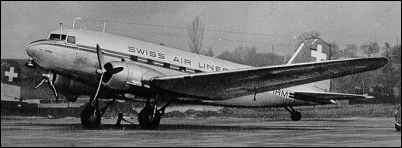
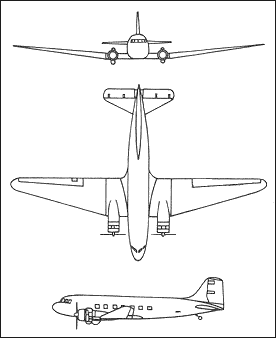
| One of the world's truly outstanding aeroplanes, the DC-3 resulted from American Airlines' requirement for a sleeper aircraft for its US transcontinental route. The DC-2 fuselage was too small for this, so, reluctantly, in the autumn of 1934 Douglas agreed to build the DST (Douglas Sleeper Transport) as an enlarged DC-2, with lengthened fuselage, increased span and, most important, an increase of 66cm in fuselage width - allowing up to 28 seats or 14 sleeping berths.
The prototype DST, with 633.4-745kW Wright Cyclone SGR-1820 engines, made its first flight on 17 December 1935 (not inappropriately the 32nd anniversary of the first powered flight by the Wright Brothers). The type entered service with American Airlines on 25 June 1936 over the New York-Chicago route, with transcontinental sleeper services starting on 18 September. The DC-3/DST soon proved itself and orders grew rapidly, with KLM becoming the first operator outside the US. Including 40 DST, 430 DC-3 had been delivered when the USA entered the war - one flew more than 84,000 hours.
The aircraft had such enormous potential that it was ordered in very large numbers by the US armed forces and when production ceased in 1947 Douglas had built 10,654 examples of all civil and military variants; Nakajima and Showa in Japan had built 485 (L2D) and about 2,000 had been built in the USSR as PS-84, but later redesignated Lisunov Li-2 with 742kW Shvetsov engines.
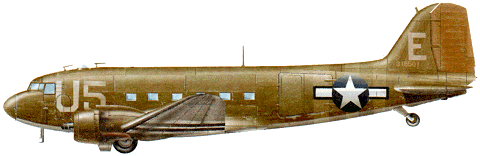
The DC-3 was built in numerous versions and with a wide range of Wright Cyclone and Pratt & Whitney Twin Wasp engines ranging in power from 742 to 894kW. The aircraft were operated on wheels and skis - one even had floats (the XC-47G-DL) - and there was the XCG-17 experimental troop-carrying glider version. Original US military contracts covered 10,047 aircraft of which more than 9,500 were versions of the C-47 Skytrain with reinforced floor and double doors, and 380 G-53 Skytroopers. The US Navy ordered the DC-3 as the R4D. A wide range of military designations was given to civil aircraft impressed by the services before delivery including G-48, C-49, C-50, C-51, G-52, G-68 and C-84. Many military DC-3 were supplied to the US's allies and the 1,900 plus supplied to the RAF were given the name Dakota - a name which has been widely used in place of the correct DC-3 designation.
C-47 made such an important contribution to the US war effort that General Eisenhower considered them to be one of the four most significant weapons of World War II. In the China-Burma-India theatre they 'humped' supplies over the Himalayas from India to China and carried airborne troops on all major invasions. Post-war they contributed to the Berlin Airlift, carried supplies and troops into and wounded men out of Korea, and even fought as heavily armed gun-ships in Vietnam.
After World War II very large numbers of military DC-3 became surplus and were acquired by most of the world's airlines. In the early post-war years they formed the backbone of most airline fleets, initially with austere interiors but later brought up to much higher standards. Some were equipped to carry as many as 36 passengers but 21-28 was standard. Many others were used for cargo and mail.
External links
| MODEL | DC-3E |
| CREW | 2-3 |
| PASSENGERS | 21-28 |
| ENGINE | 2 x 1200hp Pratt Whitney R-1830-93 Twin Wasp |
| WEIGHTS |
| Take-off weight | 12700 kg | 27999 lb |
| Empty weight | 7697 kg | 16969 lb |
| DIMENSIONS |
| Wingspan | 28.96 m | 95 ft 0 in |
| Length | 19.57 m | 64 ft 2 in |
| Height | 5.16 m | 17 ft 11 in |
| Wing area | 91.69 m2 | 986.94 sq ft |
| PERFORMANCE |
| Max. speed | 369 km/h | 229 mph |
| Cruise speed | 293 km/h | 182 mph |
| Ceiling | 7071 m | 23200 ft |
| Range | 2414 km | 1500 miles |
| Rollie Eldred, e-mail, 08.07.2024 20:45 I'm currently trying to locate any information on a C-47 assigned to VR 48. I was in the Navy Reserves and was airlifted to Selfridge ANGB from CLE once. One of the crewmen mentioned that the aircraft at one time had been used by LBJ. He also noted that they had 2 such aircraft based out of Andrews AFB. Anyone have any info on these birds? reply | | Amee Wand, e-mail, 29.05.2021 03:18 GOSSIP LANKA NEWS ශ්රà·" ලංකාවේ වැඩà·'ම දෙනෙකà·" නරඹන සà·'ංහල වෙබ් අඩවà·'ය. | Gossip Lanka | gossip lanka news | gossiplankanews reply | | Clif Walker, e-mail, 05.03.2020 18:40 I flew the DC-3 with the CAF and 2 individuals. Started in 2000 and retired in 2015. It was a dream to fly and great to show up at an airshow and watch everyone come to see us. Before that, I instructed in Helicopters for the Army for 3.5 years and then I was for a pilot for Southern Airlines, Republic Airlines and Northwest Airlines. After a long career as an airline pilot, I enjoyed the C-47 for 15 years. reply | | Russ Sifford, e-mail, 04.11.2017 04:22 First flight in a C-47 was at Keesler AFB, MS in 1948.
Fast forward to 1951 at Godman AFB, KY and Manston, England thru 1955. Long Beach ARFB, CA (along with B-26s) 1956. Suffolk County AFB, NY (along with C-119Ds) through 1959. Minot, ND 1960-1962. Was supposed to crew BG "Red" Foreman's T-29 at Chateauroux but made TSgt and orders were for a S /Sgt and got cancelled. Orders were reinstated as a Tech but by the time I got to France the job had been given to an A1C. End of flying career with over 4000 hours in "gooneys". Lost a few engines and had a few scares but those years were the greatest. Saw almost all of Europe and the Middle East. Best bird ever made. Thank you Douglas. reply | |
| | garth c good, e-mail, 04.04.2015 02:33 it seems as though this site has a few misses ,I have faa types in both DC-2 & DC-3 and a bunch more , but so far I do not see the Douglas C-39 , yes there was such a model
I flew as a co-pilot in aprox 1958 on one ,on a spray job in Baker Oregon , it is now in the usaf museume in dayton OH , it is also on the news week front cover in color full page , I can tell stories of that airplab\\ne reply | | Butch-Major-USAF-Retired, e-mail, 15.02.2015 04:04 3,000 hours - IP - Hurlburt Field, Vietnam, Thailand, England AFB. Flew all models /ec /ac /c /hc /spray version. Flew the first prop (C-47) and then the first jet (Boeing 707). Doesn't get any better reply | | Robert K. "Bob" Stein, e-mail, 01.01.2015 20:13 I was sent to Hurlbert Field in Florida to check out in the C-47. My first and only tail drager. Was trained to be a trash-hauler by IPs that had done that the previous year in Viet Nam. When I arrived in Saigon, however, Was told that the Sqd. had been disbanded. The only C-47 unit was the 4th Air Commando Sqd. flying AC-47s. This was end February 1966. I volunteered to go there and I believe that I was the first aircrew replacement since the squadron's arrival in country in November 1965. Spent six months in Bien Thuy in the delta and six at Nha Trang. The stats for the year were 2 DFC, 8 Air Medals and 600 hours of night combat time. One night when nothing was happening I scraped many layers of paint from the name plate and learned that the aircraft we were in was made in 1942. Loved that old plane. reply | | capt w kilburn ret, e-mail, 11.06.2014 06:56 This aircraft was in service with trans canada airlined in 1955 when I joined their flight crew staff. It was not built for large pilots, and created a challenge for anyone with long legs. It was soon replaced with the prop /jets. reply | | Don Gaffke, e-mail, 27.05.2014 00:19 Flew as Flt Mech and crew chief on C-47's out of Lajes Field Azores, Richards-Gebaur AFB Missouri and Otis AFB Ma. Great aircraft--very few problems--hundreds of hours flying timeagreat job for a young guy. reply | | Don Gaffke, e-mail, 26.05.2014 19:21 Flew as Flt Mech and crew chief on C-47's out of Lajes Field Azores, Richards-Gebaur AFB Missouri and Otis AFB Ma. Great aircraft--very few problems--hundreds of hours flying timeagreat job for a young guy. reply | | Dusty Rhodes, e-mail, 27.01.2014 19:30 Flew the SC-47D (Rescue Version) at Thule Greenland 1964-65. Flew one mission to Griese Fiord on Elsmere Island, Canada in Jan 65. Landed on skis between Coleman lanterns set out by the RCMP. Took a pregnant eskimo (inuit?) back to the Thule AB hospital. Great airplane. reply | | Richard L Hamel, e-mail, 29.12.2013 21:19 There is an Eastern Ailines DC 3 hanging from the ceiling at The Smitstonian Instituition in Washington, DC reply | | Ian Corby, e-mail, 03.02.2013 21:37 The DC-3 was the first a /c I flew after finishing my commercial pilot's course at Oxford (UK) in 1971,I was lucky to get the job as I had 20hrs tail wheel experience on an ex-army Auster spotter plane! We flew mail and newspapers for the British Armed Forces based in Germany.I also flew a company DC-3 operated by Martin Baker until they sold it!Sad as the fuselage was eventually used as restaurant.I had the previledge of meeting a US Navy R4D pilot Master Chief Pommeroy based at Lakenheath (UK)in the 1960's.I retired in 1999 after 24 yrs with British Airways as Capt.on DC-10 /A320 /747.If I ever won the 'lottery' I'd buy a 'turbo dak'!!!! reply | | Steve (Ron)Mihaly, e-mail, 02.12.2012 15:48 While serviing as a Paratrooper /Jump Master with the 82nd Airborn Div. I jumped the C-47 shortly befor they were replaced by the C-119. I can recall on that last jump that the plate holding anchor cable to the floor of the aircraft was held in place by four (4) bolts. Two of the bolts were missing! Rather than cancel the jump after we were approaching the Drop Zone, the Jump Master in charge that day, Sgt. Labrac, secured the cable with a jump rope, and we completed the jump without incident. Indeed, quite an aircraft! reply | |
| | Lauren Eastwood, e-mail, 01.12.2012 16:19 I worked on 2 of the assigned C-47's at Otis AFB, in Falmouth, Mass. from '69 to early '70 when the base went through closure. reply | | Roger Byron-Collins, e-mail, 17.11.2012 16:04 What a magnificent reliable workhorse. I bought my first DC3 in 1973 from British Aerospace at Filton Mristol England It was used to ferry workers on the Concorde project between Filton and Toulouse France. I formed Macedonian Aviation at Southend airport near London and acquired another three DC3 from BIA Jersy. G-AMRA,G-AMHJ and G-AMSV. These were operated out of Southend and Aberdeen Scotland with scheduled routes to Shetland Islands and work for Conoco and Ford Motors. I sold Macedonian Aviation and my beautiful Daks in the mid 1970s. reply | | John Bonner, e-mail, 08.08.2012 18:50 Okay, how about the AC-47, Spooky, Puff the Magic Dragon? With three side-firing GE Mini-guns each rated at 6000 rounds per minute (we always ran only one at switched down to half rate), this was the most fun I had in forty years of flying a variety of aircraft... Bien Hoa and Udorn RTAB, '69-'70. reply | | Jeff Arnett, e-mail, 31.07.2012 18:14 With the 11th Combat Cargo sqdn I flew this plane in Burma in WWII. It always brought us through the worst weather and rugged ,"bush" flying conditions. Great , great aircraft with no surprises for the pilot! reply | | Roberto Mendieta, e-mail, 16.06.2012 02:40 We had many of them at the Nicaragua Air Force, great transport planes, to me, the best plane ever built!!!!!! reply | | Mike Kacka, e-mail, 23.05.2012 19:31 In 1963 at 19 went to work for Ozark Airlines and spent the first 5 years of my 47 years as an A&P learning how to fix a real airplane with propellers. Finished on a A B777 no props and not as dirty or as much fun. Thanks DC 3 I grew up with you. reply |
|
Do you have any comments?
|
| 
COMPANY
PROFILE
All the World's Rotorcraft
|