|
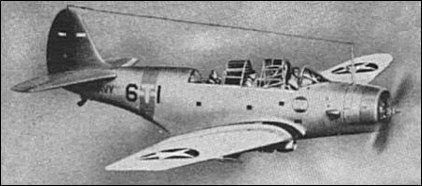
| The prototype of the Devastator torpedo bomber flew for the first time on 15 April 1935. It was the first monoplane selected for aircraft-carrier operations, the first of 129 ordered by the US Navy entering service in 1937. Armed with only one forward-firing and one rear-mounted machine-gun (plus a 533mm torpedo or 450kg bomb), it was. very vulnerable to enemy attack: heavy losses were suffered in action against the Japanese during the early part of World War II, especially during the Battle of the Coral Sea when the type operated from USS Lexington and Yorktown, the former being sunk but only after Devastator and Dauntless bombers had sunk the Japanese carrier Shoho and severely damaged Shokaku. The Battle of Midway, fought between 4 and 7 June 1942, was the Devastator's last major action: it was relegated to non-combat duties after suffering heavy losses during the battle. FACTS AND FIGURES © For the first time in a Navy
bomber rhe TBD featured an
enclosed cockpit and all-meta
construction. The corrugated
wing surfaces contributed to
strength bur increased drag. © Useless torpedoes, weak defensive
armament and a lack of self-sealing
fuel tanks contributed to
the Devastator's failure in combat. © The folding wings were a novel
feature and in the prewar days
sometimes the wing locks were
forgotten, leading to a plunge
into the sea on take-off.
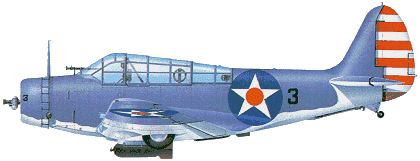
| CREW | 3 |
| ENGINE | 1 x 900hp Pratt & Whitney R-1830-64 Twin Wasp radial piston engine |
| WEIGHTS |
| Take-off weight | 4624 kg | 10194 lb |
| DIMENSIONS |
| Wingspan | 15.24 m | 50 ft 0 in |
| Length | 10.67 m | 35 ft 0 in |
| Height | 4.60 m | 15 ft 1 in |
| PERFORMANCE |
| Max. speed | 332 km/h | 206 mph |
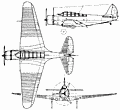 | A three-view drawing (800 x 734) |
| Anonymous, 13.03.2023 16:13 This aircraft has received a great deal of criticism for its performance during the 1942 Battle of Midway. However, it should be kept in mind that, when it first flew in 1935, it was a very advanced design. At that time other navies were still using fixed landing gear biplanes in the carrier-based torpedo bomber role. It should also be pointed out that the few Grumman Avengers that appeared at the Battle of Midway did not fare very well, either. The TBD was not a bad aircraft. It was simply "passed it's sell-by date" by the time that it was first employed in combat. reply | | Blair, e-mail, 06.12.2012 23:55 A beautiful plane, the other Douglas Plane the SBD or A-24 Is beautiful too. Such an advance in technology for the mid 30's, it must have been a site when it first came about. But a not so site flying away from enemies at only 200mph. I gotta say The Pilots and Torpedo Officer /Navigator's Radioman /Gunner's who flew the TBD deserve the utmost respect. reply | | Reverend Pervaiz Khokhar, e-mail, 26.10.2012 09:03 Hello!
Dear Sister Frankie Linda G Gentry!
Greetings in The Name of Jesus Christ!
We are much happy reading your ministry activities after visit your website. I know that you are doing God's work & saving unsaved, unbeliever, hungry, thirsty souls, last sheep, sick, suffering, street-wondering homeless children, widows, and poorest Christian families etc. How is your sound health and precious ministry? How are your life activities? We will continually pray for you & your all family members, best friends, relatives, c-coworkers and great God's people? We don't forget to you and your all family members? I know that everyone is doing well there? Everyone is doing well here too?
Today I will share message of God through Gifts every year at Christmas, Easter Festivals and Christian literature, books, Urdu bibles and evangelistic meetings, healing, miracles crusade held across the whole Pakistan, The PSSWS Ministry is reaching people and changing lives in a way that is captivating the lost and turning hardened hearts back to their first love. People are responding to this joyful, down-to-earth, and passionate ministry. They are turning in. They are listening and laughing. Most of all, they are realizing the freedom, simplicity, and joy that comes from being at peace with God and in love with His son, Jesus Christ.
I want to inform you that now-a-day The PSSWS Ministry has most urgent needs Christmas Gifts, 05 New Bicycles, 50 Urdu Bibles. Do you possible to providing us 50 Urdu Bibles distributing among with Prison & Jails, Sunday, primary school children and poor Christian families doesn't purchased or paying bible cost. The 15 Urdu Bibles cost or amount (01 Bible $,£,€,7x50=$,£,€,350). I know that you are very interested & you will try to send us some Urdu Bibles.
I'm waiting for your one time financial gifts and Love offerings to the PSSWS Ministry Only ($,£,€,350) for purchasing Urdu Bibles. Do you possible to share our most urgent needs (50 Urdu Bibles) cost or amount only ($,£,€,350) among with onto all your best, friends, co-worker and all Missionaries, Evangelists, Pastors, Elders, Ministries, Churches, Organizations, Religious Denominations, Congregations and servant or minister of God in your country etc.
We are sharing with you required needs Christmas gifts. We are looking most urgent needs (269 Christmas Gifts, New & Secondhand Clothes, Shoes, Food, Blankets, Toys, Holy Bibles, Medicine, primary, Sunday school materials etc). The PSSWS is feeding every year 65 widows and 25 poor Christian families at the Christmas Festivals. Truly at present we have urgent needs (269 Christmas Gifts Box) for Sunday school and (65 Christmas Gifts Box) for widows and (25 Christmas Gifts Box) for poor Christian families. We are brief to you urgent & necessary number of Gifts (359 Christmas Gifts Box). We have urgent needs ($3.00 x 269 Christmas box $807.00 US Dollars) and ($10 x 90 Christmas Gifts Box $900.00 US Dollars).
Are you possible to send us money for purchased 359 Christmas gifts box in Pakistan? We know that 359 Christmas gifts box are very costly & high shipping expanses sending from your country to Pakistan. I mean this 359 Christmas box purchasing maximum cost & valueless in Pakistan ($1707 US Dollars) and maximum shipping cost ($200 to $300 US Dollars) for one carton only. We don't waste God's money via shipping expenses.
I know that you are much precious servant of God for us. I know that you are interesting, willing to giving us one-time financial gifts and Love offerings to the PSSWS Ministry ($550 US Dollars for 05 New Bicycles) and ($350 US Dollars for 50 Urdu Bibles) ($1707 US Dollars for 359 Christmas Gifts Boxes) for Sunday, primary school children and poor Christian families through transfer to our electronic funding account or (Western Union or Money Gram) please see information given below:-
1. Account-holder: Reverend Pervaiz Khokhar
2. Account: National Bank of Pakistan Jhumra City Branch Pakistan
3. Account Number: 11410-3
4. International Swift Code: NBPAPKKAX02F
We are sending to you ministry report & information years 2012. The 09 months I have visited several villages & towns for teaching & preaching saved many hungry, thirsty, souls, and last sheep for Jesus Christ. During visited time I have collected views of many poor families. At currently as he sees that humanity is in urgent need of liberation. The liberation and redemption needs to come to the Christian community, realities, unity, relationship with each others and levels of society in the Pakistan. One of the needs of liberation is the liberation from poverty bringing hope to the hapless and empowerment of voiceless.
We would like to share the reality of poverty and its consequences as we encounter them in our ministry. We have saved many souls for Jesus Christ. I hope in Christ you will happy to hear that 35 people have got water baptized and 56 people repent own sins and accepted ... reply | | Matthew Kitchen, e-mail, 26.08.2012 10:50 Lovely aircraft. Too bad there aren't any survivors. I especially liked the yellow winged Devastators. reply | |
| | David Nelson, e-mail, 08.01.2012 02:43 For those of you who are familiar with Stan Stokes "Scratch One Flat Top" the sinking of the Shoho Japanese aircraft carrier. That is my dads plane . Dad was the Radio Operator on that very aircraft. Pilot was Lt. R.F. Farrington and the crew was T.R Wiebe and Walter Nelson RMSC (retired). Sure wish their would be a documentary on that aircraft like Decovery Wings used to fo. Proud of my dad and his service to the war effort. He is still alive a 91 years and loves to tell his story reply |
| Ben Beekman, e-mail, 18.03.2011 02:58 The TBD was doomed from the start if its top speed was only 206mph as stated here. Its successor, the Grumman TBF, is listed as having a top speed of 267mph, 61 mph faster (wow!) than the TBD which must have been a sitting duck. The product of a peacetime Navy with limited funding available for the required updating and modernization, the Devastator could have been improved had there been the foresight and the will to do it. But complacency seems to have been the rule in those days. As long as we had those impressive-looking battleships we had nothing to worry about. As with the faulty torpedos, it wasn't until the shooting started that those responsible for the TBD's calamitous performance had to do something about it. Sadly, its replacement came too late for the men of Torpedo Squadron 8. reply |
| Greg Dixson, e-mail, 04.03.2011 12:14 Regarding the question of whether TBDs flew with 2 or 3 crew at Midway. Per "A Dawn Like Thunder", a history of VT-8 by Robert Mrazek, there were on two crew onboard the TBDs at Midway, at least with VT-8. Recently I also saw a documentary on John Ford who did a film about Midway while he was in the Navy during WWII. Excerpts from the film showed photos only pilots and radio operator /gunners of VT-8 taken with their aircraft before the battle. reply | | Frankie, e-mail, 01.01.2011 21:27 My Uncle, was RMC3 on flight TBD-1 1507 (VT-5 Yorktown) in the Marshall Gilbert raids Feb. 1, 1942. The plane went down. Uncle MIA. I hope someday they find the wreckage. reply | | M.E. MCCAFFREY, e-mail, 17.10.2010 20:18 TO PAUL AND THE QUESTION OF THE SMALL CLAMSHELL WINDOW IN THE FORWARD BELLY OF THE A.C IT WAS NOT FOR A TORPEDO ATTACK--FOR EXAMPLE AT MIDWAY THERE WAS NO THIRD CREW MEMBER ABOARD--NO BOMBARDIER. THE WINDOW WAS FOR HORIZONTAL ATTACKS WHEN THE BOMBARDIER USED IT TO SIGHT HIS BOMBSIGHT--IT WAS USED AT THE WAKE ISLAND ATTACK, FOR EXAMPLE, AND I HAVE AN ARTICLE BY A THIRD CREW MEMBER WHI DESCRIBES THE RAID. MAC. reply | | al, e-mail, 09.10.2010 16:16 At Midway did TBD fly w / 2 or 3 man crew? reply | | Jackie, 08.08.2010 04:57 At the time when it entered service in 1937, it was the most advanced torpedo bomber in the world. It was the first widely-used carrier-based monoplane as well as the first all-metal naval aircraft, the first with a totally enclosed cockpit, the first with hydraulically folding wings; it is fair to say that the TBD was revolutionary. It can carry a single mark 13 torpedo or a single 1000 lb bomb. By the time of Pearl Harbor however, the TBD Devastator was already obsolete. After the disastrous losses at the Battle of Midway, the TBD was quickly withdrawn from frontline units for use in training. reply | | frank c. bonansinga, e-mail, 07.05.2010 02:22 George Bottjer was an Ensign in VT-5 flying the TBD from the Yorktown. Though the Devastor was not a good torpedo bomber, the pilots made it work for them. At Tulagi Harbor on 4 May and in the Battle of the Coral Sea on 7 and 8 May 1942, he was instrumental in sinking the Japanese carrier Shoho and severely damaged the Shokaku.
George Bottjer was awarded the Navy Cross for his action.
He was my boss at Raytheon for ten years from 1955 to 1965 and he never once said a word about what he did.
He was some man. reply | | john, e-mail, 20.04.2010 01:21 the japanese b5n kate was better than this aircraft googd thing we replaced it reply | | john, e-mail, 20.04.2010 01:20 the japanese b5n kate was better than this aircraft googd thing we replaced it reply | |
| | samuel., e-mail, 10.02.2010 03:57 the tbd was not a failure. in fact, it was good for its time. but that was 1935. by 1942, it was obsolete. reply | | Mark, 23.08.2009 21:56 I like the TBD. Very nice aircraft with a sad ending. reply | | leo rudnicki, e-mail, 08.04.2009 00:27 The Devastator was a failure? The role of torpedo delivery aircraft was a hazardous duty and the TBF's at Midway fared no better but were called a success. The British Beaufort torpedo bomber was statistically the most deadly a /c to fly, in the RAF. The fact that the torpedoes didn't work( another story) did not affect the aircraft. I heard that someone did hear the impact of a dud torpedo on a Japanese ship. The failure was the lack of fighter cover during the attack, as well as dive bomber co-ordination. It all went wrong and resulted in 3 dead carriers and never-to-be-replaced aircrews. The loss of TBD's used up and drew off the fighter cap and that is history. An operational disaster provided a pivotal victory. reply | | Greg, e-mail, 16.05.2008 16:17 Paul is correct, the clamshell window was for use when delivering a torpedo attack. For your information, there is a group, working with the USN, that intends to rasie a TBD-1 out of the waters of a lagoon at Jaluit Atoll. They are raising money for the effort. Check out the website at www.tighar.org. reply | | paul, e-mail, 24.12.2007 17:06 I believe those clamshells were for opening the window
so the assist pilot /bombadier could use the norden bomb sight reply | | Ray, e-mail, 14.11.2007 00:48 Can you tell me on the TBD Devastator as to what the small clam shell underneath the engine is for? It looks too small for bombs. The model airplane I have don't tell what it was for and I'm not sure if it's for a small bombs or for the pilot to observe his torpedo run. Thanks. Ray reply |
|
Do you have any comments?
|
| 
COMPANY
PROFILE
All the World's Rotorcraft
|


 Ben Beekman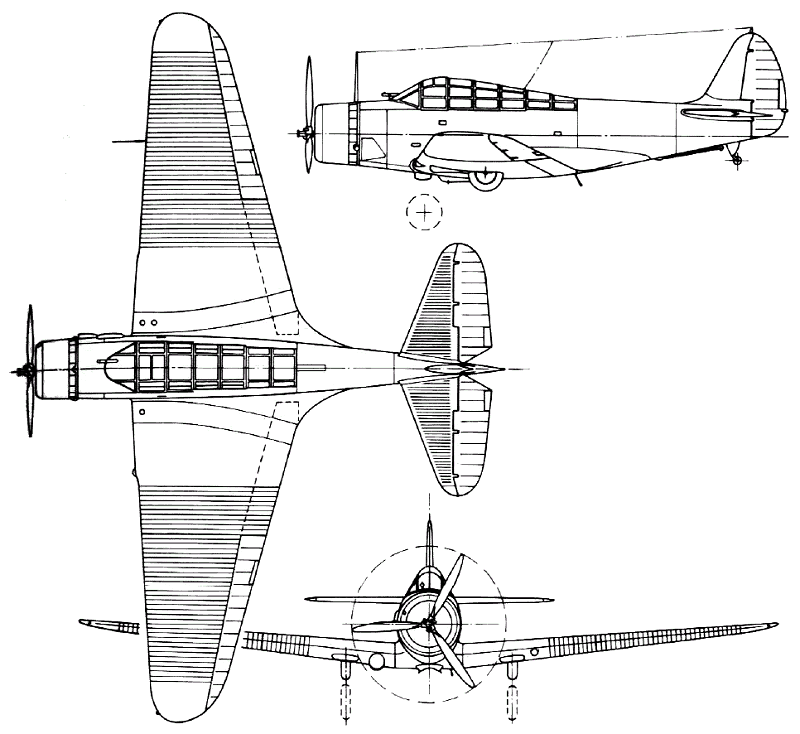


Dear Mr. Nelson,
I am Mickeen Hogan. I am 20 years old and I live in Brandon, Vermont. I was brought to the story of your father Walt Nelson by my interest in World War II Naval history. I watched an interview with him, and found it very interesting. I had a player in War Thunder make a custom skin for my TBD to match the one flown by your father.I used Starfighter Decals to make a 1 /700 scale replica of Lexington and her air group, including your father's plane. You probaly have heard this, but in 2018 Paul Allen found the Lexington, and near it is your father's plane. I am in contact with A&T Recovery, and they hope to retrieve at least one TBD from Lexington. I will keep you updated as events unfold. It is men like your father Walt Nelson who made this world a better place.
All the Best and Blue Skies,
Mickeen
Sincerely,
Mickeen
reply