|
| Immediately after the United States became engaged in World War II, and particularly as a consequence of that nation's initial involvement against Japanese forces in the Pacific, it was clear that transport aircraft would be of vital importance. Because of the theatre of operations envisaged, such aircraft would require both long range and great load-carrying capability, and in early 1942 Douglas began development of an aircraft to meet this requirement.
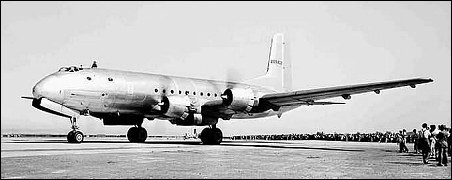
Designated Douglas C-74 Globemaster I, the first example of which 50 had been ordered by the US Army Air Force did not fly until 5 September 1945. It was a cantilever low-wing monoplane of all-metal construction, with a conventional tail unit, retractable tricycle landing gear with twin wheels on each unit, and power provided by four wing-mounted 2237kW Pratt & Whitney R-4360-27 radial engines. The C-74's large-capacity fuselage provided accommodation for the crew and 125 troops, or 115 stretchers with medical attendants, or up to 21840kg of cargo.
The Globemaster I suffered typical contract cancellations after VJ-Day, and only 14 were completed. One, with 103 passengers and crew, flown from the USA to the UK on 18 November 1949, was the first aircraft to fly across the North Atlantic with more than 100 persons on board.
D.Donald "The Encyclopedia of World Aircraft", 1997
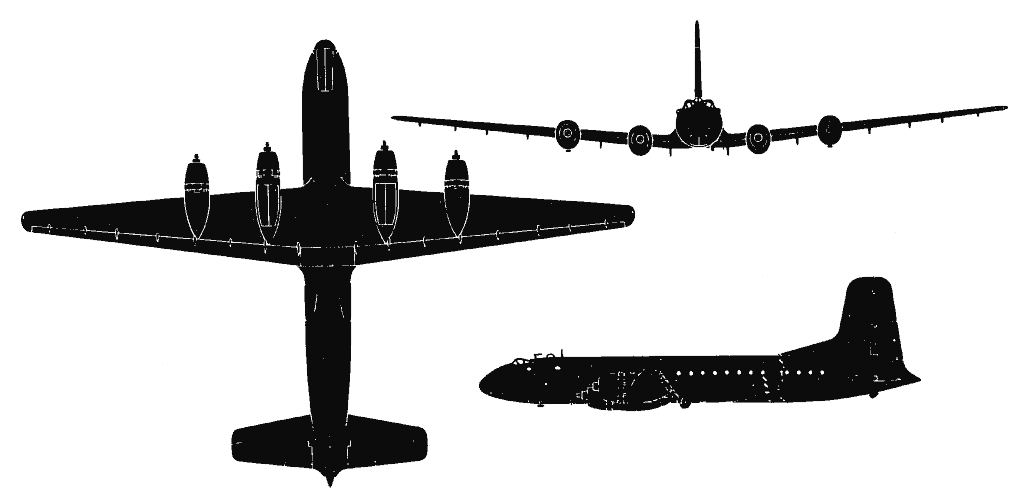
 | A three-view drawing (1024 x 504) |
| Patrick Dean, e-mail, 08.12.2013 06:11 I am seeking construction, operation, break-up and crash photos of C-74, C-124 and all Guppy Types for a book that will be published by McFarland and Company. It is a sequel to my book "The ATL-98 Carvair". The working title is "Volumetric Heavy Lift, Hybrid and Guppy Aircraft." This is a comprehensive review and comparison of Guppy and heavy lift aircraft and includes a section on external cargo transport. A large portion of the manuscript has been completed.
Any photos or anecdotal accounts anyone can offer will be appreciated.
Thanks, WPD reply | | B Fielder, e-mail, 13.08.2012 01:17 Never flew on one, but worked on Ship#1 in Bldg 13 at Douglas Long Beach in 1944. I was 16 years old at the time, working swing shift @ $0.76 /hour. Also worked on most of the ones used in the Berlin Airlift in the early 50's. The original "wet wing" was sealed with zinc chromate paste which was removed, and the wing sealed with a compound called EC-81 I believe.. reply | | Mike Baechle, e-mail, 08.08.2012 21:48 I have a number of photos of the C-74, including the Heracles. Anyone interested can send me an email. reply |
| beifang, 20.06.2011 07:13 At one time
we carried a record number of people across the North
Atlantic between the UK and USA.Lots of good memories. reply | |
| | Tony Vasko, e-mail, 11.03.2011 00:37 Saw a C-74 in late 50's or early 60's at the then KIDL in New York. It was, I think, in Dutch regestry and was name "Heracles". I was told it was flying horses. Still looked impressive. reply | | Ron Wahl, e-mail, 10.12.2010 03:59 Does this a /c have an elevator load system bottom aft.fus.There was one in MIAMI avation school many years ago.It was seased by US GOV.AT american airmotive,loaded with guns,going to Cuba app 1961....... reply | | Louis Martin, e-mail, 02.12.2009 19:19 Around 1952 as an airforce air traffic control airman, I flew as a passenger in the C-74 from North Africa to the Azores Islands It had a "Bug eyes" nose and a C-124 Tail. The story about the C-74 was that there were only 13 manufactured. reply | | GREG WHITESIDE, e-mail, 07.06.2009 00:37 My father (Sam Whiteside) was in LIFE magazine as the first pilot to fly over 200 people in an aircraft - a C-74. I am trying to find our the details of that article if anyone can help. reply | | Howard, e-mail, 27.07.2008 17:34 I was trying to find the prop radius for the c-74
Thanks reply | | Cameron Simon, e-mail, 29.05.2008 21:05 I worked on this acft straight out of Tech School at Brookley AFB. The best Airforce duty I ever had. Year was 1953 & 1954. reply | | J.P.Dearman, e-mail, 29.05.2008 04:06 I served as a load master in the C-74 squadron based at
Brookley Field Mobile AL carrying materials to and from
Frankfurt Ger in support of the Berlin Airlift.At one time
we carried a record number of people across the North
Atlantic between the UK and USA.Lots of good memories. reply | | Kretsinger, Victor H., e-mail, 25.05.2008 19:15 You'll notice that the pictures A /C has the twin bubble canopy. This was later changed to the type used on the C124, because it was difficult for the flight crew to communicate between themselves. reply | | ROBERT J. DANIEL, e-mail, 18.04.2008 04:48 Why no information about the follow-on model the C-124 that served so long hauling cargo and troops? reply |
|
Do you have any comments?
|
| 
COMPANY
PROFILE
All the World's Rotorcraft
|




bonjour je recherche document sur l'Eraclès ou photos sur le crash du 9 octobre 1963 merci d'avance
reply