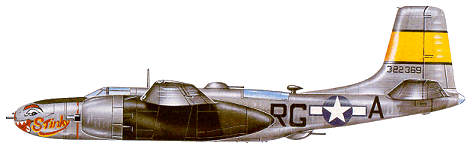
The USAAF issued a requirement for an attack aircraft in 1940, before it had information on World War II combat operations in Europe. Consequently, three prototypes were ordered in differing configurations: the Douglas XA-26 attack bomber with a bomb-aimer's position; the XA-26A heavily-armed night-fighter; and the XA-26B attack aircraft with a 75mm cannon. After flight testing and careful examination of reports from Europe and the Pacific, the A-26B Invader was ordered into production, and initial deliveries of the 1,355 built were made in April 1944.
The A-26B had six 12.7mm machine-guns in the nose, remotely controlled dorsal and ventral turrets each with two 12.7mm guns, and up to 10 more 12.7mm guns in underwing and underfuselage packs. Heavily armoured, and able to carry up to 1814kg of bombs, the A-26B was potentially a formidable weapon. Moreover, its two, 1491kW Pratt & Whitney R-2800 engines conferred a maximum speed of 571km/h, making the A-26 the fastest US bomber of World War II. Invaders'remained in USAF service until well into the 1970s.
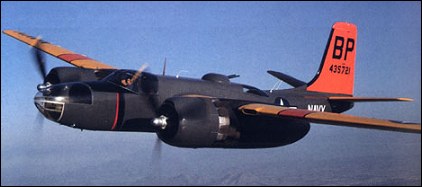
Missions with the 9th Air Force in Europe began in November 1944, and at the same time the type became operational in the Pacific. The A-26C with a bomb-aimer's position and only two guns in the nose entered service in 1945, but saw only limited use before World War II ended. A-26C production totalled 1,091. With little employment ahead of them, so far as anyone could see, one A-26B and one A-26C were converted to XJD-1 configuration, this pair being followed by 150 A-26Cs converted as target tugs for the US Navy with the designation JD-1; some were converted later to launch and control missile test vehicles and drones, under the designation JD-1D. These designations became UB-26J and DB-26J in 1962.
USAF A-26B and A-26C aircraft became B-26B and B-26C in 1948, and retained this designation until 1962. Both versions saw extensive service in the Korean War, and were again used in a counter-insurgency role in Vietnam. A special COIN version with very heavy armament and extra power was developed by On Mark Engineering in 1963, a prototype being designated YB-26K and named Counter Invader. Subsequently about 70 B-26s were converted to B-26K standard, 40 later being redesignated A-26A. Some were deployed in Vietnam, and others were supplied to friendly nations under the Military Assistance Program. B-26s were used also for training (TB-26B and TB-26C), transport (CB-26B freighter and VB-26B staff transport), RPV control (DB-26C), night reconnaissance. (FA-26C, from 1948 redesignated RB-26C) and missile guidance research (EB-26C). After the war, many A-26s were converted to executive, survey, photographic and even fire-fighting aircraft. Brief details of the two semi-production marks are given in the variants list.
Douglas A-26 / B-26 Invader on YOUTUBE
Specification
MODEL
B-26B
CREW
3
ENGINE
2 x Pratt & Whitney R-2800-27 or -79 Double Wasp, 1491kW
Super SEO Web Design is an affordable web design and marketing agency.
Allow us to design the best high-quality all-inclusive website or ecommerce shopping site for you.
We are also experts in modern marketing and can help bring a lot of visitors and conversions to your high-quality site. We market your website using tried and true methods. We not only specialise in SEO, PPC, and social media, but we can also assist you with phone calls, data entry, and bookkeeping.
We also employ the same pay per click strategies as our own business model. Did you know that if you spend £400 on Google ads, you will also receive a £400 credit, ensuring that you can generate orders?
Social media is essential for making your business appear established.
Our prices are very reasonable, starting at only:
£129 for web design £250 for ecommerce all inclusive from £129 for seo £99 for ppc £5 an hour for social media £4.50 an hour for telemarketing / cold calling £3.50 an hour for data entry £9 an hour for book keeping
Please do not respond to this email; instead, send us an email at sales@superseowebdesign.com and /or call us at +440203 4887 239.
We are a high-quality specialist design and marketing firm that is also very affordable, allowing you to get more for less.
For more information, please visit www.superseowebdesign.com.
Our headquarters are in the United Kingdom, and you can reach us at the number listed above.
If you would like a free 10-minute consultation, please email us and we will set up a call to demonstrate our superiority.
Emit Parmar Super Seo Web Design 86-90 Paul Street London, EC2A4NE, United Kingdom
The Douglas A-26 "Invader" was originally developed to succeed the same company's A-20 "Havoc". Although it did not appear until late in WW-II, the A-26 proved highly successful and remained in service during the Korean and Vietnam Wars. Note that after WW-II the disignation for this aircraft was altered from "A-26" to "B-26", but that this aircraft should not be confused with the earlier Martin B-26 "Marauder".
I went to Biggs 1st Tow in 1951, then went to Perrin on March 2nd 1952. Was put in the right seat ferrying 26`s into Perrin. Crewed and flew at Perrin and at Vance. I`m 85 now but I still remember the wonderful feeling of taking the controls(44-35466 was duel controlled.) Gosh I loved that Aircraft.
I am looking for any relatives of a Lt. Harald W. Gilbert or Cpl. Anthony Simnowski. I located the wreckage of an A26-B in the mountains of Ellijay Georgia and have written an article concerning the crash in the local paper. Please contact me if you know of any relatives related to these two men. The crash happened on Feb. 13th 1945 on Stover Mountain in Gilmer county.
Saw your post on aviastatlr.org concerning the A-26 crash on Stover Mtn. I grew up a few miles away on Doublehead Gap Rd. I heard of the story from the old-timers and even hiked the mountain once, wondering if I would find any evidence on a rocky outcropping.
I did not. Wondering what information you could provide about the condition of the wreck.
I have since gone on to join the USAF and I have flown C-17s. Currently flying the T-1 at Columbus AFB, MS.
Hi Ray, we have a cabin in ellijay and somewhat familiar with Stover mountain and have a good friend that lives on it. Oddly very few locals know this story. Can you email the article you wrote about it? I believe they were on a teai ing mission from Pensacola and got lost? Thank you. Brian Wallace 404-626-3596
Brian , sorry to burst your bubble but locals that are any age know all about the plane and the crash . A couple years ago there were still parts of the engine on the mountain. Undoubtedly you spoke to someone claiming to be a local . Known about this all my life.
Mr. Jones, I meant no disrespect to you or anyone in Gilmer County. I have many friends there. I'm sure there are many who know the story, it was that a few I mentioned it to had not heard of it. My friend that told me about it is in his late 60's and grew up there. I also have a close friend that lives on Rich mountain all his life and hunts all over those parts, who had not heard of it. Seemed like a big story to me but was surprised that some weren't aware.
Calspan Corporation flew two specially modified, experimental B-26s from the mid-1950s until 1981. With computerized hydraulic flight controls added to the right side, they could mimic the handling qualities of other aircraft. In addition to many R&D projects, they were used to train test pilots at the USN & USAF Test Pilot Schools. Every student flew 3 or 4 flights in these aircraft. Many of these pilots went on to become astronauts and other famous test pilots. I logged 800 hrs in these aircraft from 1978 until 1981 and flew the 10,000th hour on one of them. For planes, expected to last 6 months when built in 1943, certainly surpassed all expectations. Sadly, in March of 1981, one of them crashed after a wing failure. The other one was placed in a museum at Edwards AFB where it probably remains. They were replaced by a similarly modified Learjet 24.
I forgot to add Dad was in the Texas National Guard, then the 111th Tactical Reconnaissance Squadron assigned to the 68th Observational Group. He spent 2 weeks shy of 3 years over seas, from 1942 to 1945.
My dad was a rear gunner /radio operator on an A-26B /C during the EAME campaigns. Toward the end of WW2, his crew was flying anti-submarine missions out of North Africa. What was most interesting, due to the small crew size, everyone on the crew was cross-trained to fill in for any other position. Dad could fly, navigate, communicate and defend with the turret gun. He was hit by shrapnel at some point.
Due to an accident while off duty, Dad had to go to sick bay. When he returned, his flight had taken off on a mission. They never came back. The weather was poor and the pilot was not skilled at bad-weather flying. The plane crashed into a mountain, killing all three on board.
Dad is gone now, and I'm trying to find more information about this event. However, I don't have any details on the specific plane or the date of the crash. Would like to hear from anyone who might have heard of the crash. Thanks.
Over the years the re-designation of the Invader by the Air Force has led to some confusion over the identity of this aircraft. During WW-II this aircraft was developed as a "ground attack" aircraft to replace the Douglas A-20 "Havoc". Consequently, the Army Air Force designated it "A-26". After the new U.S. Air Force was established in 1947, the "A" for "Attack" designation was dropped, the A-26 became reclassified as a "light bomber" and was re-designated "B-26". There had already been a "B-26", the Army Air Force's well-known Martin B-26 "Marauder" of WW-II. However, that aircraft had been phased out of service by 1947, and the Air Force apparently did not consider there to be any chance of confusing the two types.
My father Lee Topp flew a b-26 in Korea probably about 1952 and 1953. He did at least some of his training at Langley Air Force base. If anyone remembers him or has any information about him, especially about what squadron he was in, I'd be grateful.
Michael, our Dads might have flown together both in B-26 school at Langley AFB, VA. and then at a base in South Korea in the 1952-53 time period. If you haven't yet seen your Dad's military personnel information, do order a set of your dad's Air Force personnel records. I have a set of my Dad's records and it has helped me to understand all our military moves while I was growing up (1944-1962). It shows that Dad attended B-26 Invader flight training at at bases in Texas and Virginia before going over to South Korea and flying in the 37th Bomb Sqdn, 17th Bomb Wing. Send me an email and we can work on our Dad's B-26 experiences. I'm retired from Boeing and live up in washington State.
I first flew a Douglas B-26 at Perrin AFB November 1952. From the went to Langley to pickup a Bombardier and Gunner. Then to Korea K-8 90th Bomb Squadron for 47 missions, most with an engineer and gunner. Was reassigned to the 1st Tow Target Squadron at Biggs AFB in El Paso. Loved that plane and had no desire to get into jets so left USAF when they were upgrading.
Interesting stories and comments here. I currently fly an A-26B for the CAF Invader Squadron in Ft Worth, Tx. Also restoring the last flying K model for Greatest Generation Aircraft in the same hangar. AF64-17679 was its number with the tailcode of "IF" for England AFB, LA from the mid 1960's. As a kid, I missed many a fish bite out on Lake Texoma back in the 50's watching all of the Perrin AFB T-33's and F-86's in the pattern. I don't remember the A-26 that trained there back in '52 and '53, but I have made up for lost time. It is fun to outrun P-51's at airshows now. Down low, the A-26 is quite the serious hauler. The B model is painted in Korea era paint. The K will be in SEA camo with a black bottom and jungle on top. Come see us at the Vintage Flying Museum at Meacham Field in Ft Worth.
A squadron was stationed at Nakhom Phanom Royal Thai Air Force Base, Thailand 1967-1969 while I was station there. They were used to interdict trails in Laos and other areas of Southeast Asia. Always enjoyed watching them takeoff and land while setting in the weather observer van at the end of the runway. One of my favorite aircrafts because of it's beautiful silhouette. It just looked fast!
My Post: Pat Daily, 11.02.2015. Not sure if I posted correct email address. Correct email address is n2dkb@comcast.net. I would appreciate hearing from any reliable source on this subject. C.V.D.
I have the same question which I have not heard or seen an explanation. I was a Flight Engineer on Lt. John Wright's crew. I do remember we having to take a "little detour" around something in the middle of the taxiway on the 95th.st. side of K-9 before the conflict ended. Don't remember what the object was but I do know we done a little "dip" off the taxiway through what I remember was a drainage ditch running along side the taxiway. We learned after the mission that night when we were leaving debriefing that all six blades were slightly bent back. I am not sure at this time who was responsible for this incident? I have heard over the past 60 years a couple different stories. Who did it? Was it our crew, John Wright, Dick Uyehara and me, Clarence Daily, (A3C Clarence Daily) C.V.D.
I had the privilege and honor of flying 50 combat missions as a bombardier-navigator in Douglas 26s with Col Delwin Bentley or Capt Robert Crow with the 95th BS, 17th BG at K-9 AFB, Pusan, throughout the last seven months of the Korean War ending on 7 /27 /53. Most of our missions were to destroy, damage and delay the flow of trains and trucks carrying men and materiel to the front lines alone the mountainous eastern half of the peninsula during the night at low levels and airspeeds. The B-26C was the perfect aircraft for this mission profile! I recently finished and published a book (INTO THE LAND OF DARKNESS) comprised of fifty non-fiction short stories /related photography that describe our combat experiences.
God Bless, et al. I was an Arcft Electrician, (made buck Sgt in 20 months), on B-26's at Perrin AFB, TX in 1952. Was selected to Pilot Training as an Aviation Cadet in Dec 52 and ended up reporting for Basic Training in the B-25 at Vance AFB, TX in Sep 1953. The B-26 Sqdn have moved to Vance during the spring /summer of '53. The B-26 studs would 'jump' a B-25, with ONE ENGINE FEATHERED. Frank Mangini, a good friend with the B-26 Sqdn, in the Admin section got 'my silver dollar' for my first salute - and - then he and I got some 'serious pay back'!! We went to the Maintenance office after my graduation on Mar 15, 1954 and he got to call the office to 'ATTEN-SHUN' as we walked in. Some 'pay back' is just a whole better than others!! Our Pilot Class had several classmates who stayed at Vance and went to the B-26's there - I'll check if anyone of them would have something to add.
My Dad, Howard Gammon was navigator for Col Randy Holtzapple in the 319th Bomb group in the Pacific. He recalls the names Hugh Dunwoodie, Robert Wieman and Rex Whitney but thinks they were in another squadron. He's 92 and still plugging along. He also recalls Deke Slayton who went on to Nasa but was in another squadron of the 319th than my Dad.
I flew in the JD 1, with UTRON 7, out of Brown Field, Chula Vista, California from March 58 to October 59. I was an AM 2 and flew as an observer next to the pilot. I flew three times a week, and took flights for married guys that didn't want to fly. Sometimes two flights a day. I went to survival school and have many hours in the JD 1. My only complaint is that my Navy personnel records only shows 31 hours of flight training. No mention of aircrewman wings being awarded, which still smarts to this day. Thanks Navy.
Lt Sparling, thanks for the memories of you puking in the sectional map that collapsed after it became saturated, then was thrown into the bomb bay tunnel for the guys in the aft station to get splattered on.


 Ray Barker



Ray,
Saw your post on aviastatlr.org concerning the A-26 crash on Stover Mtn. I grew up a few miles away on Doublehead Gap Rd. I heard of the story from the old-timers and even hiked the mountain once, wondering if I would find any evidence on a rocky outcropping.
I did not. Wondering what information you could provide about the condition of the wreck.
I have since gone on to join the USAF and I have flown C-17s. Currently flying the T-1 at Columbus AFB, MS.
Thanks for your interest in this bit of folklore.
Daniel Bruce
reply