|
| US Navy interest in German delta-wing research led, in 1947, to the design by Douglas of a carrier-based interceptor which embodied a variation of the pure delta wing. Approval of the Douglas design was signified by the award of a contract for two Douglas XF4D-1 prototypes on 16 December 1948, the first making its maiden flight on 23 January 1951 powered by a 2268kg thrust Allison J35-A-17 engine. This represented an emergency powerplant, resulting from delays in development of the Westinghouse J40 turbojet which had been the planned engine. Both prototypes were flown subsequently with the XJ40-WE-6 developing 3175kg thrust and the XJ40-WE-8 which had a rating of 5262kg with afterburning, but problems with this engine programme led to final selection of the Pratt & Whitney J57 engine for production aircraft.
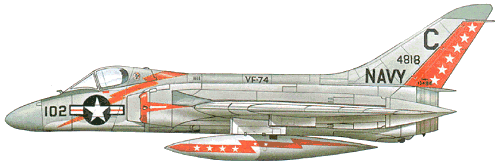
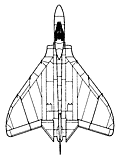
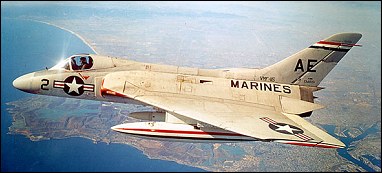
The F4D Skyray was a cantilever mid-wing monoplane, the wing of modified delta configuration incorporating elevons to serve collectively as elevators or differentially as ailerons. The tail unit had only swept vertical surfaces, landing gear was of retractable tricycle-type and the pilot was accommodated well forward of the wing in an enclosed cockpit that provided excellent visibility.
The potential of the F4D was demonstrated effectively by the second prototype on 3 October. 1953, then powered by the XJ40-WE-8 turbojet, which set a new world speed record of 1211.746km/h. The first production F4D-1 was flown on 5 June 1954, powered by a Pratt & Whitney J57-P-2 turbojet developing 6123kg thrust with afterburning, but it was not until 16 April 1956 that deliveries began, initially to US Navy Squadron VC-3. The 419th and last production aircraft was delivered on 22 December 1958, but in the intervening period a change had been made by installation of the higher-rated J57-P-8 engine. All aircraft retained the F4D-1 designation, the popular (derived) name being Ford.
At the peak of its utilisation, the Skyray equipped 11 US Navy, six US Marine and three reserve squadrons, but none was used operationally. The type survived in first-line service until the late 1960s, with two front-line squadrons not converting to the type until 1964. It was redesignated F-6A in September 1962.
| MODEL | F4D |
| CREW | 1 |
| ENGINE | 1 x Pratt & Whitney J57-P-8B turbo-jet, 64.5kN with afterburner |
| WEIGHTS |
| Take-off weight | 11340 kg | 25001 lb |
| Empty weight | 7268 kg | 16023 lb |
| DIMENSIONS |
| Wingspan | 10.21 m | 34 ft 6 in |
| Length | 13.93 m | 46 ft 8 in |
| Height | 3.96 m | 13 ft 0 in |
| Wing area | 51.75 m2 | 557.03 sq ft |
| PERFORMANCE |
| Ceiling | 16765 m | 55000 ft |
| Range | 1931 km | 1200 miles |
| ARMAMENT | 4 x 20mm cannons, 1814kg of weapons on six hardpoints |
 | A three-view drawing (1693 x 1520) |
| James S Hughes, e-mail, 18.03.2016 21:27 My e mail address from the post below is hughes5580@bellsouth.net reply | | James S Hughes, e-mail, 18.03.2016 20:59 The post from Michael A Gianetti Jr 24.02.2013 was very interesting to me. I was a plane captain in VMF(AW)114 at Cherry Point flying F4D's from Sept 1958 to Oct 1960 including a Med cruise in 1959. I hade a very good friend David R Grayce which you mentioned in your post also a plane captain who I very much would like to hear from or receive any information from anyone- buy the way the F4D's was a great plane -Thanks reply | | Patrick W. Keef, e-mail, 31.12.2015 21:58 Remembering LTCOL Dewey F. Durnford. He was our 1st executive officer of the newly formed squadron VMF(AW)314 Sept 1959 at MCAS EL Toro. He was a great pilot and a good officer. The troops all liked him.
He served in World War II shooting down several of the enemy's aircraft. On one occasion while shooting down a betty bomber it dropped a "Baka Bomb" which he also shot down saying in the process "Look it just had a baby". Told to the flight line crew by Col Durnford beforn he went out for a hop. He was later transfered to VMF(AW)513 as the new skipper of that squadron. Semper FI. reply |
| Patrick W. keef, e-mail, 31.12.2015 20:28 Was a plane captain on the F4D skyray from 1959 at El Toro air station to 1961 at Atsugi Japan. Served with a great bunch of guys in VMF(AW)314 The Black Knights. reply |
|
| | Bob Crowley, e-mail, 13.12.2015 00:07 In answer to Mike West. There was no missile tray.Our Skyrays had an external centerline midship pylon reply | | Bob Crowley, e-mail, 12.12.2015 23:27 1962 stationed at NAS North Island Utility Squadron 3 as an AMS 3.In our mix we had 8 F4D Skyrays The Pilots loved the power as soon as they where over the water past Point Loma hit after burner and go vertical.San Clementie Island was a Fleet gun& bomb range, we had landing strip there and also serviced the island .We would watch the F4DS do 20mm gun runs. It was a unique Squadron we had many roles to fill and a mix of aircraft to accomplish the work required.In addition the Skyrays we had as follows........
.4 F9fS......1 R3D.......1 R5D.....We worked on the DASH Helo.....I. We also had 4 P2V Neptunes ( 2 burnin 2 turnin ). On the P2 wing pylons we would hang recip or jet powered target drones for Fleet target practice.We would fly the drone in from the P2. With diversity of the Squadron we would be rotated in for aircrew flight hours. From Utility Squadron 3, orders to VF-33 NAS Oceana Va. F8E Crusaders to F4B Phantoms....CVW-6.....CVA-66 USS AMERICA............I was in Utility Squadron 3 from 11 /62 to 10 /64....Can not get any info on the Squadron.......Any one who was in the Squadron or has some info please e-mail me, be great to hear from you!! reply | | Mike West, e-mail, 20.11.2015 21:34 In 1957 my family lived in "Quarters N," NAS North Island. The house 40 yards (tops!) from the runway. Even as a 3rd grader, used to love watching the Fords (and every other Navy plane) taxi by getting ready for takeoff. QUESTION: Did F4Ds have a drop-down missile tray in the fuselage? Seems to me they did, but I can find no mention of it in the literature. Thanks! reply | | Edward Lee, e-mail, 19.01.2015 12:37 I was in VF23 stationed at Moffett Field, California, one of the first fighter squadrons to receive these aircraft into service in 1956. The "Ford Drivers" (pilots) in our squadron love the birds, but we had them a little more than a year and the whole fleet was transferred to a Marine Squadron. reply | | Wayne Kitzerow, e-mail, 02.11.2014 03:47 I was a plane captain and mechanic on the F4D with VMF 513 from Nov. 1958 until Nov. 1960. It was a fine a /c with not that many problems. We were the first ones the pilots would talk to after a hop, so we knew if there were problems. reply | | Dudley Gillaspy, e-mail, 10.07.2014 17:17 I flew the "Fords" w / NavReserve @ NAS Olathe Ks,'63-'64; Not a good A /C for the Reserves., many maint and supply problems,poor 'availability', but really an impressive to fly..Great performance,tough getting much good flight time. Transitioned to A4's in '65 and problem solved. reply | | Warren Jackson, e-mail, 13.03.2014 18:55 I was an AQF2 in VF101, both at Cecil Field when it was a stand-alone squadron, and later when we moved to NAS Key West, merged with VF 38 and became FAWTULANT. As I remember, when we first got F4Ds, they killed about a pilot every two months or so (uaually the young dumb ones) for the first year.
I do not remember them being too maintenance heavy for anyone. After a while, the pilots finally figured them out and were pretty happy with them.
Their real claim to fame was that they were really a pocket rocket, climbing from a standing start at a (for the time) record breaking rate. They had more thrust than they weighed. reply | | Ralph Koslin, e-mail, 24.02.2014 07:23 I am trying to find an 'old' original VF-21, VF-23, VF-141, VF-162, VMF-AW-115, and or VMF-AW-314 patch.
I am also looking for any old USNR and USMCR Squadron patches from NAS Olathe KS VF-881, VF-882 / VMF-113, VMF-215.
If you have only one patch, I would be happy to reproduce the patch + send a new hard-cover book on the Skyray. An embroidery shop with a loom, can spin an EXACT reproduction of the patch - same size, design, and colors. I would like to keep the original patch for my collection.
I would be happy to send the hard-cover Ford book up front for an old patch.
Please kindly look at your leisure. Thanks for your interest. reply | | Jeff, e-mail, 21.01.2014 06:46 Does anyone know where I can get a squadron patch vfaw-3 north Island F4 D skyray? Thanks reply | | Ernie Eaglin, e-mail, 13.08.2013 03:55 I was an AE 3 for VFAW-3 in 1958-59 . I loved this a /c and found it to be very easy to service. reply | |
| | Michael A. Gianetti Jr, e-mail, 24.02.2013 02:53 I was a Plane Captain VMF, VMF(AW). VMFA-115 on the beloved Ford.
Then we picked up the Phantoms, F4B if memory serves.
I remember SSGT Miiliron (sp) and am still in conrtact with MGYSGT Art Larsen and MGYSGT David Grayce.
Made a Med, came back, went to Cuba.
Today, 2 /23 /13 is the 68th anniversary of the raising of the Flag on Iwo Jima. God Bless America and the United States Marine Corps.
Semper Fi,
Gman reply | | Michael A. Gianetti Jr, e-mail, 24.02.2013 02:51 I was a Plane Captain VMF, VMF(AW). VMFA-115 on the beloved Ford.
Then we picked up the Phantoms, F4B if memory serves.
I remember SSGT Miiliron (sp) and am still in conrtact with MGYSGT Art Larsen and MGYSGT David Grayce.
Made a Med, came back, went to Cuba.
Today, 2 /23 /13 is the 68th anniversary of the raising of the Flag on Iwo Jima. God Bless America and the United States Marine Corps.
Semper Fi,
Gman reply | | Frank Grant, e-mail, 16.02.2013 20:54 I flew the F4D-1 in 1958 and 1959 while attached to VMF(AW)314 at MCAS El Toro, California, Atsugi, Japan and Ping Tung, Formosa. I have only great things to say about the "Ford". It was a "fun aircraft" to fly. reply | | Jim, e-mail, 11.11.2012 20:59 If you watch close there is at least one instance of a Ford launching off of a carrier during the Cuban Missile Crisis Blockade, in a documentary I have see a couple of times on Public Television. reply | | Jim, e-mail, 11.11.2012 20:55 I checked in to H&MS-11, MAG-11, Avionics in Aug. '61. The OIC there, a Field Commissioned 1st Lt (Korea) Asked where i came from. I said El Toro, Mag-15 Q-50 shop, Sir. He smiled and said something to the effect. Do we ever need you. Go see S /Sgt??? at the other end of the building... What I didn't tell him was at El Toro my NCOIC put me, the kid just out of A school in a little supply closet. Where I never got to work on the gear... It turned out there was a ton of black boxes /pallets off the Q-50 that were down. So many so all the reserves were used up and many aircraft on the flight line from those two squadrons who didn't have radar... I and a Sgt who just got there also who didn't know the Q-50 really. I knew basics but that was it, other than being class honorman a year and a half earlier. We divided up th separate sections of the radar, got out the Service Manual for the gear. Worked nights and weekends and started RFI'ing that gear. As soon as a piece was RFI-ed. The Front bench would call one of the squadrons and they would be right down with an exchange and we just kept going. Within a month we had every thing caught up and all the extra stock sections RFI and we just had the daily repairs. And field changes to do. I loved every minute of it!!! Got P2 Pay for it too :) reply | | RC, Sheffield UK, e-mail, 03.08.2012 11:29 This looks very much like a Vulcan prototype I saw once. reply |
|
Do you have any comments?
|
| 
COMPANY
PROFILE
All the World's Rotorcraft
|


 John LaGatta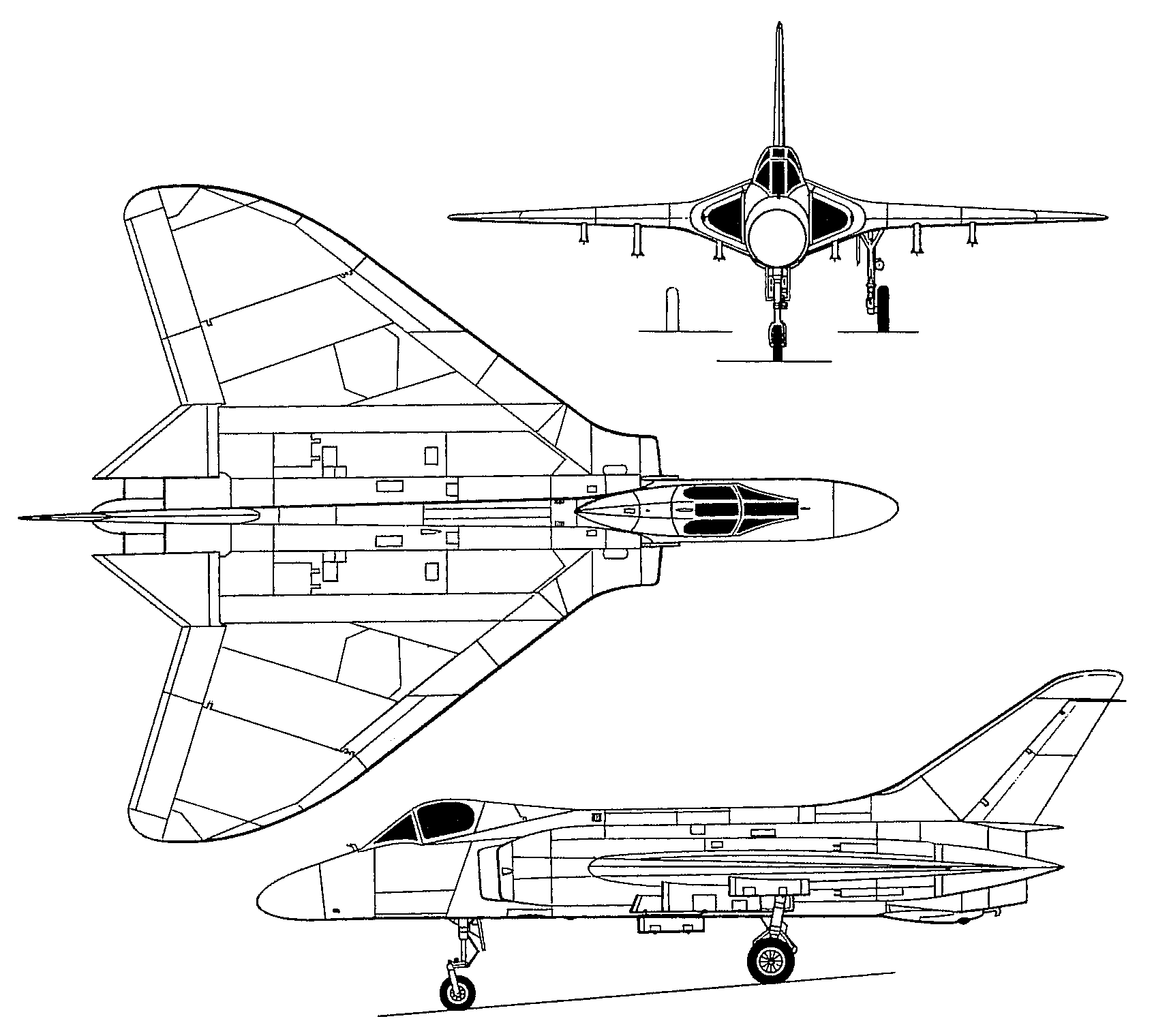


Hi Pat
Still goin strong in Rome ny. Hope you are well, Seeing your post brought back a flood of memories
Jack
reply