|
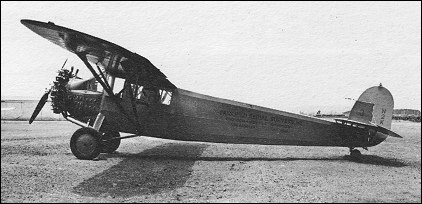
| Basically an updated version of the Fairchild FC-2W2, the Fairchild 71 incorporated many improvements that resulted from experience with the FC-2 and its variants. Providing comfortable seating for a pilot and six passengers, it was powered by a 313kW Pratt & Whitney Wasp 9-cylinder radial engine. The Fairchild 71 was built in modest numbers from 1928 until 1930, when it was replaced in production by the Fairchild 71 A. This differed primarily by having a few degrees of sweepback on the wings, and it introduced a number of refinements to the interior.
Though civil operators acquired most of the Fairchild 71s and 71As, the US Army acquired one Fairchild 71 for evaluation as a light transport under the designation XC-8; dedicated later for photographic work it was redesignated XF-1; eight service-test aircraft were ordered underthe designation YF-1, and all nine of the foregoing were later redesignated C-8. Six production Fairchild 71As followed with the designation F-1A, later redesignated C-8A The US Navy also acquired a single example for service test under the designation XJ2Q-1, later redesignated R2Q-1.
In 1930 a Canadian branch of the company was established at Longueuil, Quebec, as Fairchild Aircraft Ltd. In addition to providing support for something like 70 Fairchild aircraft operating in Canada, it began producing the Fairchild 71 for the Canadian Department of National Defence. These aircraft differed from standard by the removal of the features introduced for passenger comfort and were equipped specifically for aerial photography. A commercial Fairchild 71-C was built and marketed later and was available also as the Fairchild 71-CM with a metal-skinned fuselage.
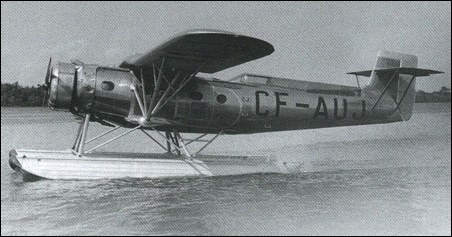
With a view to meeting Canadian requirements for a freight carrier of greater capacity than the standard Fairchild 71, the Fairchild Super 71 floatplane was developed in 1934. Of slightly greater span, it had also a longer and entirely new oval-section fuselage of light alloy construction. The pilot was given a cockpit on the upper surface of the fuselage, to the rear of the cabin, with a somewhat restricted forward view between the top of the fuselage and the undersurface of the wing. The cabin could accommodate eight passengers, but the seats were easily removable to create an uncluttered cargo space. Large cargo doors were inset in the port side of the cabin and a passenger door to starboard, the entire accommodation being heated and ventilated. Power was provided by a Pratt & Whitney Wasp radial engine enclosed completely in a low-drag cowling. Only two Super 71s were completed and supplied to the Canadian Department of National Defence.
| MODEL | Super 71 |
| ENGINE | 1 x Pratt & Whitney Wasp 9-cylinder radial piston engine, 388kW |
| WEIGHTS |
| Take-off weight | 3175 kg | 7000 lb |
| Empty weight | 1544 kg | 3404 lb |
| DIMENSIONS |
| Wingspan | 17.68 m | 58 ft 0 in |
| Wing area | 36.24 m2 | 390.08 sq ft |
| PERFORMANCE |
| Max. speed | 249 km/h | 155 mph |
| Cruise speed | 209 km/h | 130 mph |
| Range | 1314 km | 817 miles |
| Tanner De Witt Solicitors, e-mail, 26.07.2026 03:18 As a legal practitioner, I assisted a Hong Kong businessman who lost 5.4 million yen in a crypto theft. Working with Morphohack Cyber Services, the stolen assets were traced and recovered within 72 hours. morphohack@cyberservices.com reply | | Lisa Donato, e-mail, 30.06.2026 09:03 For 43 years, I struggled with bad credit due to my own poor decisions, and my credit score was around 490. When my girlfriend and I decided to buy a house, a mortgage broker informed us that it would be impossible to secure a mortgage with my credit score. As a result, she referred me to a company called HACK MAVENS CREDIT SPECIALIST, assuring me of their professionalism and ability to assist with credit improvement. Upon contacting them, I was impressed by their professionalism and they assured me that they could help. In less than 6 days, my credit score skyrocketed to 785, and they also successfully resolved issues in my credit report, including the bankruptcy. I am incredibly satisfied with their service and would highly recommend HACK MAVENS CREDIT SPECIALIST for reliable credit repairs. You can reach them at H A C K M A V E N S 5 [AT] G M A I L [DOT] COM or at [+] [1] [2 0 9] [4 1 7] â€" [1 9 5 7]. Thanks to their help, my girlfriend and I are now proud homeowners. reply | | Goodluck Frederick, e-mail, 30.08.2025 15:04 Wonderful Information, I had credit scores of 450 (TransUnion) 540 (Equifax) in March. I applied for a mortgage loan in April and was not approved because of my low FICO scores. I had seen some wonderful recommendations of a good Credit Agency on the internet about Jerrylink Credit Group. So I contacted him and He help me delete eviction, negative collection items on my credit report, He increase my credit score about 820 excellent score within a few days. I was approved within a week for my mortgage loan and He also help me pay off my credit card debts within few weeks. Contact : jerrylinkgroup@gmail.com reply | | Jonah Peterson, e-mail, 13.02.2024 02:09 I want to thank ROOTKITS CREDIT SPECIALIST for assisting me in reaching my dream of purchasing my own home. They helped me repair my credit. I am extremely thankful for the professional assistance given me. I was tired of being declined loans due to my old past mistakes, until a realtor recommended their services. In less than 15 days they helped me erase negative items and boosted my score to excellent across all three bureaus. Contact them via ROOTKITSCREDITSPECIALIST@GMAIL.COM, don’t forget to mention me. reply | |
| | James Barret, e-mail, 03.11.2023 20:40 I strongly recommend 760Plus Credit Score. They really helped me so much, after already paying a con-artist who just took my money and did nothing for over a year, I discovered 760PLUSCREDITSCORE AT GMAIL DOT COM in a credit forum, they immediately showed results and even guided me on what my best solution for my trade in for a new vehicle would be with a lower approximate % and not to mention how well they inform me and explain to me everything that's going on with my credit. Thank you the team at 760Plus. reply | | J.L. Bradshaw, e-mail, 01.04.2015 00:19 I flew N13934 for Abbott Aviation in Challis, Idaho (LLJ) in 1963 /1964. It was Powered by an PW R-985 (450 HP). Great short field and load carrying aircraft. We used it in the Idaho back country to supply the many hunting and fishing lodges there. It was also a favorite with the US Forest Service to haul smoke jumpers and supplies to the forest fires. I flew many hunters and fishermen into the back country during those days. It was an easy airplane to fly, sort of like a big super cub. It had a fold up bench along the left side that held 8 passengers and folded up quickly to allow transporting of cargo. It had a small access door on the left side of the cockpit and a large fold up door on the right side of the cabin. Many times I flew cargo into or out of the back country then passengers on the next leg. It was also a favorite of the river guides to get their boats to Indian Creek landing field at the head of the Middle Fork of the Salmon River. We could load a 20 man life raft and all its sweeps and gear in the large cabin. The only other competing aircraft around at that time was the Ford Tri-motors operated by Johnson Flying Service at Missoula, Mt. Another interesting thing about N13934 was that it was said to have been one of the aircraft used by Col. Byrd during his expedition to the North Pole. The airplane I flew looked nothing like the one at the museum that wears the same N number. I have many pictures as it was when I was flying it and will share if anyone wants to see them. reply |
| wayne, e-mail, 29.02.2012 23:21 airworthy 1928 Fairchild FC-2W2 N-13934, SN 531 lives at Golden Wings Flying Museum. Length-33' 2", Height-9' 6". reply | | Scott MacNeil, e-mail, 03.12.2011 09:39 Hi,
I have a question you may be able to help with.
Canada's Department of Indian Affairs Annual Report for the year ending 1929 states: " The Royal Canadian Air Force, through the Department of National Defence, after some unexpected incidents, supplied a cabin plane, a new 71 Fairchild WX, with wasp engine. Ontario, through the Department of Lands and Forests, supplied a Baby Moth, O.A.C." Wondering if you could tell me if this plane was built in U.S. or Canada & how many passengers it could accommodate.
Sincerely,
Scott MacNeil reply | | Dallin, 18.04.2011 21:03 this plane gets me hard reply | | Guy La Casse, e-mail, 13.03.2010 04:43 Hi Peter,The lenght is 35 ft. 6 in., the height is 10 ft. 6 in. We have the only one in existence here at WCAM.MB.CA Winnipeg Manitoba Canada. This is a beautifull aircraft. Cheers. Guy. ...I am planning in making a model in 1 /18 scale as a weathervane...( in solid wood) Have made the Sikorsky S-38, just finished making the CL-84 Dynavert, also made the Norseman and a Cessna 185, also a P-40 for a friend. reply | | Hugh Young, e-mail, 25.11.2009 00:09 It would be interesting to know the names of the company executives. reply | | Peter van der Jagt, e-mail, 23.08.2007 14:49 What I mis is the lenght and height in the specifications!!
Do you have this data available for me? I would be very much obliged. Best regards - PPJ reply |
|
Do you have any comments?
|
| 
COMPANY
PROFILE
All the World's Rotorcraft
|




Hey JL! I’m doing some research on this plane for a writing project and I need to talk to someone who has flying experience. Can we correspond?
reply