|
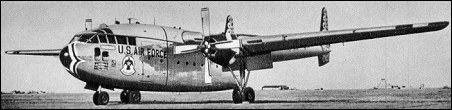
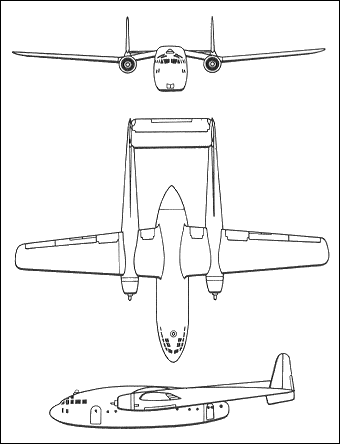
| During 1947 Fairchiid developed an improved version of the C-82, the XC-82B prototype being a conversion from a production C-82A. It differed primarily by having the flight deck resited into the nose of the aircraft and the installation of 1976kW Pratt & Whitney R-4360-4 Wasp Major 28-cylinder radial engines. Following service tests it was ordered into production as the C-119B Flying Boxcar (55 built), these having the fuselage widened by 0.36m, structural strengthening for operation at higher gross weights, and more powerful R-4360-20 engines. Accommodating up to 62 paratroops, and with increased cargo capacity, the C-119s gave excellent service during operations in Korea and Vietnam, as well as in a wide variety of other heavy transport applications. C-119s also serve or served with the air forces of Belgium, Brazil, Ethiopia, India, Italy, Nationalist China and South Vietnam, many supplied under the Military Assistance Program. In addition, some surplus military aircraft, both C-82s and C-119s, were acquired by civil operators.
In 1961 Steward-Davis Inc. of Long Beach, California, developed a Jet-Pak conversion for C-119 aircraft. This involved the installation of a 1542kg thrust Westinghouse J34-WE-36 turbojet engine in a specially-developed nacelle mounted on the upper surface of the wing centre-section. At least 26 Indian Air Force C-119s had a more powerful HAL-built Orpheus jet pod to enable them to operate with greater payloads under 'hot and high' conditions.
| MODEL | C-119G |
| CREW | 5 |
| ENGINE | 2 x Wright R-3350-85, 2610kW |
| WEIGHTS |
| Take-off weight | 33747 kg | 74400 lb |
| Empty weight | 18136 kg | 39983 lb |
| DIMENSIONS |
| Wingspan | 33.3 m | 109 ft 3 in |
| Length | 26.37 m | 87 ft 6 in |
| Height | 8.0 m | 26 ft 3 in |
| Wing area | 134.43 m2 | 1446.99 sq ft |
| PERFORMANCE |
| Max. speed | 470 km/h | 292 mph |
| Cruise speed | 322 km/h | 200 mph |
| Ceiling | 7300 m | 23950 ft |
| Range w/max.fuel | 3669 km | 2280 miles |
| Jim Barita, e-mail, 10.02.2014 20:26 After 5 yrs Reg AF on Fighters(no rides) Joined ART program at 910TCG YNG OH. Loved the flights in 119s Sat in R /O NAV seat. View was fantastic. A /C were 51 models Like new. MacNamara shut us down in 1966.Sent planes to bone yard? We also had 2 C-47s 39 and 41 models. also like new. reply | | Larry Wright, e-mail, 25.01.2014 22:55 As a reservist in the 452 TCW I flew the C-119 FOR 2359 hours from 1954 to 1965. We had the "G" model with the 3350's. Our outfit was based at Long Beach Airport in Long Beach California. In 1960 we moved to March AFB, CA. I was the chief of maintenance and flew most of the test hops needed. O one of the reserve missions a reserve crew put a C-119 in an alphalfa field due to a propeller problem. I took some maintenance personnel to the location and they changed the prop regulator, run it up and it was ready to go. I had the farmer cut us a swath to take off in. The field was 2600 feet long. I taxxied the airplane to the end of the field, turned it around, backed it up so the tail was over the fence. The Highway Patrol stopped the traffic on the highway for our takeoff. We never had any markers to mark our liftoff spot so our wing commander stood to the side of the cutoff path. As we lifted off I gave a quick salute to our CO. He never forgot it. We climbed to about 600 feet, did a 180 and buzzed the field on our return to March. Being the Chief Test Pilot I had several interesting problems on my test hops.
On one test hop we had a runaway propeller. I was on downwind just about to turn base when the right one took off to 3100 RPM. I was full cross control on the rudder and aileron but I still had to turn left for base. The tower called and asked if we were having a problem and then cleared all the traffic out of the area. The copilot could not feather the right prop or slow it down even though I had the throttle full back. I took the prop control and slammed it full back and full forward several times and it helped to turn the aircraft for base. Using this procedure I was able to turn final. We got the gear down shortly before we crossed the end of the runway. Afterward, the SAC base commander gave me a $25.00 war bond and a nice letter plus a nice letter from my wing commander. They also made me Safety Man of the Month.
All in all the ol' C-119 was a fun airplane to fly and maintain. I had about 200 top maintenance personnel that kept the 3 squadrons with 55 C-119's that we had running good. reply | | Bill Beavers, e-mail, 19.01.2014 01:45 Remember the C 119's were at Donaldson, AFB, SC in the 1950's----I was in Vietnam in 1965 to 1966, didn't see any over there--My unit flew C 123's reply | | mike digirolamo, e-mail, 03.01.2014 22:38 I was a radio operator from 1957 to 1961. I would set in rear of plane sometimes on takeoff with paratroopers and the noise of the engines was almost unbearable. Does anyone know the sound level in decibels of the engines on takeoff? reply | |
| | AJAY RAM, e-mail, 12.12.2013 08:54 We flew these C119G to the highest airfields in the Himalayas. An achievement which the manufacturers or the erlier crews could not have imagined. reply | | S/SGT RAYMOND J YUHAS, e-mail, 26.10.2013 02:06 I just want to add my outfit # at Asiya Japan, it was the 63rd Troop Carrier Squadron reply | | RAYMOND J YUHAS, e-mail, 26.10.2013 01:52 I was a radar and radio ground mechanic at Ashiya ,Japan
from May 1954 thru Feb 1965. One of our aircraft was # 555,we were named the BLUE TAIL FLIES. We once shuttled DEBBIE RENOLDS from Guam to Ashiya when her ride was not
avaiable. E Mail and tell me if you were at Ashiya at that time please. S /SgtRaymond Yuhas thanks you reply | | R. Sanderford, e-mail, 21.10.2013 11:45 The Wright 3350's listed in the specs are the engines that Kaiser installed in the 71 C-119's built at his auto factory in Willow Run (the old Ford B-24 plant).
All the Fairchild built C-119's used P&W 4360's. reply | | Leroy McVay, e-mail, 16.10.2013 19:16 1953, North Island Naval Air Station, San Diego. Was on operations line crew. Watched a C-119 taxing toward us. Suddenly they did a ground loop. We jumped on tug to see what happened. Crew chief said they'd blown a brake assembly. We chocked the plane and I drove the tug up to overhaul and repair to see if they could fix it or what. They could handle and gave me a tow bar. As we were getting ready to tow the a /c for repair the pilot came over and in a very stern voice told me. "You can't tow this plane! It doesn't have brakes!" I asked him if he wanted to push it and then told him to grab a chock and walk by a wheel. End of problem. reply | | C.T. Ligon, e-mail, 06.05.2013 04:37 This is in response to the C119 crash that happened on Oct 24th, 1957 outside of Tinker AFB, in Midwest City, Oklahoma. (See the link below)
Jim Bina, jamesbina=verizon.net, 22.08.2012
I can confirm that this crash did happen. I was 3 and 1 /2 years old, we lived just north of Reno and Midwest Blvd, on the east side of Midwest Blvd. Our back yard backed up to Soldier Creek and Tom Poor Park. This was about 2 miles north of Tinker AFB. On that evening, my older brother and I were in the living room which attached to the kitchen. My Grandmother was looking out the kitchen screen door towards the creek and Tom Poor park. I heard my Grandmother cry out, "Oh, no" . The impact of the plane was only about 500' from my home and I was knocked off of the couch onto the floor, and the lamp next to me was knocked over. All I can remember was hearing the non-ending wail of sirens. My mom and Grandmother told us that this airplane had crashed near our back yard, into a tree which burned for a long time. All 4 members on board died. Due to the heroics of the pilot and crew, many lives were spared as they put the plane down in the middle of Soldier Creek, with houses on both sides of the creek. The craft took off north from TAFB, lost lift, turned the craft to try and return and nosed into the ground. My Dad is now a retired Aeronautical Engineer who had been working at Tinker AFB at the time. He told me just recently that it was the elevator hinge pin that caused the crash. He also said unfortunately, it was because it was installed upside down by an unsuspecting mechanic. I have often thought about that heroic pilot and crew. reply | | John F. Hondo Hahn USAF 1965-6, e-mail, 31.12.2012 20:46 In 1967, a group of us from 325th Fighter Wing at McChord Air Force Base in Tacoma, Washington, flew on a 129th C-119 to Hayward Field in Hayward, Calif. We were base winners in a talent contest that would take us to the regional contest at Hayward and then the winners on to the Air Force competition. Those that were selected from the AF finals would tour with the Air Force USO entertainment grup featuring Jack Jones. Unfortunately, Rick Warner, from Detroit, and I were not the winners in Hayward of the folk /rock category. I'm just wondering if anyone remembers this from either McChord (our traveling group etc.) or Hayward that may have taken pictures. Please feel free to e-mail me. We were called "Ricky and Johnnie"...Thanks so much and go Falcons, wherever you may be today. reply | | A/2C Sibert, e-mail, 31.12.2012 18:37 Was at Dreux Air Base Jan'60 to April'61 and was on base basketball team and flew on C-119s to all our away games
worked transit alert all my days at Dreux was with 7305 CAMS reply | | Steve (Ron) Mihaly, e-mail, 02.12.2012 15:37 As a Pparatrooper & Jump Master with the 82nd Airborne Div,1954-57 I experienced 75+ jumps from the C-119. What I remember most was the horrendous noise of the engines just prior to takeoff, and hoping the plane had enough HP to get off the ground! On one occasion, National Guard pilots were getting some flight time in, and actually scrapped the tops of the trees on take off. reply | | James H. Smith, e-mail, 06.10.2012 03:39 I married my lady Betty on the C-119G, on May 7,1954.Chaplain
Sigliono of Nashville, TN performed the ceremony. He set up
a make-shift altar in the forward fuselage and installed the loading ramps with heavy rope up the sides to complete the aisle. Great wedding and great marriage. We're still going strong. Later I crewed and flew as engineer on C-119Gs at Neubiburg AB, Germany.The last three numbers of S /N of the plane i crewed was
136. I read someplace that it was converted to a gun ship in Nam. I,ve never recorded this info and think it should be included somewhere as part the "Boxcars" history. reply | |
| | Hugo Ruiz, e-mail, 21.09.2012 17:49 For Todd Milburn. Complete response to his request follows.
hugo ruiz hugo.ruiz510@gmail.com
Sep 9 (12 days ago)
to toddmilburn
I served with your father in VMR 252, USMC, part of MAG 35 (Marine Air Group) , based at Cherry Point, NC. The incident of which you speak was legend for years among us. Your father and a radio operator named George Hogarty, from Boston , were crew on a flight to Texas. At the time it was a reserve /civilian base with relatively little security. Your dad and George (incidentally I was a radio operator and new George well) went out on the town and as I understood the events got somewhat intoxicated and decided to fly to Shreveport to continue the party. They went to Love field, impersonated the pilots, filed a flight plan and proceded to take off, at night. It is my understanding that upon take off they barely missed a radio tower. It is my further understanding the polished off a bottle of booze while in flight. Barksdale, I believe was a
SAC base with super security, but they called in for landing and were given permission. Lore has it that they got lost in flight and the flight time was longer than it should have been. I also believe they aborted the first attempt to land but landed safely on the second attempt. While on board they asked for transportation to BOQ which was waiting when they were on the tarmac. They proceded to BOQ but while on the way they saw a bus going off base and asked the driver of the car to stop so they could board the bus. For whatever reason the driver became suspicious and reported the incident. They were stopped at the gate and detained. I understand that while being interviewed no one believed that they were crew chief and radio operator.
I was at Cherry Point in the morning when news came in that one of our planes was at Barksdale. Simultaneously, the pilot and copilot came to Love and found they had no plane and that a flight plan had been filed. At that point the pilot reports the incident to VMR 252, the facts are reconciled and Sgt. Milburn and Sgt. Hogarty were arrested. They were brought back to Cherry Point by another of our aircraft in shackles. They were court martialed and sentenced to time in the brig. A buddy of mine was the R /O on the flight to pick them up, and he said he was not allowed to speak to your dad or George by the accompanying Military Police. I do not remember what the sentence was, but I do remember seeing them marching with other prisoners to the mess hall for meals. The brig was about 500 yards from our barracks which was # 203. I know that George Hogarty had his sentence reduced and he was given a Bad Conduct Discharge or a General Discharge and presume your dad got the same.
I hope this clears some of the mystery from your recollection. Both George and your dad were my friends. I flew a number of times with your dad, as there were no fixed crews for each plane. Feel free to ask me anything more. How is or was your dad. What happened to him after he left the Corps?
Sgt. Hugo A. Ruiz reply | | Hugo Ruiz, e-mail, 10.09.2012 00:05 I will write to Todd Milburn whose comments appear above. I served with his father and am very familiar with the incident he describes. I served in VMR 252 at Cherry Point Marine Air Station in North Carolina from 1952 t0 1953 during the Korean war. The squadron was VMR 252, part of MAG 35. Our sister squadron at Cherry Point was VMR 153. reply | | Jim Bina, e-mail, 22.08.2012 19:06 My dad piloted C-119's out of Chanute AFB in the late 50's. He related to me that he and about 5 other crews traveled to Tinker Air Force Base, OK in 1957 to pick up some modified C-119's. The story goes that the mod was for new stainless steel elevator hinge pins. My dad and the crews were scheduled for departure on Oct 24, 1957. They all boarded their assigned aircraft, made their checks and proceeded to the runway. They lined up for departure, my dad was second in line. He said he watched as the first C-119 proceed down the runway, lifted off, cleared the end of the runway, and abruptly nosed down and crashed. The remaining C-119s returned to the ramp and the flight back to Chanute was cancelled. The cause of the crash was determined to be the failure of the new elevator hinge pin that had just replaced. I am trying to verify this story and have verified by the Oklahoma Crash Database that there was a C-119 that crashed at Tinker on 24 Oct 1957, the same time we were stationed at Chanute. Can anyone assist with additional details on this C-119 accident? Thanks! reply | | Norman E. Rhoads, e-mail, 07.08.2012 16:56 After six months of A&E school at Wichita Falls, TX. in 1953 I was assigned to Sewart AFB south of Nashville, TN. I was assigned to that base until my discharge in 1957 we had C-119 Flying Boxcar type aircraft there. Probably around 1955 everybody had an opportunity to volunteer for a six month TDY assignment in Dreux, France. There were three groups at Sewart; there were enough volunteers to make up one group. All flying was done out of the municipal airport at Athens, Greece; therefore, all crews and planes stayed there. No military facilities there. Per Diem was paid and we stayed in hotels and ate out every meal. As maintenance was scheduled the airplane was flown to Dreux. All personnel at Dreux was sent to Athens for a month. I don't know what we were doing over there in Athens. I did enjoy that six-month-tour however. The C-119 was quite an airplane. reply | | Jim Blackburn, e-mail, 05.08.2012 04:28 Went thru Randolph AFB transition training in the C-119G in early 1953, then flew the Arctic re-supplying the DEW Line. Was based at Harmon AFB with the 6614th ATS. Had some close calls after losing engines, but survived. If we had a heavy load (D-8 Catapiller bulldozer, etc.) and lost an engine, we could not stay in the air. We were told it would not ditch and our best bet was to put it down at the edge of a lake or shore with the gear DOWN. The fusilage would not hold up in a belly landing. reply |
| David Morrow, e-mail, 31.07.2012 18:40 Having an engine reverse was not uncommon in this aircraft. In the mid-1950's, my father, Eugene T. Morrow, had an engine reverse at 600' on takeoff from Randolph. All previous incidents on takeoff (I believe there were 5) were fatal. After taking out power lines, he had been able to set the plane down in a farmer's recently plowed field. Landng perpendicular to the furrows, they bounced badly stopping with the nose less than 100' from the farmhouse. No injuries. The aircraft was covered in dirt, but otherwise appeared undamaged. The student with Dad froze and never flew again. reply |
|
Do you have any comments?
|
| 
COMPANY
PROFILE
All the World's Rotorcraft
|




Hi Jim, I was one of the pilots in the 6614th ATS with Major Jernigan in command. I'm now 92 years old. If you are still around too, you might want to look at some pictures from 1953-54 at EHARMON AFB, Stephenville, NFLD. Fritz
reply