|
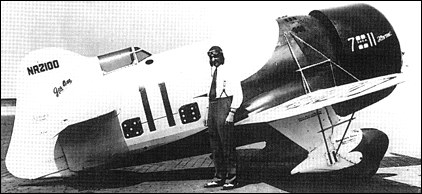
| The five Granville Brothers of Springfield, Massachusetts became famous
with their high-powered Gee Bee racing planes of the 1920s and 30s.
The planes themselves became notorious for crashing, and some developed a
reputation as 'unflyable'. The Model Z won several races, but during a record
attempt a wing folded up on one Model Z and it crashed fatally. The barrel-like
R-1 and R-2 were essentially the largest available engine with the smallest
possible airframes behind them. Someone said a Gee Bee was 'a section of
sewer pipe which had sprouted stubby wings'. In general the Gee Bees were
shorter than their wingspans, made very fast landings and were extremely
tricky for all but the most experienced pilots to fly. The Model Rs suffered
several crashes. The R-2 killed its pilot and was rebuilt and crashed again not
once but twice. Combined with parts of the R-1, the hybrid aircraft crashed
fatally on its first test flight. FACTS AND FIGURES © The R-1 and R-2 were designed
for minimal frontal area at the
expense of almost everything else,
including the pilot's visibilty. The
high speed and no view made
landings particularly exciting. © The R-1 was a circuit racer and the
R-2 had more fuel for cross-country
racing. The hybrid aircraft had an
additional tank, which moved the
centre of gravity too far aft. © Wing flutter is thought to be
behind at least one Gee Bee crash.
At facing speeds the structure
could resonate and quickly fail.
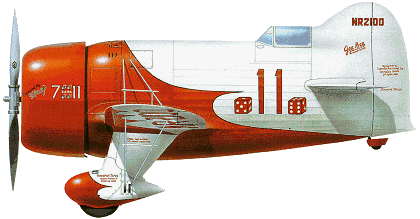
| MODEL | R-1 |
| ENGINE | 1 x 730hp Pratt & Whitney Wasp T3D1 radial piston engine |
| WEIGHTS |
| Take-off weight | 1395 kg | 3075 lb |
| DIMENSIONS |
| Wingspan | 7.62 m | 25 ft 0 in |
| Length | 5.33 m | 18 ft 6 in |
| PERFORMANCE |
| Max. speed | 476 km/h | 296 mph |
| Bernard Biales, e-mail, 15.05.2023 21:50 The point of interest of the Rs was not mininal cross section. Rather it resulted from NACA studies on trading off pressure (separation) and friction (surface) drag. This led to an an optimum length to drag ratio, which was under 5:1. It normally would be applied to wing of pylon mounted engine nacelles. But Hall applied it to the fuselage, giving very short moment arms for the tail surfaces. I think he used a zero pitching moment Munk airfoil, which would reduce demands on the horizontal survace. reply | | Anonymous, 15.09.2022 22:46 The "Gee Bees" were the ultimate 1930s air racers in that they were the fastest airplanes in the world designed and built not by NASA aeronautical engineers from at Edwards Air Force Base, but by local guys in a garage. The design philosophy was simple: just bolt the biggest engine you can get onto the smallest possible airfare. Nothing to it! In the 1930s there was no problem finding pilots crazy enough to fly them. However, the legendary Jimmy Doolittle was among the few pilots able to fly them successfully, winning the 1932 Thompson Trophy Race in the R2, but even he did not like them much. I believe that every single Gee Bee ever built ended up crashing. reply | | Mike Schardt, e-mail, 09.04.2015 00:20 The Granville Brother Airplanes Were all Beautiful Airplane.My Wife & I went To Springfield.Ma. to Look At The Replica's. Greet Looking From the Golden Age. Old Pilot. reply | | Bruce Pike, e-mail, 11.12.2013 22:05 As I write this, my Dad is 102 years old, and lived in Springfield Mass. He was there when they paraded the Gee-Bee down main street after Doolittle won the trophy. He is probably the only person left to have seen the actual plane. We had a model club in the 40's that met at the old airport. I grew up with thethen owner's son, bill Sawn. reply | |
| | Robert E. Kubicek,JD, e-mail, 28.11.2011 19:17 The Model Z racer was flown by Lowell Bayles who won the thompson Throphy in it at a speed of about 220mph. Shortly after he made A low level land speed record attempt requiring 2 passes in opposite directions on a closed speed dash diving down thru the closed course. on 1st run his speed was clocked about 260mph, but the timing mechanism did not operate properly to qualify as a new land speed record. Made a 2nd run that was correctly timed, turned around to make 3rd run when it is believed the gas cap in front of him flew off and smashed into the windshield. Bayles lost control, the plane barrel rolled into the ground. The ship was demolishwed and Bayles was killed. Zanford "Granney" Granville spent hours studying the film and concluded this is what happened. Bayles was a very experienced pilot. reply | | ROBERT E. KUBICEK, JD, e-mail, 27.06.2011 21:07 I GREW UP IN WEST SPRINGFIRLD, MA. ACROSS THE RIVER FROM SPFLD PLAZA ON LIBERTY STREET. WENT TO SCHOOL WITH GRANNY'S SON ROBERT. SPENT DAYS "HANGING" AROUND SPFLD AIRPORT.MET BOB HALL AND OTHERS. TOM NALLEN IS AN AUTHORITY ON GB'S. ALSO RECALL LOCAL EFFORT OF WALLY BURNETT AND OTHERS TO RAISE $$ TO PURCHASE A CALIFORNIA BUILT FLYABLE REP OF SUPER SPORTSTER "CITY OF SFLD". THAT A /C IS NOW IN THE COLLECTION OF VINTAGE A /C OWNER AND DISPLAYED IN HIS MUSEUM OFF RT 4 NEAR LAKELAND, FL. OWNER TOLD ME HE FLEW IT ONLY ONCE AND THAT WAS ENOUGH !
IN 1990'S I CARRIED ON A campaign FROM N C TO GET EITHER THE MUSEUM OR CITY TO FINANCE PURCHASE AND EXHIBIT AN R2 REPLICA (MADE PRILIMINARY ARRANGEMENTS FOR A STATIC REPLICA TO BE BUILT FOR $250K)TO CELEBRATE THE ACHIEVEMENTS OF GRANVILLES THAT ADVANCED AVIATION IN THE WORLD AND PUT SPFLD ON THE MAP. WAs told BUDGET RESTRAINTS PREVENTED IT.
HOWEVER HAVE LEARNED A REPLICA IS NOW HANGING FROM CEILING OF TOURIST CENTER OFF I-91 AND THAT VOLUNTEER ENTHUSIASTS BUILT A FULL SCALE REP ON DISPLAY AT CONN AVIATION MUSEUM AT BRADLEY. WORTH TIME OF ANYONE INTERESTED TO see them reply | | katie, e-mail, 08.06.2011 16:25 I AM AMAZING!! AND SO IS CHARLOTTE LILY SARAH AND HOLLY!!!! reply | | Tom Nallen, e-mail, 28.03.2011 00:31 The Gee Bee R-1 you show is the 1933 variant, not the 1930 model as stated. The Gee Bee Z that crashed on a speed record attempt was the one and only Gee Bee Z , not "one Model Z". The Gee Bee R-2 did not crash and kill its pilot. The R-1 /R-2 hybrid, dubbed the "Intestinal Fortitude" did not crash fatally on its first flight. Your Gee Bee drivel is more fiction than fact and you should be ashamed of posting such inaccurate misinformation under the guise of historical fact. Your site does a terrible injustice to the Granville Brothers and you should hang your head in shame and get your crap off line! reply | | wigida, e-mail, 25.03.2011 06:34 Did prop torque overcome stability and wildly gyrate the airframe so as to induce high rate airframe spin - that is did the engine spin (roll) the aircraft because of propeller resistance? reply | | marty, e-mail, 23.12.2010 18:30 The Na.me Gee Bee was because of 2 reasons,one the granville Brothers initials, and the plane resembled a bumble bee of sorts. The reason the planes were un stable had more to do with the pilots experience in flying than Plane instability.
Although the R1 and R2 are similar they were 2 very different beast.In hindsight Jimmie Doolittle knew it was a very unstable aircraft especially if you turned it too hard it would snap roll.When he won his last race he kept the plane in a slight bank rather than sharp turns around the pylons. He still lapped the competitors 10 times except for Wedell Williams.The color was due to the only paint on hand the painter had,He painted Coca Cola signs for a living.Hope this helps. reply | | Mike, 20.12.2010 21:54 The frequency of crashes which plagued the original Gee Bee models was probably due to a tail-heavy condition. The exact replica of an R-1 which toured airshows for a number of years not long ago was a very stable aircraft which routinely performed basic aerobatics. reply | | Pops Meade, e-mail, 10.03.2010 18:26 Virtually everything written above is incorrect. What a pity.... reply | | Bernie, e-mail, 12.02.2010 06:29 My Dad told me stories of these planes. They pylon raced at an airport which is now the Springfield Plaza in Springfield, Ma. reply | | Ron, e-mail, 09.01.2010 06:30 The Gee in GB stood for Granville as in Granville Brothers. reply | |
| | Giorgio BARBERIS, e-mail, 15.09.2009 21:26 I'm a fan of "Gee Bee" (same initials as my name and surname). Does anybody have an idea how to say in other words the term "GEE" the Granville Brothers used for naming their race-planes?
Thanks and kind regards. Giorgio reply |
|
Do you have any comments?
|
| 
All the World's Rotorcraft |