 |
Grumman UF/HU-16 Albatros1947 |  |
| AMPHIBIAN | Virtual Aircraft Museum / USA / Grumman |
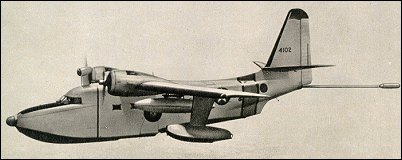 |
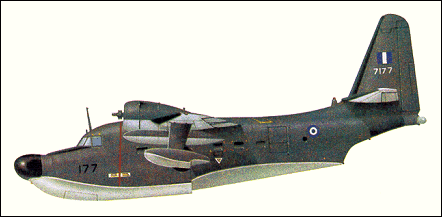
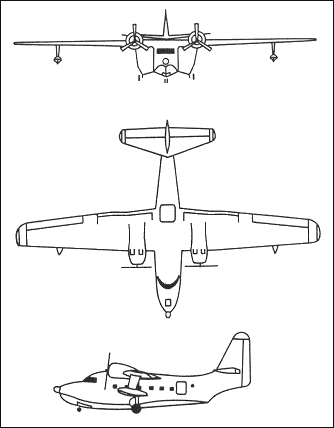
Experience with the Grumman Goose, which served throughout World War II with great reliability, prompted the US Navy to procure a somewhat larger amphibian with greater range capability. In 1944 the company initiated design of its Grumman G-64 aircraft, which was to be named Albatross, and which saw service with the US Air Force, US Coast Guard and US Navy. The prototype was flown first on 24 October 1947, and was of generally similar configuration to its predecessor. Fixed underwing floats were retained, but these and the entire structure had been considerably refined to reduce drag. Other changes included the provision of a cantilever, instead of strut-braced, tailplane; tricycle type retractable landing gear; and pylons beneath the wing, outboard of the engines, which could carry weapons, or drop-tanks to increase range. Additional fuel could also be carried in the underwing floats. Accommodation was provided for a crew of four and the cabin could accommodate 10 passengers, stretchers, or cargo, according to requirements. The prototype ordered by the US Navy for service as a utility aircraft had the designation XJR2F-1, and flew for the first time on 24 October 1947. Initial production was of the UF-1 model, and a modified version introduced in 1955 was the UF-2. This latter aircraft had increased span, a cambered wing leading edge, ailerons and tail surfaces of increased area, and more effective de-icing boots for all aerofoil leading edges. In the tri-service rationalisation of designations in 1962, these aircraft became HU-16C and HU-16D respectively. Winterised aircraft for Antarctic service were designated UF-1L (later LU-16C), and five UF-1T dual-control trainers were rede-signated TU-16C. The USAF found the G-64 attractive for rescue operations, the majority of the 305 ordered serving with the MATS Air Rescue Service under the designation SA-16A. An improved version, equivalent to the US Navy's UF-2, entered service in 1957 as the SA-16B; in 1962 these became HU-16A and HU-16B respectively. HU-16E was the designation (originally UF-1G) of Albatross aircraft operated by the US Coast Guard, and 10 supplied to Canada were designated CSR-110. An anti-submarine version with nose radome, retractable MAD gear, ECM radome and searchlight was introduced in 1961, and was equipped to carry a small number of depth charges. The versatile Albatross continues in service with a few air forces and navies, but its powerful and fuel-hungry engines have meant that surplus aircraft which became available for use were not a particularly attractive proposition to airline operators, and in consequence few were adapted for such a role.
Thomas Hsueh, e-mail, 07.02.2021  John Barron John BarronDear John, Robert Prange, e-mail, 02.01.2021 dick wilburMy Dad flew the Grumman Albatross out of Roosevelt Roads from '62 to '64 when I was in grade school. He participated in the project flying scientists and crates of baby sea turtles around Costa Rica to re-populate the turtles. If you are still working on this, I can find an article in the Roosy Roads newsletter from back then. My Dad was in a utility squadron there; he also flew the Twin Beech (SNB or C-45). Other squadrons at Roosy Roads then had P2 Neptunes and Connies. Somewhere we have 8mm film showing the crew members riding around on the adult sea turtles on the beach. Robert Prange, e-mail, 02.01.2021 dick wilburMy Dad flew the Grumman Albatross out of Roosevelt Roads from '62 to '64 when I was in grade school. He participated in the project flying scientists and crates of baby sea turtles around Costa Rica to re-populate the turtles. If you are still working on this, I can find an article in the Roosy Roads newsletter from back then. My Dad was in a utility squadron there; he also flew the Twin Beech (SNB or C-45). Other squadrons at Roosy Roads then had P2 Neptunes and Connies. Somewhere we have 8mm film showing the crew members riding around on the adult sea turtles on the beach. Sandy Monroe, e-mail, 24.03.2023 Robert PrangeYou helped me do a blog on the aircraft. It has been published and can be found on Hampton Roads Naval Museum Blogspot. Thank you very much Alexander Monroe, e-mail, 13.01.2023 Robert PrangeIf you can get me a copy of The Roosevelt Roads article, I’d be obliged. Sandy Monroe 228 Bay Colony Drive, Virginia Beach, Va, 22451 Ken Hopke, e-mail, 09.10.2022 Richard OkerblomPlease contact me at 760-861-3470 William G Schultz, e-mail, 04.10.2022 Ken HopkeKen ,was your Dad's name Charlie (and mother named Fran) and he passed away about 1976 while working at El Toro with the Marines. Ken Hopke, e-mail, 09.10.2022 William G SchultzSurprise I spotted your email. Please contact me again. All you said is accurate.
elizabella, e-mail, 25.06.2024 Johncan get the whole information about this please, this crash on june 25 1973 in kosrae was my great great grandfather who died in the crash is there any video or anything on sadly in kosrae we heard story but if there any more information u can help me more it i would be soo appreciate it Alexander Monroe, e-mail, 26.03.2023 Harry MarshallI have done a piece on this a /c which may be found on the Hampton Roads Naval Museum Blogspot. I appreciate reading of your experiences in her. Thank you. Sandy Monroe, Captain USN (Ret.) Vince Guarino, e-mail, 15.09.2022 Harry MarshallI may have flown on that same plane 1958-1960 at USNS Trinidad. Pilot was base Commander Capt. David Sooy or an Enlisted Pilot. Flew as an observer. Went to Barbados and twice to San Juan. If it is the same place it was taken out of the boneyard in Arizona by a former Navy Flight Surgeon and completely restored. He keeps in in a collection at Driggs Idaho. After restoration he flew it to Australia. Have a model of it on my desk as this is written. Very much enjoyed flying low and slow over some beautiful places.
|  COMPANY PROFILE | |||||||||||||||||||||||||||||||||||||||||||||||||||||||||||||

|


|
Dear John,
If you still have some G111, I would like to buy them. Please reply to my email or give me a call at 360 941 3565. Thanks. sssssssssssssssss
Tom
reply