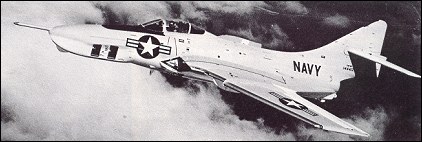
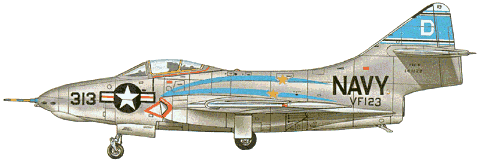
The Cougar was a swept-wing development of the earlier G-79 Panther. The fuselage was similar but the wings and tailplane were swept at 35°. First flown in prototype form on 20 September 1951, the initial production version was the F9F-6 armed with four 20 mm cannon and powered by a 32.25kN Pratt & Whitney J48-P-8 turbojet engine. The F9F-6P was an unarmed photographic-reconnaissance version with a longer nose to accommodate K-17 and tri-metrogon cameras. Next came the F9F-7, similar to the previous version except that it was powered by a 28.25kN Allison J33-A-16A engine.
The first production F9F-8 flew on 18 January 1954. Powered by J48-P-8 engine, it was a development of the F9F-6 with increased speed and range. Movable leading-edge slats were replaced by fixed cambered leading-edge extensions outboard of the wing fences. Total internal fuel capacity was increased by 530 litres. A photographic-reconnaissance version (the F9F-8P) flew for the first time on 21 August 1955 and had an extended nose for the cameras. The F9F-8 went out of production in 1957.
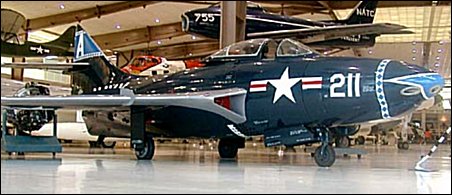
The final version of the Cougar was the F9F-8T two-seat fighter-trainer, first flown on 4 April 1956. Production of this version ended on the last day of 1959 after 399 had been built. Total production of the Cougar was 1,985 aircraft. Many F9F-8Ts were flown operationally in Vietnam.
Grumman F9F Cougar on YOUTUBE
3-View
A three-view drawing of F9F-8 Cougar (1278 x 926)
Specification
MODEL
TF-9J
ENGINE
1 x Pratt & Whitney J48-P-8A turbo-jet, 32.0kN
WEIGHTS
Take-off weight
9344 kg
20600 lb
DIMENSIONS
Wingspan
10.52 m
35 ft 6 in
Length
13.54 m
44 ft 5 in
Height
3.73 m
12 ft 3 in
PERFORMANCE
Ceiling
15240 m
50000 ft
Range
966 km
600 miles
ARMAMENT
2 x 20mm cannon, 907kg of weapons on external hardpoints
After ADJ school in Millington, TN in mid-1967 I was assigned to VT-23 late in the same year and stayed there till early 1970 as a plane captain /jet mechanic. As you, worked on the J48 along with the test cell at night. Loved being there and still to this day keep in touch with a few mates. Wish I could remember more.
I was a AM E-4 with VF111 and we got a F9F8T early 1957. I did acceptance check and also Installed In Flight Fueling Probe, As far a si know i was only or first enlisted to fly second seat in training for NAVCAD My skipper had a special interest in me for some reason and wanted me try for fighters, I was sent to all the requirement for jet flying certification seat ejection high altitude pressure chamber, and i had 60 hours in simulator, And on Sundays he sent his best pilot to take me up and give me the stick to do maneuver's, I loved it but failed eye exam so ended that idea and i staye enlisted and retired years later E-6 . I did fly lots of air crew and right seat with out wings as pilot like me since i had the training ,Later in VF111 we transitioned to FJ3 and the T bird went to NAS Miramar as NAS Alameda transferred all air groups out and to Miramar, I left the squadron in July 1957 just before its West Pac cruise, My F9F8 T , Nose number 199, Bu Number 42471. its on the list of Models, I still can remember how to crank it up and do the maneuvers,,
1955, assigned to VF 782. Commander Miller in charge. Striker for jet mechanic, air traffic control , chose Aviation electronics Technician. Eventually made AT-2. Assignments included NAS Fallon, NV, NAS New Orleans but mostly NAS Barbers Point, Honolulu, Hawaii.
Served with VMT-1 MCAS Cherry Point, N.C. 1962-1964 i have written to the Windsock (base newspaper) trying to get pictures of the F9F Cougar T with the designation BE on the tail. could you help with the matter ? I would appreciate it.
I had a number of flights in this bird in the winter of 1969 out of Beeville. Lots of fun. Got to dogfight in it, and it made me want to barf. Also, got to do a loop and immelman which made me want to vomit. After first dog fight we were looking for another plane to dogfight but couldn't find him, and I was sorta relieved, heh heh. I was an RIO candidate for F4-Js, but sadly, I washed out on my 12 check when I went starboard instead of port on my last intercept. Phooey. No farm in Vietnam, and no stay at the Hanoi Hilton. Shucks!
Went to VT 22 in 69 from ADJ A school, work line and P /C until I made AD3 just as Zommie took over. Was qualified form low /high power. We transitioned to the TA4J and I became low /high power turn qualified, also worked P /P and phase shop. Left in July 71.
My first squadron out of school at NAS Memphis was VMT-2 at El Toro, I was a seat mech and cross trained as a rigger by the Master Gunny who was NCOIC of Seat Shop and Flight Equipment. We had too many folks so I volunteered to work on the flight line. Made Plane Captain and then was allowed on many occasions to fly back set on Seat hops to play target for the F4's working up training to go on West Pac to Nam'. Great officers and many VERY senior enlisted personnel. Great Squadron under Rex Deasy and Jimmie Green.
Flew the F-9 in advanced training in Beeville, VT25, early 1971. Great, rugged (under powered) airplane. Tough to bring aboard, but other then that the thing could out turn almost anything and was very stable. Fun to fly.
Was assigned to VT-26 from May 1970 - July 1972, AMH-3. Plane Captain on the TF-9J. The Cougar was so rugged that they took the wings off and used it for a tank.
I got my wings out of Navcad school in November 1982 and was assigned to VF191 (Commander Bob Elder) at Moffett, which was the second squadron on the west coast to receive the Cougar. Later, while CarQualing at Barber's Point on the way to Korea, I transferred to VF143 (Commander Paul Paul) at Miramar, which had lost several pilots to accidents and several consequent resignations by scared former prop reservists, who were never became comfortable in jets. VF143 toured on the Essex, and my most memorable moment occurred after an auto acceleration at 40k forced me to shut down the engine over the South China Sea 200 miles from the ship, on top of a high overcast. SOP for an air start was to fire one of three shotgun shells at 25k....no joy on # 1. No luck on #2 at 15k either. Thank God I got a start on my final try at 10k, so I didn't have to eject and hope to survive in a poopy suit in frigid water in the middle of nowhere. Afraid to shift from the emergency manual throttle control back to auto, I realized that the manual control gave me extremely rough RPM control for the carrier approach, and I so informed the ship. But the ship neglected to tell the LSO, so he waved me off several times with some nasty comments about my unusually rough approaches (in a heavy sea). Finally I was so low on fuel I told him to bring me aboard no matter what, which he did.... I had to dive for the deck and caught a wire but crunched my left landing strut. When the authorities sorted out my predicament, I received zero pilot error and pats on the back from Cdr. Paul and the ship's captain. In VF143 I was proud to be the wingman of Lt. Valentine Schaeffer ("Prince Valient"), an admiral's son, Annapolis grad and a great pilot and friend for life. He hung in there with me all through my flameout adventure. I later instructed jet instrument flying in TV2's at FAWTUPAC at Moffett and then flew Reserve Cougars and Furys at Floyd Bennett through 1962. The FJ4 Fury (Air Force Sabre F86) was the Porsche of the skies in those days....one of the finest fighters of all time.
I was on USS Princeton in Korean war, and VF191 had been assigned the original Blue Angels .I have the Korean War Patch of Satan Kittens,, LCDR J Magda was only Blues that was killed in Combat,
Worked in the engine shop of Marine Training Squadron One ( VMT-1) from 1962-1965. The squadron trained pilots of reciprocals or helos on how to fly jets, and the Corps wasn't about to let them fly anything expensive, so hence the TF9J.They were very reliable, and we had very few problems with them. Stationed at Cherry Point N.C. the largest Marine Air Station.If any others on here are from that base, e-mail me.
I have come across a picture of a Cougar hanging over the side of an Aircraft Carrier, being held only by the tail hook with both pilots in the cockpit with canopy open. If interested, let me know how to attach the picture or visit Facebook, Terry McGinnis, Tonkin Gulf Yacht Club, posted 9-25-14
The F9 Cougar was an important asset in our arsenal of freedom throughout the 1950s and 1960s. The F9 Cougar was also an important part of TV science fiction during that same period. In a 1960 Twilight Zone episode titled "King Nine Will Not Return" an F9 Cougar jet is briefly seen flying overhead near the end of the episode. The storyline featured a WWII B25 pilot suffering survivor's guilt transported to the crash site in a North African desert where his bomber went down in 1943. The episode largely deals with his unsuccessful efforts in trying to locate his missing crew. Upon finding a grave for one of the missing crewmen, he sees an F9 Cougar flying overhead. The pilot realizes that this particular aircraft does not exist in WWII. Filled with anguish and regret that he was not able to have been with the ill-fated mission due to suffering from a fever, he collapses in the sand. When he awakens we learn that the pilot is now in a hospital bed 17 years after the crash. He apparently hallucinated his return to the crash site upon seeing a newspaper headline noting the discovery of the long lost B25. Reading the headline caused him to faint on the city street, when he was then taken to a nearby hospital. The pilot comes to terms with the reason for his not being part of the ill-fated mission but also notes that it felt as if he had actually been traversing about the North African desert. His doctors concur that it was all in his mind, but one mystery remains: how did the pilot's clothes and shoes get filled up with sand when all of this supposedly occurred on a city street in a great metropolitan area [nowhere near a desert or beach area]?
Believe it or not, when I learned that the jet aircraft seen flying at the end of that TZ episode was an F9 Cougar, it inspired me to learn more about it. At the Flying Leatherneck Aircraft Museum at MCAS Miramar [San Diego, CA] there is an F9 Cougar on static display. Ironically there is also a B25 [PBJ version] also there, but at the moment it is under refurbishment and will be returned to public display at a later time.
Identifying real aircraft featured in TV or motion picture fiction is part of my love for aviation. The love for aviation inspired me to write this book:
HIGH FLIGHT Aviation as a Teaching Tool for Finance, Strategy and American Exceptionalism By George A. Haloulakos, MBA, CFA ISBN: 9780-1007-2738-0 Order your copy online at: ucsandiegobookstore.com Or by phone: 858-534-4557 "Partial proceeds support aviation heritage"
I was in VU-4 NAAS Chincoteague VA 1957 /59. We had F9F6s and 9s.as well as several other types of aircraft. Worked in the engine shop and spent may hours in the intake preparing for tail removal and pump adjustment. I will never forget my first turn up. Didn't light off in time and had to shut down and mop all the fuel out of the tailpipe.
When it did light off I just barely escaped going over max tp temp.
I was a rigger at Oceana VA in NAS Fleet All Weather Training from 1956 to 1958.Iwent for my OMYASS and flew about 9o hrs. in the back seat. It was one my best lifetime memories in the Navy along with my first jump.
I was with VF111 Sundowneres from 1955 thru to July 1957, We Transitioned from F9F /6 to F9F /8 Cougars about the time I arived in squadron. I was an AB /AN at first then skipper said I had to change to Aviation Metal smith, I also got involve with the Cougar fast as I got trained on my own in the NAMO trainer for Cougar Flight qualifications. I was recomened by skipper for Flight school after some education advances. We got one of the first Trainer Cogars early in 1957 and Lt Pete Petterson would pick me up at the barracks on Sundays and take me up for a spin,, I had completed Egr4ess, night vision and High Alt, Pressure chamber and was qualified. He would give me the stick and l;et me do several combat moves and stunts. I9t was a thrill as I may have beem the first or only Elisted to fly the T bird at that time. The Cougar is of course always my favorite Air craft as I served 30 years in the Navy and flew air crew and worked on many many aircraft. I didnt pass Physical so didnt make fighter pilot but did make air crew. My time in the Cougar and with the Sundowners has never left my memory and Is still my best years in The Navy. I was also a bad kid at that Time and even told the skipper CDR Medic that i should be thrown out of the Navy,, He chewd my butt and said if he ever saw a 30 year sailor I was it,, I didnt think he knew what he was talking about but guess what,,Ha,Ha,, He went on and made Admiral and I did my 30 years.
The only F9F-8 I ever flew was Zeke Cormiers #1 aircraft when I tried out for the Blues in 1956. It was the cadilac of any a /c I had flown. It would still look good at todays airshows.
I remember the original Blues when assigned to VF191 on my Ship the uss Princeton cv37 in Korea,, I was a flight deck AB,, I later became a AM and three of my pilots became blues .. one was killed in Training and one was a good friend and my Div. Officer, JG Danny McIntyre, 1961 Blues, He later flew Crusader in Viet Nam as LCDR,
pc on f9f8t mid 50s at miramar / vf124. got some back seat time. erceived omass quals.ac had nose gear problems /desinged fix and solved problem.great time of my life
I was at NAS Chase Aug.1970-Nov.1973 in VT-25. Started in Line Div. as plane captain, went to fuel crew, then went to Power Plant Shop. Worked on TF-9J and TA-4J, and a few old Chevys. Made a couple of trips out to the Lex for 'quals'. Nearly got blown off the flight deck while greasing a tailhook when the JBD came up to soon! Made lots of friends, still see a few from time to time, and it is still HOT-HUMID here in Beeville !!
VT-23 Kingsville TX, I was a plane captain for the Cougar and was later transferred TID to AMD as a aviation structural mechanic. Got out in 72 as an E-5. I went to Corpus Christie and did my ejection seat check and Oxygen tank training. I think I logged about 30 hours back seat time. I really cherish those memories. I loved that old bird. I probably logged as many hours in the back seat of the A-4 Skyhawk. There's an old VT-23 Cougar sitting out in the desert at one of the aviation museums in Tucson AZ. If I could post pictures here I share them with you.


 William Lagler




After ADJ school in Millington, TN in mid-1967 I was assigned to VT-23 late in the same year and stayed there till early 1970 as a plane captain /jet mechanic. As you, worked on the J48 along with the test cell at night. Loved being there and still to this day keep in touch with a few mates. Wish I could remember more.
reply