|
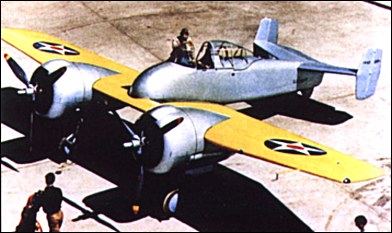
| Ordered as a prototype on 30 June 1938 by the US Navy
Bureau of Aeronautics, the XF5F-1 was of radical concept.
It was intended as a twin-engined shipboard
fighter, and this at a time when the first single-engined
shipboard fighter monoplanes were only just commencing
flight test. Conceived as the G-34 Skyrocket,
the XF5F-1 was flown on 1 April 1940, and, in its initial
form, had a singular appearance resulting from an
abbreviated forward fuselage, the wing leading edge
extending ahead of the fighter's nose. Powered by two
1200hp Wright XR-1820-40/42 radials and having provision
for two 23mm Madsen cannon, the XF5F-1
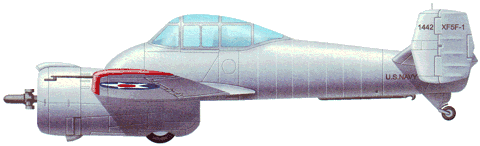
underwent some redesign as a result of testing, the engine nacelles being lengthened, the fuselage nose
being extended, etc. Flight testing of the XF5F-1 provided
information utilised in the development of the
more advanced XF7F-1 (G-51).
| MODEL | XF5F-1 |
| WEIGHTS |
| Take-off weight | 4599 kg | 10139 lb |
| Empty weight | 3677 kg | 8106 lb |
| DIMENSIONS |
| Wingspan | 12.80 m | 42 ft 0 in |
| Length | 8.75 m | 29 ft 8 in |
| Height | 3.45 m | 11 ft 4 in |
| Wing area | 28.19 m2 | 303.43 sq ft |
| PERFORMANCE |
| Max. speed | 616 km/h | 383 mph |
| Range | 1930 km | 1199 miles |
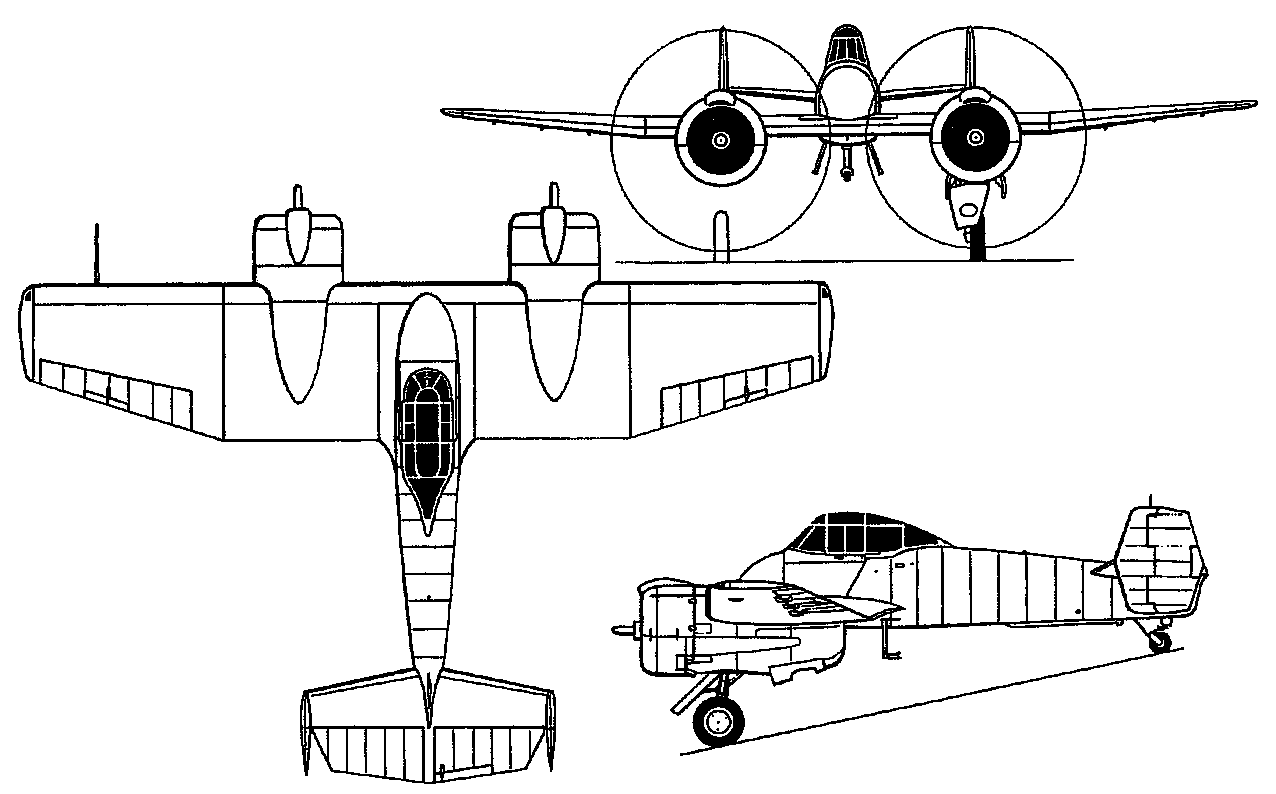
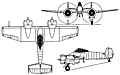 | A three-view drawing (1276 x 794) |
| ron, e-mail, 20.03.2018 08:46 This XF5F prototype never was armed, but the Madsen 23mm cannon was proposed among the different gun suites considered.
Since this cannon is not well known, here are some details:
Reportedly it's tendency to jam was overcome overall by this time.
The cannon weighed 55kg.
The Madsen 23x106mm cartridge fired a 175g HET shell with a M /V of 730m /s.
Unfortunately it's RoF between 300 and 400 r /m was slow for air to air combat.
Still, China bought a few and installed them in a couple of their Hawk 75s in under-wing pods. Or so I read.
The 23mm cannon used a necked up Madsen 20mm cannon shell to 23mm to reduce M /V allowing for double the HE fill.
It was proposed for US fighters like the XP-38 and others.
I found this data online, so correct me if you have any other info.
My use for the cannon this slow, would be to back up some HMGs adding to them some serious punch, P-38 style.
The 23mm has the HE fill between the 20mm and 30mm shell. The fifties would be for pattern density in a dogfight.
4x23mm cannons would have some density combined, but the weight trade-off would be more. Still, this could be equivalent to perhaps 5x20mm cannons. Just depends on many factors. If the fighter had more hp to handle heavy cannons and ammo for example.
It is an interceptor with 4,000 f /m climb rate unarmed. So it has to cope with more than fighters, and still climb well.
Each 23mm hit would be like twice the punch of a 20mm hit! Perhaps 6 times the punch of a 12.7mm HMG hit.
These cannons aren't that much heavier than the Hispano 20mm cannons either.
The guns are all concentrated in the nose, for full effect.
The M /V would not match the MGs as well though. Decisions decisions! reply | | Karaya2, e-mail, 11.02.2015 10:10 The F5F is a prime example of a "what might have been" in aviation history. Much has been made of its teething problems, but most sources that dwell on such matters forget that it never was allowed to progress beyond the experimental stage, a stage normally fraught with problems in any new airplane of the times. One of its issues was its adverse stall /spin characteristics in certain attitudes. An early fix was to position the wing leading edge well forward so that the fuselage seemed to be taking a bite out of it. But, time and good engineering tends at length to worry such problems into oblivion. For a direct contrast of problems with any other airplane, try at firt looking up the glitches suffered by the F4U Corsair in its formative years! Its prototype was a relative disaster, anything but the promising first-line fighter and world-beater it finally came to be. Why, the plane was not even cleared for carrier duty, its primary mission, until the war was half over! If normal development had been allowed to continue on the Skyrocket beyond the time the Navy Department finally pulled the plug, and a subsequent purchase order had resulted, America would have entered WW II with a 400 mph class fighter capable of an initial climb rate of over 4,000 fpm which, by the way, could easily outturn a Hellcat. From the beginning, Japan's Zero fighter pilots would have had that unpleasantness to face rather than the far less capable Wildcat. There is little doubt that the plane's impact on the early months of the war would have been palpable, and not necessarily to Japan's advantage.
The reason the Skyrocket was not adopted was somewhat more complex than the logistics of manufacture and maintenance alone, although that definitely had some impact on the final decision. The bottom line was, the F5F was expensive when compared to the Wildcat that could be built at half the cost. Couple that with the fact that the U.S. Navy of the times was a Depression-era, cash-strapped battleship-laden organization staffed with battleship admirals who were not impressed with Billy Mitchell's "stunt." The powers that be acknowledged that the Navy needed some airplanes, but their types and performances were of little consequence to the higher-ups. So long as the airplane they bought filled a hole in the sky and was cheap, it was mission accomplished! It was a foolish, short-sighted approach to be sure, but what military decision of the day wasn't?
One can only imagine what the F5F's potential might have been. Given nothing more than the technology of the time, look what potential was available: Wet-winging, courtesy of Consolidated who employed it in their PBY; engine alternatives, such as the Pratt-Whitney R2000, an upgraded R1830 Twin Wasp designed for the Douglas DC4 /C-54 and capable of pumping out 1,600 hp on military-grade 115 /145 avgas; aluminum armor, courtesy Lockheed; power-boosted ailerons, again Lockheed; employment of magnesium alloy cladding in non-stress areas to bring down weight, thanks again to Consolidated's developments in behalf of their upcoming B-36, and of course the two-stage, two-speed supercharger that was then in an advanced state of development. The list of available technology goes on, and the upgrades the airplane might have been subjected to as the war progressed boggle the imagination.
Unlike its successor, the F7F Tigercat, whose mission had been superseded before it even flew by the likes of the Corsair and soon by the Douglas AD-1, and so probably never should have been built, the Skyrocket, as a multi-mission point defense interceptor, air superiority righter and fighter-bomber, could have ruled the Pacific. As I said before, a prime example of "what might have been." reply | | Thom, e-mail, 18.03.2014 14:26 Minicraft Models used to produce a 1:48 scale plastic kit. I purchased one from Squadron.com several years ago. Their web site still lists them. reply | | Rudy Dracka, e-mail, 24.02.2014 17:13 Where can a person get a model of this aircraft reply | |
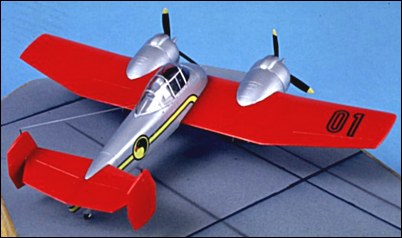
| | Rudolph, e-mail, 24.02.2014 17:11 where can a person get a model of this aircraft? reply | | roy 24/10/2012, e-mail, 24.10.2012 21:59 does any company in u.k.produce decals of blackhawk insigna /logo.also is there a kit of the f5fon the market at present? reply | | airnut, 26.07.2011 12:16 Alas, shown is the Blackhawk comic book model. When I started reading Blackhawk comic books, the F5F was the star. The 7 Blackhawks each had an F5F and they seem to progress through experimental planes. The last I remember was the F-90 which I believe was Lockheed's first attempt at a swept wing fighter. Where did all those comics go???? Remember it did take some time to find out there was such a plane as the F5F as things were pretty hush hush in those days. While the F5F was really cool looking, the child of the F5F, was the exceedingly beautiful F7F. reply | | baxie, 21.06.2011 06:08 If development had continued, the history of the twin-engined fighter would have been very different... reply | | Rudy Dracka, e-mail, 21.04.2011 20:09 where can one get a model of this airplane ? reply | | XWXwireXWX, e-mail, 17.04.2011 05:44 The fighter itself was an incredible leap forward in technology, but like planes like the P-39 and other, it was too radical a design with too many new untested ideas. reply | | steve, e-mail, 15.02.2011 18:25 The XF5F can be usefully thought of as the backup to the possible failure of radar development: An interceptor whose extreme climb performance permitted launch on the very short warning of an incoming raid provided by visual detection from a screening destroyer. Perhaps fortunately, the F5F lost its mission before its developmental troubles could be cured.
The F5F's problems involved engine cooling and aerodynamic turbulence due to its too-short engine necelles. (Compare the Cyclone installation on the later S2F.) What the aircraft really needed was a smaller diameter engine - imagine a larger-displacement equivalent of the Gnome-Rhone 14M. reply | | junqueira macos, e-mail, 10.01.2010 20:18 Este avião é maravilhoso. Como conseguir o projeto para construção dele para radio controle na escala 1 /4 ou em escala menor? reply | | junqueira macos, e-mail, 10.01.2010 20:18 Este avião é maravilhoso. Como conseguir o projeto para construção dele para radio controle na escala 1 /4 ou em escala menor? reply | | Jim Lloyd, e-mail, 17.03.2009 23:23 It actually was continued into the F7F Tigercat, a clear descendent of the Skyrocket reply | |
| | Roy Johnson, e-mail, 06.09.2008 01:07 In the early 1940's the comic book "The Black Hawks" featured a squadron that flew the Grumman Skyrockets. They later switched to jets after WWII. reply | | Castle22r, e-mail, 16.06.2008 18:56 The plane was ahead of it's time. reply | | Aero-Fox, 11.03.2008 05:29 This aircraft had reportedly superb flight and handling preformance, it's only technical problem was unreliable landing gear, which could have been ironed out with commitment to the project. However, the reason the F5F was not adopted was reportedly a logistics issue...it was thought it would be too hard to maintain a twin-engined fighter in the field, which strikes me as odd...the F5F had radial engines, simple and reliable, whereas the P-38, the adopted twin-engine fighter, had in-lines...which are more complicated and harder to service...
If development had continued, the history of the twin-engined fighter would have been very different... reply |
|
Do you have any comments?
|
| 
COMPANY
PROFILE
All the World's Rotorcraft
|