|
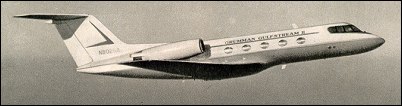
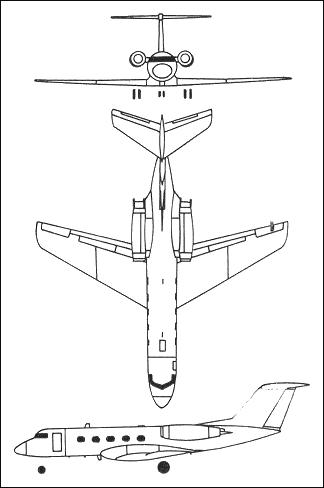
| Encouraged by pressure from existing Gulfstream I operators, in early 1965 Grumman began preliminary studies for a turbofan-engined version of its very successful corporate turboprop. Market research indicated a requirement for an aircraft with the cabin volume of the Gulfstream I with high-speed transoceanic capability, but also capable of good short-field performance. By the time the planned full-scale mock-up had been completed, Grumman had received 30 firm orders, resulting in a programme go-ahead on 5 May 1965. There was no prototype as such, the first aircraft making its maiden flight on 2 October 1966.
With two Rolls-Royce Spey Mk 511-8 engines, each producing 5171kg thrust in an airframe some 65% of the weight of a similarly powered aircrach such as the BAe (BAC) One-Eleven and Fokker F28, the Grumman Gulfstream II met the short-field performance with ease and had a maximum-fuel range of more than 6115km.
All Gulfstream IIs were fitted with avionics and custom interiors at distributors, and in December 1967 the fifth aircraft was handed over to AiResearch Inc. for completion before becoming the first to reach a customer, in this case National Distillers and Chemical Corporation of New York. It became the first executive jet to fly non-stop across the North Atlantic in both directions, flying from Teterboro, New Jersey, to London Gatwick in 6 hours 55 minutes on 5 May 1968, and back to Burlington, Vermont, on 12 May in 7 hours 10 minutes.
Manufacture and improvement continued until December 1979, when the last of 258 production aircraft was delivered. By then Gulfstream American (now Gulfstream Aerospace) had superseded it in production by the more advanced Gulfstream III, and the advanced wing developed for this aircraft has become available as a retrofit for the Gulfstream II, the resulting conversion designated Gulfstream Il-B. Gulfstream Aerospace now has an active conversion programme in progress, the new wing increasing the range of the Gulfstream II and, at the same time, giving a significant improvement in fuel efficiency.
| CREW | 2-3 |
| PASSENGERS | 12-19 |
| ENGINE | 2 x Rolls-Royce MK511-8, 50.7kN |
| WEIGHTS |
| Take-off weight | 26080 kg | 57497 lb |
| Empty weight | 17235 kg | 37997 lb |
| DIMENSIONS |
| Wingspan | 21.0 m | 69 ft 11 in |
| Length | 24.4 m | 80 ft 1 in |
| Height | 7.5 m | 25 ft 7 in |
| Wing area | 73.7 m2 | 793.30 sq ft |
| PERFORMANCE |
| Max. speed | 947 km/h | 588 mph |
| Ceiling | 13100 m | 43000 ft |
| Range w/max.fuel | 6050 km | 3759 miles |
| Jim Dunigan, e-mail, 25.03.2015 23:51 I was fortunate to have worked in the Savannah Plant #55 from 1967 thru 2003. I worked on most of the Gulfstrean's. The GII (G1159), GIIB, GIII, GIII Cargo Door A /C and GIV Cargo Door A /C, also the GIC, GIV, GV. The GIV was later redesignated the G400. The GIV-SP was redesignated the G450. The GV changed to G500. The GV-SP changed to G550. All of these A /C were hand built and as Grumman use to say, "if it had Gulfstream on it it was like having Sterling on silver. I am very proud to have been one of the people that participated in building these great Aircraft. reply | | Joe Miller, e-mail, 11.10.2013 06:25 I was the Captain & the head of the Robert W. Galvin flight dept. N55RG had only one owner the Galvins. After 46 yrs. of flying corp. jets 9 /9 /2012 was N55RG's final flight & also my final flight. N55RG's new home is the Carolinas Aviation Museum. I was rated & flew all the Gulfstreams but N55RG was my favorite. I lost a friend but found her a good home. reply | | ROGER, e-mail, 22.08.2012 18:13 Where is Aero Commander reply | | David Zang, e-mail, 07.06.2011 18:56 Prior to the above mentioned "go-ahead" date of May 5, 1965, I worked as an engineering aide / computer programmer for Grumman in Bethpage, NY - re: the wind tunnel analysis for the Gulfstream II design. My work merely involved creation of reams and reams of automated Calcomp plots for the designers. reply | |
| | Vern Baisden, e-mail, 01.03.2011 18:21 When I was being type rated in the G-II.a few decades ago. Flight safety told us, the only similarity between the G-I and G-II were the windshield and nose gesr. having flown both, they were right. They are very different birds. both retain the, "Grumman Ironworks", heritage.
The G-II was very complex, but a dream to fly. It was probably the only aircraft, that I have flown, that didn't require full power for takeoff. It was luxury. reply | | john walmsley, e-mail, 05.01.2011 18:51 The National Distillers flight implies 7 hrs endurance G2.I
understand it took G2B - with G3 wing to do this.Any one is
invited to comment on real world #'s.Also some had INS with
independent nav - how good was this compared to GPS etc?JW reply | | john davis, e-mail, 18.12.2010 02:23 Flew the GIII (dc version) and this was my all time favorite plane in my career. Went all over the place and never had a problem except for noise on takeoff at some places. Great plane, reliable for months at a time, great performance, and a real pilot's plane! reply | | john, e-mail, 10.11.2010 17:20 The text of the GI and GII appropriately attribute these aircraft to Grumman, as is the GIII--as least the DC electrical system version which is not listed. Then came the GIII with an AC electrical system or properly, VCSF, Variable Speed Constant Frequency and an early glass cockpit. The Gulfstream Aerospance workhorse, the GIV, is not referenced, muchless the -V, -450, -550, or -650. All these aircraft, the gold standard in executive aircraft of their era. reply | | Bob Cupery, e-mail, 26.08.2010 23:41 I had the pleasure of flying a couple millian miles on G-II
S /N 042. Was Director of Maint.?Flight Eng. Passengers like Elvis, Sony& Cher, Rod stewart, R. Regan,H. Hughes,Shaw of Iran. and many WW -II flying aces.I changed the first windshield in the field. GUAM what a life exp. reply | | Capt Jim Osborn, USCG (ret), e-mail, 09.04.2009 23:12 What a privelege it was to be able to fly this skyrocket of an aircraft for the Coast Guard's VIP unit in DC in the early 70's. My transition from the 135 Kt Grumman Albatross to this mach .85 machine was a real eye opener. The GII was so far ahead of its time in performance, safety and comfort for its select passengers. Usually in my day, the CG flew other services cast off aircraft. With the GII we had the premiere of the corporate transportation world for many years before any other service had it. It was really great to fly and was such a head turner when we parked on the front row of airports around the world (sigh!!!!!). reply |
|
Do you have any comments?
|
| 
All the World's Rotorcraft |