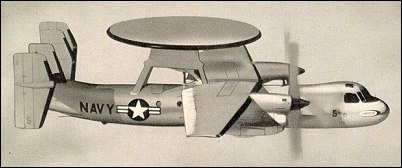
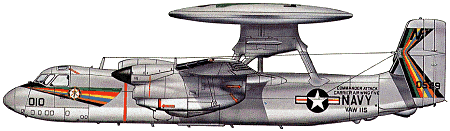
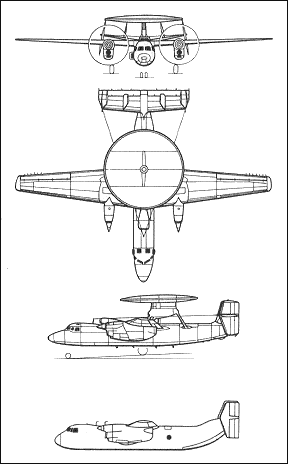
The Hawkeye was evolved as a carrier-borne early-warning aircraft, but is suitable for land-based operations from unimproved fields. The prototype flew for the first time on 21 October 1960, since when four versions have been built.
The E-2A (formerly known as the W2F-1) was the initial production version and flew for the first time on 19 April 1961. Delivery of 62 to the US Navy began on 19 January 1964. The E-2B version, which flew for the first time in February 1969, differs from the E-2A by having a Litton Industries L-304 micro-electronic general-purpose computer and reliability improvements. A retrofit programme updated all operational E-2A to this standard.
The E-2C first flew in January 1971 and 41 had been delivered by the end of 1977. Firm orders exist for a total of 47 aircraft, with procurement of 36 more by the end of 1985. Israel has four and in 1979 Japan released funds for the first four of an eventual total of about 15 for the JASDF. The E-2G has an advanced radar that is capable of detecting airborne targets anywhere in a three-million-cubic-mile surveillance envelope. It first entered service with the US Navy in November 1973 and went to sea on board USS Saratoga in late 1974. A training version is designated TE-2C.
Teams of Hawkeyes are able to maintain patrols on naval task force defence perimeters in all weathers, at an operating height of about 9,150m. They are capable of detecting and assessing any threat from approaching high-Mach-number enemy aircraft over ranges approaching 480km. The radar also monitors movements of enemy ships and land vehicles. It enables each E-2C to track, automatically and simultaneously, more than 250 targets and to control more than 30 airborne interceptions. To make this possible highly sophisticated equipment is carried by the aircraft, including a Randtron Systems AN/APA-171 antenna system housed in a 7.32m diameter saucer-shaped rotodome mounted above the rear fuselage of the aircraft.
I flew the E-2C with VAW-116 (Sunkings) on the Ranger and Kittyhawk from 82-85. I then went on to fly the Hawkeye for US Customs in the late 80's out of Corpus Christi. They were considered a stop-gap while the round radar was being tested on the P-3AEW. Good times!
I worked Avionics with the USMC / USMCR from 1984 to 1988, and then as a reservist several years later. Earned a BSEE in 1991, and supported the development of the CNS /ATM upgrade in the following airfrrames. P-3, C-2A, E-2C, to name a few. yes, the GNS-530 was part of this upgrade, however flat panel glass was also part of the solution via Rockwell Collins Displays, and along with a military GPS / INU system. The issue with the GNS-530 GPS RX is it does not have any ani spoofing capabilities and can be easily jammed. Unlike military GPS RX's, which can play through some environments where the GPS signal is being jammed by those seeking to remove the GPS NAV capability from the military customers.
Great memories! I worked as AMS from mid 73 to Jan 77. RVAW-110. Worked the A-3s,P-,3s,C-118s in Alameda Overhaul afterwards, then with A&P lic, the T-56 /D-501s at Alameda National Airmotive teardown /assembly for awhile.
Loved the E2-C HAWKEYE. Worked on them (ADJ) from 1976-1981 RVAW 120 NAS Norfolk. Great Aircraft . Would love to hear from some of my shipmates that served in the Squadron at that time
A great career in both E-1 and E-2; OINC of VAW -11 det Golf aboard the Oriskany and VAW-116 on the Coral Sea--CO of VAW-110 At Noris--Great group of professionals-
Master Chief William O'Donnell, e-mail, 31.05.2012 04:44
I was a NFO with the E-2C for over ten years. ( Enlisted could fly then). I became the primary flight instructor with Grumman when the Coast Guard accured the aircraft. I flew over 200 drug interdition missions with the Coast Guard as the CICO & flight instructor. We pissed off the Cartel and all had a price on our heads. We cost them Billions and enjoyed our job and kicked ass. When I retired from the Navy I never thought I would fly again, but Grumman made me an offer I couldn't refuse, to fly again. It took about 2 seconds to make up my mind and my career was set. I also did "Black" projects with the E-2C in the desert. That was neat...Sorry - no comment... I am retired now from both the Navy & Grumman ( Northrop-Grumman), but I am still an Grummanite...and always will be. God Bless America.
came to vaw 11 after A school, was in det delta for the first west pac cruise on the constellation,was still in delta when we chopped into vaw-113 made 2 more west pac`s,still have the 1966 cruise book.LCDR. T.W. CONBOY was the skipper,air wing 15 CO was CDR J.D.WARD
Started w /E2Bs @ RVAW-110, NAS North Island in 75 as a Aviation Electronics Tech, then moved to NAS Miramar when the Hawkeyes relocated. Went on to VAW-116 Sunkings 76-79 (USS Nimitz maiden voyage and USS Zippo cruises)then on to AIMD, Hawkeye Avionics, 79-81. Glad to see some avionics mods finally getting installed. Who can ever forget "The Hummer."
Man..my business partner flew the E2A off the USS Randolph. He just turned 70 and I want to get him some memory of this plane and possibly ship in the form of a great photo to be framed. Does any one have any ideas as to what a retired Navy Officer would like relative to his plane and ship? thanks so much
I was involved at Grumman on this aircraft from its inception as the W2F to its production as the E2C.Through this period I served in many functions.Electronic tech.,RFI /EMC Systems Engineer and Grp.Ldr.,Sub-Contract Mgr., Flight Test Project Engr.,Program Manager. I have about 500 hours flight time in E2 aircraft, including some carrier ops flight time.I had the honor of working with some the finest,talented,dedicated people during my tenure at Grumman. Most especially, with those who worked in final assembly Plants 4 /2.
There was also a C2A version of the E2A. It was like a small C130 that could operate from a carrier. I did some flight tests at Grumann in the 70's when I worked for Allison. On one flight, we had no copilot and Irode in his seat.
VAW-11 Det Mike to VAW 112. NAS North Island. Enlisted, CD tech. Not much room for a 6' 1" person to stand up inside. Deployed on CVAN 65, USS Enterprise. Cruse 1 '66-'67; cruse 2, '67-'68. Was on board when North Korea captured the USS Pueblo, January 1968, cold so very cold on the flight deck.
Hello to All--I first flew the E-2 in June, 1971, as a newly minted Naval Aviator. Initial training at RVAW-120 in Norfolk and then assigned to VAW-125. I flew with Mark Harrison (noted above) on two extended Med. deployments aboard the USS John F. Kennedy. After a long period of time away from naval aviation I have been the simulator instructor at Point Mugu for E-2C flight crews for the past ten years; the plane has not changed much with respect to the pilots. The 8-blade props have made the plane quieter and have less vibration; recent installation of a Garmin-530 GPS finally allow E-2 pilots to do more than TACAN & PAR approaches; and the electronic flight displays will be the first primary flight instrument improvements since the plane was first introduced. The plane now weighs 55,000 pounds. The E-2D is expected to be around 59,000; same airframe and engines as the E-2C (T56-427) and rated at 5100 HP.
I joined the E2A squadron VAW12 in Norfolk on Jan.1966. This squadron was renamed RVAW 120. We supplied the fleet with aircraft and crews. If anybody out there is /or was station there during these years, I would be happy to hear from you. TOM
I joined the E2A squadron VAW12 in Norfolk on Jan.1966. This squadron was renamed RVAW 120. We supplied the fleet with aircraft and crews. If anybody out there is /or was station there during these years, I would be happy to hear from you. TOM
I reported to VAW-11, North Island NAS, as a newly minted Aviation Radar Technician in February of 1964, two or three weeks after the first E-2A Hawkeye, alias Super Fudd. I was with the first operational deployment of the E-2A, Det Charlie, aboard The USS Kitty Hawk in October of 1965. Details and photos of my time with VAW-11 can be found at my donsafer dot com site.





My first cruise as a nuggetbpilot was in DetD on the Connie. I was a 22 year old Ensign. Lcdr Conboy was OinC...he passed away years ago.
reply