|
| It is probably true to say that the Hellcat was designed in the spring of 1942, as important changes to the XF6F-1 and XF6F-2 prototypes led to the XF6F-3, which flew for the first time on 26 June 1942 (sometimes stated to be August). Large-scale production of the F6F-3 began at the end of that year and the Hellcat was first reported in action with a US Carrier Task Force in an attack on Marcus Island on 1 September 1943, flying from USS Yorktown.
The F6F-5 differed from its predecessor by having a redesigned engine cowling, improved windshield, new ailerons, strengthened tail surfaces, additional armour behind the pilot and a waxed high-gloss skin finish. It could also carry two 454kg bombs under the centre-section or drop-tanks, and was equipped to carry rocket projectiles and search radar as the F6F-5E. Night-fighter (F6F-5N) and photographic-reconnaissance (F6F-5P) versions were also in service.
The F6F-5K was a long-range radio-controlled pilotless drone conversion of the Hellcat. The modification was undertaken by the Naval Aircraft Modification Unit at Johnsville. Several were used in the Bikini operations.
The F6F-5 was the last operational version of the Hellcat, which was finally withdrawn from production in November 1945. The 10,000th Hellcat was delivered to the US Navy in March 1945 and final production amounted to 12,275. Interestingly the Hellcat was the only US aircraft designed and built after Pearl Harbor to be produced in this quantity and proved one of the most significant fighters flown in World War II, achieving a major victory against the Japanese in the Battle of the Philippine Sea. It was also flown by the Royal Navy as the Hellcat I and II.
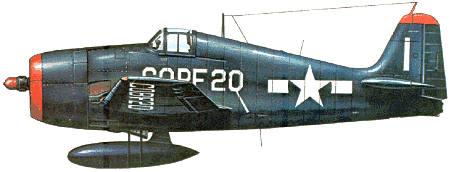
| MODEL | F6F-5 |
| CREW | 1 |
| ENGINE | 1 x Pratt & Whitney R-2800-10W Double Wasp, 1491kW |
| WEIGHTS |
| Take-off weight | 6991 kg | 15413 lb |
| Empty weight | 4152 kg | 9154 lb |
| DIMENSIONS |
| Wingspan | 13.06 m | 43 ft 10 in |
| Length | 10.24 m | 34 ft 7 in |
| Height | 4.11 m | 14 ft 6 in |
| Wing area | 31.03 m2 | 334.00 sq ft |
| PERFORMANCE |
| Max. speed | 612 km/h | 380 mph |
| Cruise speed | 270 km/h | 168 mph |
| Ceiling | 11370 m | 37300 ft |
| Range w/max.fuel | 2462 km | 1530 miles |
| ARMAMENT | 6 x 12.7mm machine-guns, 2 x 454kg bombs or 6 x 127mm missiles |
 | A three-view drawing of F6F-5 Hellcat (1280 x 874) |
| Darren, e-mail, 11.11.2022 21:14 Great article and comments!
Just to add, the 380 mph maximum level speed often quoted for the F6F-5 was with dual bomb racks and six rocket launching hard points. In a "clean" condition the Hellcat could indeed touch 400 mph, but after 1944 it was common to use the Hellcat in the ground attack role so top speed was limited by the racks and hard points. Still, it had enough speed to handle any Japanese fighter, including the Jack, Frank, and George. reply | | Heinkel Wulf, e-mail, 13.03.2018 10:59 I know the Bearcat that came later was more advanced, but I'd honestly prefer the tried and true Hellcat myself, mostly for the roomier and more comfortable cockpit, but also for the longer range. If I'm not mistaken, the Bearcat was mostly intended to be a lightweight interceptor that could operate from small escort carriers that couldn't equip the larger and heavier Hellcats. Aside from that despite having a huge respect for the Bear and being a fan of the design, I can't see the burning need for it, considering how completely the Hellcat mopped the floor. Even against later, much more advanced and powerful aircraft than the Zero, such as the Raiden, Shiden, Hayate, and Goshikisen, it held it's own. Even over Europe, I'd take one over a Mustang or Lightning any day. reply |
| Heinkel Wulf, e-mail, 13.03.2018 07:59 I've read that the Hellcat was thanks in large part to having the largest wing of any single engine fighter of the war, Allied or Axis, able to turn with, or even out turn late war models of the Zero. I'm pretty sure the F6F was the only top of the line fighter in the Allied arsenal able to claim such a feat. The F6F-5 was also able to (just) breach the 400mph mark thanks to having a smoother gloss skin compared to the earlier F6F-3. I've heard it's excellent turning ability and slow speed handling cut into it's roll rate compared to other aircraft, but I do know it could still outroll the Zero which was it's most common opposition with ease at high speed. I can imagine how much better the mark five version was once it got cannon and radar. Night fighter par excellence. Most people aren't aware that they even flew in USN colors in the ETO and shot down several German bombers, and I've heard they even mixed it up with 109's and 190's, but I could be wrong. I know the RN Hellcats did, and came out of the fight with favorable results against both types. The corsair was a magnificent aircraft in it's own right, but imho, the Hellcat has by far the best balance of qualities for a carrier aircraft during that time. A true pilots aircraft without doubt. Not hard to see how they achieved such an amazing kill to loss ratio. Like the AAF's P-47, it may not have been as glamorous as the Corsair or Mustang, but it was a tough as nails bare knuckle brawler that did the bulk of the dirty work. reply | | ron, e-mail, 24.07.2017 03:33 If the F6F-5N had the 20mm Hispano Mk II cannon which was improved by the RAF, it was acceptible. If it was just the 20mm Hispano M2 from the USAAF, then it was rejected by the USN for fighters. I concur. The M2 misfired due to a 2cm gap in striking the cartridge. The RAF Mk II version fixed this for the Spitfire, the USAAF would not; not until the 1950s with the M39!
The 20mm Hispano M2, then the M3, then the M24, same problem. Stubborn USAAF Ordinance Dept through 2 wars, that's all!
The RAF had patience but that ran out in 1942. They wanted the US to help supply them Hispano cannons as good as theirs. Not a prayer! reply | |
| | Ron, e-mail, 07.10.2015 06:04 Gary,
The F6F-6 prototype may have gone 417 mph but it's climb was only 3,070 fpm, putting it between the -3 and -5!
I was surprised.
Perhaps they were wise to go with the F8F.
I would have put off the fancy wingtips till later to get the Bearcat into action faster.
The F6F-6 still had no rear view canopy! Most Japanese fighters had it from the start!
If it had the F8F canopy I might favor the F6F-6 to relieve the -5 before the end of WW2.
I like the firepower upgrade too. But I would exchange the M2 Hispano (and even the postwar M3) for the much superior MkII and then MkV Hispano of the RAF! That goes for all US Hispano armed fighters like the F6F-5N, P-38, A-36, and F4U-1C and so on.
The razorback canopy and the unreliable US version of the Hispano 20mm cannon were crying out for upgrade more so than the overdue power improvement for awhile already.
The US Hispano story is an embarassment. reply | | Ron, e-mail, 07.10.2015 04:42 I just recently learned that the survivability of the F6F was far better than the F4U. The unprotected oil tank on the F4U-1 to -4 was toast with a rifle hit!
For this reason, the F6F had a 30% better durability.
I used to think the Corsair was tough, which it was but for that achilles heel.
The losses bear this out, especially on ground support missions. This was not lost on the Japanese like it was on the US brass. This was remedied postwar.
I have newfound respect for the Hellcat.
It doesn't have the vulnerability of the P-47's boost plumbing either. So the F6F may be the best protected US fighter!
Pilots never referred to it as 2 lbs stuffed into a 1 lb bag like P-47N pilots did about their fighter.
OK, so the Grumman was slower but in the Pacific it was fast enough.
Being a solid all-around fighter paid dividends.
Don't forget it gave a good account of itself against the Luftwaffe in limited action too. reply | | Ron Kron, e-mail, 02.04.2015 07:12 For George Townsend : And the takeoff trim was 0-0-3R.Great a /c, fun and forgiving. Cabaniss and Barin Fields 1953. reply | | GARY BEDINGER, 01.04.2015 07:29 GRUMMAN CAME UP WITH A WINNER BACK IN 1942 WHEN THE "HELLCAT" WAS FIRST INTRODUCED TO THE U.S. NAVY IN THE SOUTH PACIFIC DURING WW2.THE "HELLCAT" FLEW AT 380mph AND THE "HELLCAT" COULD CARRY A BOMB LOAD OF 2,000lbs.MTHE U.S. NAVY PILOTS WHO FLEW THE "HELLCAT" LANDED ON THE DECKS OF U.S.NAVY AIRCRAFT CARRIERS ALIVE WHILE FLYING THE F6F "HELLCAT".THERE WAS A HANDFUL, I MEAN A HANDFUL OF F6F "HELLCATS" WHICH COULD FLY AT 400mph BUT THESE "HELLCATS" WERE IN THE TESTING STAGE.WW2 WAS OVER WHEN THE 400mph "HELLCAT" FLEW.THIS WAS THE F6F-6 reply | | Ron, e-mail, 17.05.2014 04:13 I would like to hear more about the 2x20 mm, 4x12.5 mm armed F6F. I believe some -5N night fighters at least had that mix.
That reminds me of the A6M5c and A6M7s with roughly equal firepower (many A6M7s were night fighters too).
While the Hispano 20 mm cannons were classed as unreliable by the USN, suplementing them with 4 HMGs seems prudent (in contrast to the 4 Hispanos on the F4U-1C or -4B).
The Hellcat thus would be more likely to jam than the slower Mk4 and faster Mk5 cannons on these A6Ms but they only have 3x13.2 mm MGs vs the 4x12.5 mm MGs for this version of Hellcat.
Of course this is the not to say these are comparable in any other way except maybe in the dark. reply | | Dick Ryan, e-mail, 08.02.2014 06:35 I'm a volunteer at the Yanks Air Museum,Chino,Ca. One of our ongoing restoration projects is an F6F-3 Hellcat. We have a set of alleged -3 wings but the undersides have a difference. One has a series of long, horizontal access panels over the flap actuating rod /assy. The other has a series of smaller(about4x5) access plates. We are trying to determine which is the newer or visa versa. If you can help, contact me at aeroman2@verizon.net. reply | | George Powell, Capt. USN ret, e-mail, 28.12.2013 20:18 Flew the Hellcat during advanced training, circa 1954. Favorite memories: Blowing a jug while flying formation over Corpus Christi Bay and chasing cattle across the King Ranch. reply | | Bob, e-mail, 19.11.2013 01:34 My dad worked as a mechanic on the carrier USS Marcus Island, and he said the Hellcat was terrific. He also said while the Corsair was a real screamer, it was a plumbers nightmare to work on. Hydraulic back ups for everything. reply | | Harold Haskins Capt. USMCR Re, e-mail, 30.10.2013 05:07 Flew this marvelous A /C in ATU-300, Corpus Christi, Tex.
Spring-Summer 1954 . Returned to Pensacola Fla. Carrier
qualified in the Hellcat in early July 1954 . reply | | Ron, e-mail, 24.04.2013 08:32 Hey Steve,
That's a myth.
Sounds good but ... not factual.
Many believe the F6F was designed after capturing a Zero anyway and keep publishing this myth. As the text at the top states, the Hellcat was in the air by June 1942 already.
What matters is that it delivered the same effective combat results as if that myth was true. So chalk it up to poetic license. Quite a work horse wasn't it! reply | |
| | willis E. Vanderberg, e-mail, 01.03.2013 19:21 Just for the record, we had F4U-5N'S aboard the USS Salerno Bay CVE 108 in the early fifties. This was the smallest carrier class built. If the Corsair was so dangerous on carriers we never saw it in our experience. reply | | Chuck, e-mail, 10.11.2012 20:32 My Father became an ACE while flying the F6F-3, station aboard the USS Wasp CV-18. He was in VF-14 "the Iron Angels" and is a plank owner of the Wasp. reply | | Naga, 14.07.2012 01:47 My great grandad had an affinity for this plane. While stationed on Iwo Jima, his line was attacked by a Mitsubishi G4M. The commanding officer told his men to stay in their foxholes, but when a pair of Hellcats teamed up and brought down the Betty, they got up and cheered, with their officer yelling at them to get back in their d*** foxholes. reply | | David Bonnot, e-mail, 22.06.2012 23:46 Stationed at Point Mugu, Ca. 1956 /1957 we use the f6f for drones and fired sparrow missles at them. The drones were painted bright red and controlled from another aircraft. Probably in over the year I was at Point Mugu a hundred were distroyed in flight. On one flight, the sparrow missles both missed and the drone lost radio control operation. Heading for downtown Los Angles, the air force was called in with f89 interseptor aircraft. After firing a large number of rockets the f6f finally gave up by running out of fuel and crashing. reply | | Gene L oveland, e-mail, 03.06.2012 22:19 Flew the 1o,ooo Hellcat we received on board the Ticnderoga on two occasions.The cockpit had notes and telephone numbers of every girl who worked on it.I did not follow up. All the The F6's we flew were just great and gave you a feelig of confidence that you were flying the very besy. reply | | George Townsend, e-mail, 08.05.2012 20:56 The F6F Was the Navy Advanced Trainer in Feb 1954 When I graduated at Pensacola. I did my final CARQUAL in The F6F-5.Wonderful airplane. R2800 PW. I loggged about 100 hrs.T /O 54in MP and 2660 RPM. I still remember. reply |
|
Do you have any comments?
|
| 
COMPANY
PROFILE
All the World's Rotorcraft
|


 Jean Stravinsky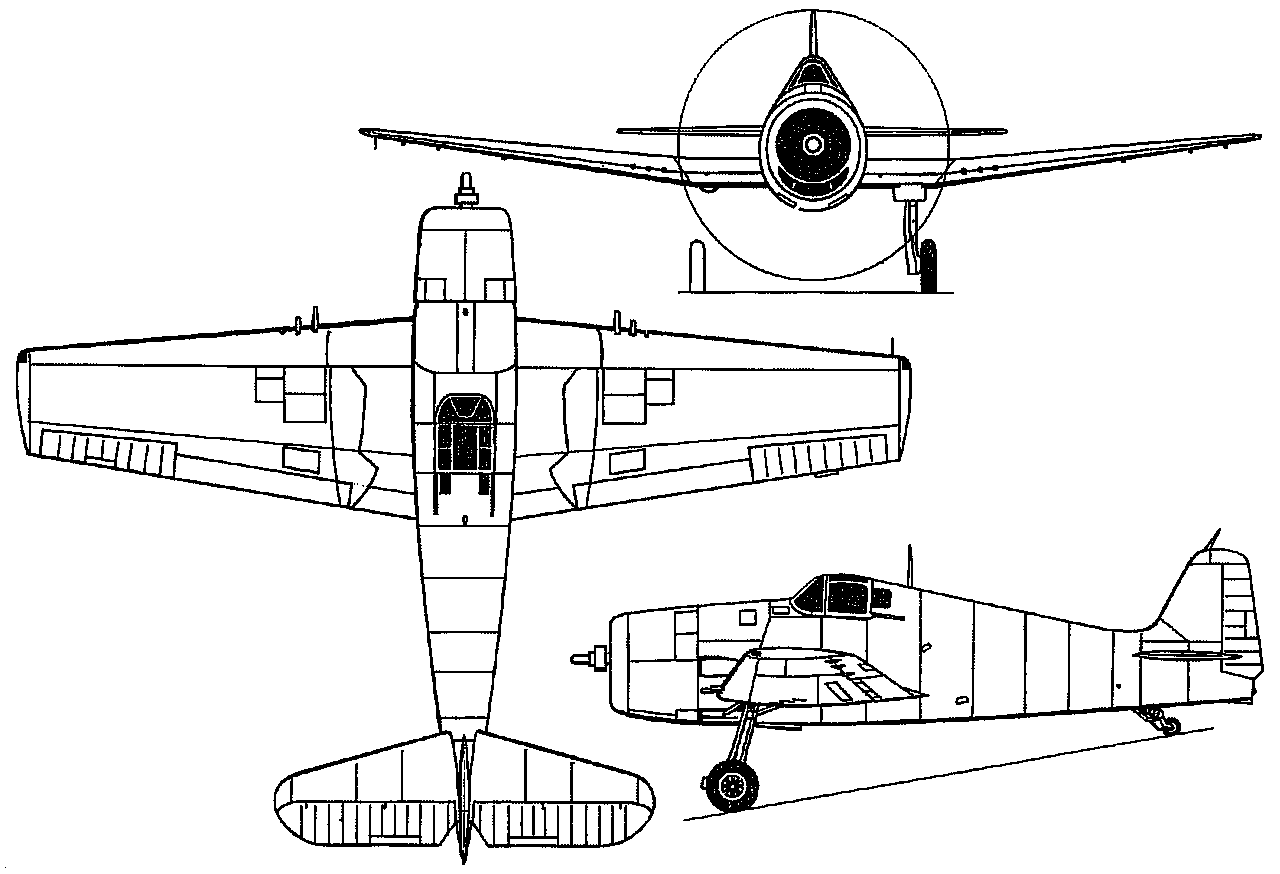


Fastest test of an F6F-5 on record was from No 58310. and peaked at 390 mph at 23 000 ft. It was only above 380 mph TAS between 20 k and 28 k.
375 mph top speed between 16 000 ft. and 26 000 is far more typical.
Over nearly 10 tests, only one outlier is barely 390 at 52", and there are some -3 at 60". 400 MPH is not credible. That being said, only the Frank reached 400, and probably barely.
Contrary to what is often assumed, the Zero rarely turned (preferring the Hineri-Komi or hit and run, as per Navy doctrine), and the Ki-84 probably only turned better in left turns (17-18 seconds), while being about the same in right turns (19-20 seconds).
The Japanese Navy cannons had a slow rate of fire, and even 4 of them on the N1K did not prove enough to kill Hellcats easily. (The N1K was formidable in maneuvering, similar to late Zeroes if not better)
Vertical handling in loops, and its turn rate, made the Hellcat fearsome, though the climb is only better than on the Ki-84 among Japanese types, as the Ki-84 had a too small prop that did not allow a proportional climb rate. Ki-84 climbed no better than a FW-190A in actual Japanese data.
reply