|
| The first prototype flew on April 19, 1960. A total of 482 were built.
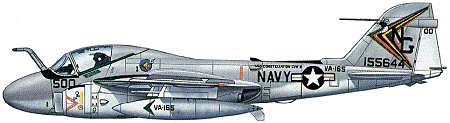
| CREW | 2 |
| ENGINE | 2 x P+W J-52-P-8A, 41.3kN |
| WEIGHTS |
| Take-off weight | 27500 kg | 60627 lb |
| DIMENSIONS |
| Wingspan | 16.2 m | 53 ft 2 in |
| Length | 16.3 m | 54 ft 6 in |
| Wing area | 49.2 m2 | 529.58 sq ft |
| PERFORMANCE |
| Max. speed | 1000 km/h | 621 mph |
| Cruise speed | 770 km/h | 478 mph |
| Ceiling | 12700 m | 41650 ft |
| Range w/max.fuel | 5000 km | 3107 miles |
 | A three-view drawing (1000 x 553) |
| Jule "Butch" Potter, e-mail, 13.10.2025 23:43 I was AIMD for VA 165.
Completed training at Millington, and learned I was to be an AQB. First VA 128, then VA 165, Whidbey. Two tours. Feb 1970 (USS America) and Sept 1971 (USS Constallation).
I was trained (mostly at Whidbey but also at the Grumman plant in Bethpage) on all the DIANE weapons system gear and the (first deployment) FLIR system for the A6C (both IR and LLC cameras). Specialized in the Low Light Level TV.
The FLIR pod, suspended beneath the belly of the A6C was, in kindest terms, pretty ugly, and way too big. The technology inside it was awesome. It meant working with things like rotating nitrogen cooled "fingers", solid germanium lenses, fiber optic coupling, Perking Elmer catadioptric lenses that were several feet long and about 20" in diameter, image intensifiiers, and television of course.
After all that training and experience, for my second deployment, the A6C went East and I stayed with VA 165. Ended up being the odd job dude for AIMD on the Constellation as the war wound down. Even fixed blown electronics for the forward elevator once. The XO asked. reply |
| Ken Hopke, e-mail, 01.07.2023 06:10 Anyone who knew my dad Charles Edward Hopke, A-6 rep at El Toro please contact me. Dad passed away in Jan 1975. I continued a full career flying G-2,3,4 and 200 aircraft.
Ken Hopke
760-861-3470 reply | | Alden Schofield, e-mail, 16.10.2020 19:05 Joined the Navy in 1965-1969. Went to A-school in Millington, Tenn. from there was assigned to VA-35 in NAS Oceana, Va. was an AQB2 by the end of my Career. Ran the “Hot Bench” DIANE system on the USS Enterprise for two cruises. All led to an incredible career in the computer industry ( Honeywell large systems) after leaving the Military. reply |
| David McClellan, e-mail, 19.12.2017 23:55 Went from Memphis to VA 42. Got assigned to GD to help rewire missile system on shot up B Bird. When I came up for rotation to sea duty, they said oh no, you have to stay here and train on Standard Arm. So, entire active duty tour at VA 42.
P.S. never trained a soul reply | |
| | Allen C. Ericksen, e-mail, 27.11.2017 18:55 did three WestPACS one on the USS Ranger and two on the USS Enterprise as a member of VA-196 AMH 4 got to know this bird inside and out. great plane best all weather plane to fly reply | | Bruce Shaffstall, e-mail, 20.11.2017 18:34 I cannot believe this site and the comments from everyone. What an aircraft! Inertial navigation system, D I A N E, with spinning drum memory that I ran into in the telephony career, which was the database for an electroning switching office at General telephone, after my 4 years as an Avionics Tech, at Cherry Point, VMA AW 332, (hat and Cain Squadron)and overseas at Iwakuni, Japan, 71 -72. For aw hile at Cherry Point I was even cross trained so I could do all three Avionics Shop, AE, AT, AQ, preflights AND go through ALL the other preflight Check cards 250+ to be a Plain Captain. Even worked HMMS intermediate Maintenance fixing what had to be one of the first ANTI Lock brake systems. I lOVED my work in Avionics as a SGT QC in Iwakuni and Naha Okinawa. Wouldn't trade my 4 years on this aircraft for anything. Iwakuni was in VMA-AW 533. Then left the Marines. reply | | Robert Lamberson, e-mail, 27.02.2017 02:44 I worked in Grumman's Plant 5 (Ken Lee's) test hangar in the early 1960's, doing static, fatigue & drop test on the
A6. How exciting to see it perform so well in service. It was a fantastic aircraft and still is with the fact that
EA6B's (same airframe) are still in service. reply |
| Wendell J. Clarke Jr., e-mail, 25.07.2016 23:19 Just love reading through all these stories! I saw the name Bruce VanTassel a couple times. I remember working with him when I was the new guy in the VA-95 AQ shop back in 1980. It amazes me to this day what a great responsibility we had maintaining these aircraft and most of us were barely out of high school! There hasn't been a day go by that I have not thought about something that happened during my short 6 year Navy career. I enjoyed working on Intruders and the people I worked with. Sorry to see them gone but all good things must come to an end. The experience led me to a career with a major defense contractor maintaining targeting systems (FLIR, etc.) on Apache helicopters. Thanks to all the other veterans out there for your service!! reply | | Kenneth Pipkin, e-mail, 11.06.2016 05:03 I flew the EA-6A at Cherry Point right out of flight school in Dec '68. At that time they had us do several flights in the A-6 with the wing tip speed brakes. When we transitioned to the EA-6 without the wing tip speed brakes the roll out on landing was much faster and it was not uncommon to over heat the brakes. After reading the NATOPS manual concerning the max speed to open the canopy I came up with the idea of opening it as soon as I dropped below the max speed. It was amazing what a good speed brake the canopy turned out to be. It became standard practice of many of my fellow pilots after that. I also flew the EA-6A in VMCJ-1 in Nam from Nov '69 until we pulled out in late '70 and went to Iwakuni. I loved this plane and sure hated to see it totally replaced by the B model. Even worse to see the A-6 taken out of service. Actually saw 10-12 of them dumped in the ocean to make artificial reefs. That was sad. reply | | Doug Young, e-mail, 30.01.2016 04:17 I neglected to mention the squadrons I was in, mostly because most that I was in while in A6's were already mentioned, but I was in some of them at the same time or close to the same time as others here, so I will list them and make some attempt to relate them to a time schedule when I was there. I went to VA42 the tilted pawn, the East coast Rag Outfit for training on A6A's right out of AQA school in Memphis, in 69 after 1 1 /2 years during which I made AQFAN due to a mix up in tests ordered, then made AQB3, before I sewed on AQFN. When I made third everyone was excited to see the results posted in Personnel, when I arrived at work, until personnel called down to the Shop to assure us absolutely no one made AQ3 on the east coast from that test. I trudged up the outside Ladder to the Catwalk with my head hanging to see for myself, after being told by my shift supervisor we didn't have time to check useless lists, but it wasn't useless to me. My wife was outside the fence just 3 miles away from me at the time pregnant with our second child, and a $50 raise meant the world to us. looking up and down the list amidst many Personellmen, chanting no one made it give it up, when I found my name followed it all the way across the very wide green formfeed computer paper to where it said advanced. I had to check 4 time to make sure I'd followed the correct line and it was correct, then couldn't stop laughing with tears of joy in my eyes, as I walked out on the catwalk looking toward home thinking we would finally have enough food and gas for the car every month. I couldn't wait to get home that night to tell my wife. since I'd made An in the last increment and third in the first increment, Id actually gotten orders to VA52 NAS Whidbey as an AQBAA, then made AQFAN, but would be arriving as an AQB3. When I informed Personnel I was advanced, the Personnelman asked if I wanted to accept it, cause itmeant changing from AQF to AQB. I said are you nuts? that's a $50 raise. I have a wife and 2 kids and am working on Bombers anyway. The F was wrong not the B, and will only last 6 months, and doesn't really matter anyway, and besides I'd accept ADJ3 or BM3 for a $50 raise. I had the sorest arm in history when I had AQ3 tacked on with my arm still purple from AQAN 6 months earlier, then it was off to VA52 and Vietnam, on the the Kitty Hawk, returning home as an AQ2 in 71, then after 2 years outside back in the world, something just seemed to be missing, and I went back in and went to VA128 West Coast Rag, then back to Vietnam two more cruises in VA145, and VA165, then a somehow got off the wall orders to VF71 I believe it was, and was retreaded to F4's and sent to AIMD. was retreaded again, made a med cruise in VF74 with F14's. came back as AQ1 and was sent to Oceana as an instructor on Terrain Clearance, Video Tape recorders, and Micrologics, back in A6's, then back to VA42 framp then To VAQ133 key west, with numerous planes:A3s,A4s,A6As,A7s,and P3s and finally Dam Neck to run an ITCS Station, Flying drones. Truth is even after all this time I still miss working on planes, and wish I was still working on them. Working on consumer electronics just cant compare. It seemed like our jobs meant something more there, like we meant something there. The fun things I did there just cannot be matched on the outside. I think I could still put an A6 system fully up in short order, and love doing it. reply | | Doug Young, e-mail, 29.01.2016 21:55 Wow! When I saw this site, it really brought back good memories. Not necessarily the 3 tours in Viet Nam, but, I went all the same places as most everyone Posting here. I'm amazed I don't recognize a single name. Maybe its my age creeping up on me. As an AQ, a new rate that had just got started up when I enlisted in 67, and would be Phased out as I retired 22 years later, and receiving my third choice of A schools also, having scored 3rd in an enormous Avionics class, and going through a 15 week course on fast track, in 11 weeks, I went nearly everywhere everyone else here did, except the Marines of course, "tho in my second time in Va42 East coast "Rag outfit" (training squadron) at NAS Oceana, I did schedule many Marines for their schools on the A6. I always prided myself on my ability to find and repair difficult problems on the A6A,C,E, EA6A before the B and KA6D. I always got a kick out of that, and just walking out on the Tarmac at Cubi with my toolbox to do battle with the A6's before hitting Po city for the evening. Bruce Vantassel was one of my favorite Tech Reps. I just loved his no B.S. direct to the point fixes. Inertial Nav system don't work, "jus' reach up unner da splash curtain and Fwap da J-box. and his fixes worked 99.99% of the time. the other .01% of the time left you feeling like maybe you just some how didn't do it right. I too wanted to get out and become an engineer, but somehow barely missed that, instead repairng Tv's for a couple a years then back to the Navy, as a "LIFER" (a term we had all shudder at the mere mention of in my first hitch) and back to Nam. funny thing was my supervisor when getting out first time, asked me to write an ORT Manual on the A6A DIANE system, which I did. on my return I was told I couldn't work on a plane without this ORT manual on the Aircraft with me. first glance told me it was the same manual I'd written 2 years earlier, basically my little gen Wheel Book, cleaned up spell checked, abridged and published as a feather in someone elses cap, and possibly a dollar or two in their pockets. and now it had my old Shop Chief and our Tech Rep at the time, listed in the front as its authors. so I threw it on my tool box and when ever the new Shop Chief came out to ask what the ORT manual in my tool box said, Id quote from memory the passage that might apply, and continue troubleshooting. My old Shop Chief hardly batted an eye when I waked into the Weapon system Specialist class he was teaching at NAMTRADET, he just handed me the lesson guide told me to take the class and went to the Club. OH and by the way some of that shoe polish on the aft ped came from my flight deck boots. Bruce said the tuning fork that was the basis for the half second iteration time of the Q61 clock, got stuck, and you had to "fwap" de Aft ped to unstick it (never knew if that was technically accurate, but it always worked, so was functionally accurate in any case). God I miss those days. reply | | Larry Reddick, 24.07.2015 22:45 I joined the Navy in 1968 with little idea what I might end up doing. Out of boot camp, I got my 3rd choice of "A" schools. I was sent to NATTC Memphis for Avionics Fundamentals and then Aviation Fire Control training. My first duty station was with VA-42 at NAS Oceana. I went immediately into "C" school training on the A6. After graduation, I transferred to VA-65 for 2 Med cruises 69-70 and 71-72. I loved working on the A-6. After serving my 4 years, I knew what I wanted to do. I wanted to be an engineer and somehow work in aviation. I attended college on the GI Bill (which paid for everything back then) and earned a BSEE from ODU in Norfolk. After graduation, I received a job offer to go to work at NASA at the Johnson Space Center. They were just starting a new program (the Space Shuttle) and they were looking for a few engineers with degrees and prior experience with avionics. The guy who hired me said that what caught his eye on my resume was not that I had graduated with honors from college, but that I had served in the Navy with AQ training. He had the same training. He hired me on the spot over the telephone. That was in 1977. I recently retired from NASA as a Senior Staff Engineer after 37 exciting and rewarding years. None of that would have happened had it not been for the A-6A and the Navy giving me my 3rd choice of "A" schools after boot camp. "You never know what you are going to get." reply | | Rita "Modok" Beigh, e-mail, 23.06.2015 04:42 I worked on these birds for ten-and-a-half years. It really pisses me off that these super attack aircraft were supposedly "replaced" by that Mattel rinky-dink F18. There is nothing flying today that can do what the Intruder did on a routine basis. '242, 533, 202, 121, H&MS 12, 14
Semper Fi !!! reply | | Wayne Massing, e-mail, 23.02.2015 02:18 Had the luck to be assigned to Intermediate Maintenance of the A6 right out of A-school in Millington, Tenn. First went to VA-128 (RAG)as staff, then attended the C-school to learn to maintain the Vertical Display Indicator (VDI-the TV screen in front of the pilot that allowed all-weather flying and navigation). Went to VA-145 on the USS Ranger for two Westpac cruises to Yankee Station off Vietnam. Worked the VDI the first cruise, then the ASQ-61 D.I.A.N.E. navigational and bombing computer system the last cruise. Went back to shore duty at NAS Whidbey Island, Wash., still working the DIANE system, then went to school on the replacement for the tired old ASQ-61 computer. Worked that until my last sea duty tour with VA-52 on the USS Kitty Hawk in March, 1978. The old DIANE system was very quirky to work because of the all the boxes, cables and connectors. Many boxes had pigtail cables that had a rash of intermittent shorts and opens. The forward pedestal unit was a 75 lb. rotating memory drum with all the computer data and bombing data stored on it. That drum didn't like to be moved around while it was rotating. Occasionally, a cat shot would send the floating read /write head into the drum surface to cut a groove into the drum's surface. Bad drum at that point...off to depot maintenance. The aft pedestal had the BN's joy stick and data entry keyboard. Judging by the amount of shoe polish we had to remove from the unit during maintenance, the BN's did a lot of kicking to get the computer to work. Good old 1960's technology. When the war was on, most A6's seemed to fly (IMHO) with a few systems shut off, such as the Radar Data display on the VDI. When "peace broke out", all systems were expected to be working and our work load increased significantly. The newer computer system was easier to maintain, and I suspect to use by the crew. Grumman seemed to have reps around most of the time that helped in troubleshooting some pretty wacky problems, then in getting the parts that we needed. Bruce Van Tassel was one. I was proud of the work I did during my 10 years of active duty with the A6A, A6C and A6E birds. reply | |
| | mike burr, e-mail, 07.11.2014 03:05 was in vmcj-2 at cherry point 1969-70 went to danang 1970 and from danang to iwakuni japan 1971. after japan finished tour out at cherry point, was discharged june 1972. worked on A6 intruders (powerplants) my whole tour.SSGT JJ cadle was my shop leader at cherry point first tour, SSGT George Smith was over shop my second tour at cherry point, I was in an all weather attack squadron when discharged. had some good times working on the A6s. would like to hear from some of the guys( Armstrong,Dillard,Rogers,Mcmullen,Gilbert,Lewis,Ottinger. Call or write If you don't E-mail! Mike Burr / 404 frontier circle / china grove N C 28023 / 704 857 6369 reply | | Chris Rogers, e-mail, 28.08.2014 04:13 My father flew the A-6 when they were first deployed, was a Navy Cross recipient and he flew hundreds of missions in Vietnam. He was in multiple squadrons from the 128 (XO) to VA-95 (CO) to 165, etc. He was a test pilot and flew ~50 different types and loved the A-6. I see a lot of familiar names from our next door neighbor at Whidbey, Rupe Owens and our neighbors across the street and my little brothers buddy Brian Wood. reply | | Michael Parkef, e-mail, 31.07.2014 02:14 Was with VA-165 74-76...Plane Captain on KA6D 524 bunk 149952...There were none better in getting the job done.. reply | | Ed Bates, e-mail, 16.01.2014 16:21 I worked on these awesome machines during my tenure @ Grumman back in the seventies. I was on the retrofit program for major fusalage overhaul and outer wing retrofit of these fine birds and it was one of the most awesome tasks I have had in my over thirty years of aviation. I know that fusalage back to front. Wing tip to wing tip. Gosh how I miss those days...We had a strong pride in America back then....as we would watch our completed bird fly back into service. reply | | Phil Ruede, e-mail, 26.05.2013 19:07 the Cadillac of all-weather attack reply | | warren laquee, e-mail, 26.05.2013 02:09 I was with vma-533 all of 68and most of 69. saw tet of 68. not good!we got totally leveled.a6a was very tough. did a lot of rolling thunders in 68.lost some good crews. reply |
|
Do you have any comments?
|
| 
COMPANY
PROFILE
All the World's Rotorcraft
|


 Jule "Butch" Potter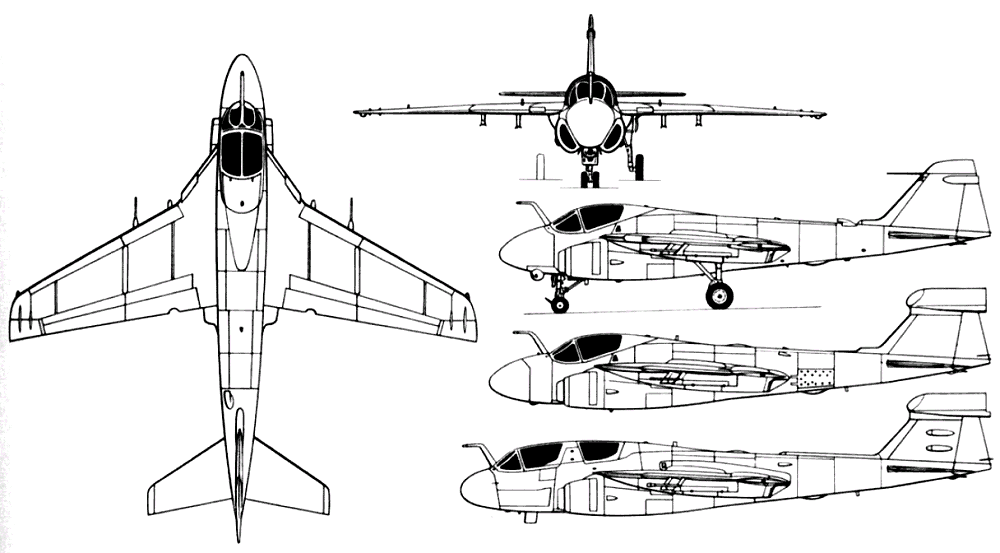


Hey Jule. Thanks for the fast response. And your info is extremely helpful. Was there any test equipment designed for the ASQ-61, or was it all oscilloscopes and soldering irons? Also, was the computer 8 bit with 4K memory on the drum?
I trained on the A-6A DIANE system, but then went to a squadron that was receiving new A-6Es with ASQ-133 (IBM) computer based on 4 /pi. 16 bit all solid state with 128K memory. Also newer radar (still by Norden) with built in target tracking. Later went to first squadron with TRAM equipment. Amazing how technology marches on.
Thanks again for your service (and knowledge)
Bill
reply