|
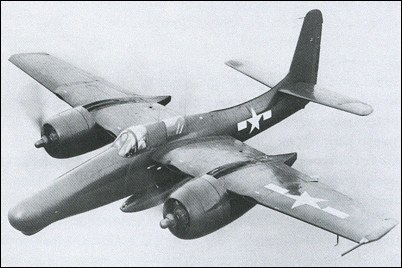
| Very different from the Grumman 'cats' which had preceded it, the F7F Tigercat (as it became known) was designed as a twin-engined fighter-bomber for operation from the then new Midway class of aircraft carriers displacing 45,000 tons. In fact it was not until 1945 that F7F-4Ns were delivered equipped with arrester gear and suitable for carrier operations. In spite of its size, speed and tricycle landing gear, the Tigercat also operated successfully from carriers of the Essex class.
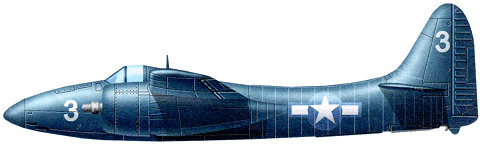
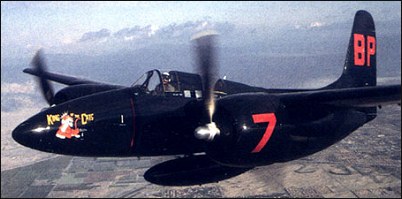
The prototype XF7F-1, which flew for the first time in December 1943, had been designed for a close-support role. To provide high performance and the capability to carry a heavy weapon load, it was powered by two 1,565kW radial engines mounted in underwing nacelles. Deliveries of single-seat land-based production F7F-ls to the US Marine Corps began in April 1944, but only small numbers entered service before production of a two-seat night fighter was initiated - this having the designation F7F-2N Tigercat. Other variants included F7F-3 single-seat day fighters, similar to the -1, and -3N and -4N two-seat night fighters. Tigercats were developed too late for operational deployment in World War II, and while small numbers served post-war with the Marine Corps, these were soon displaced by first-generation jet-powered fighters/fighter-bombers.
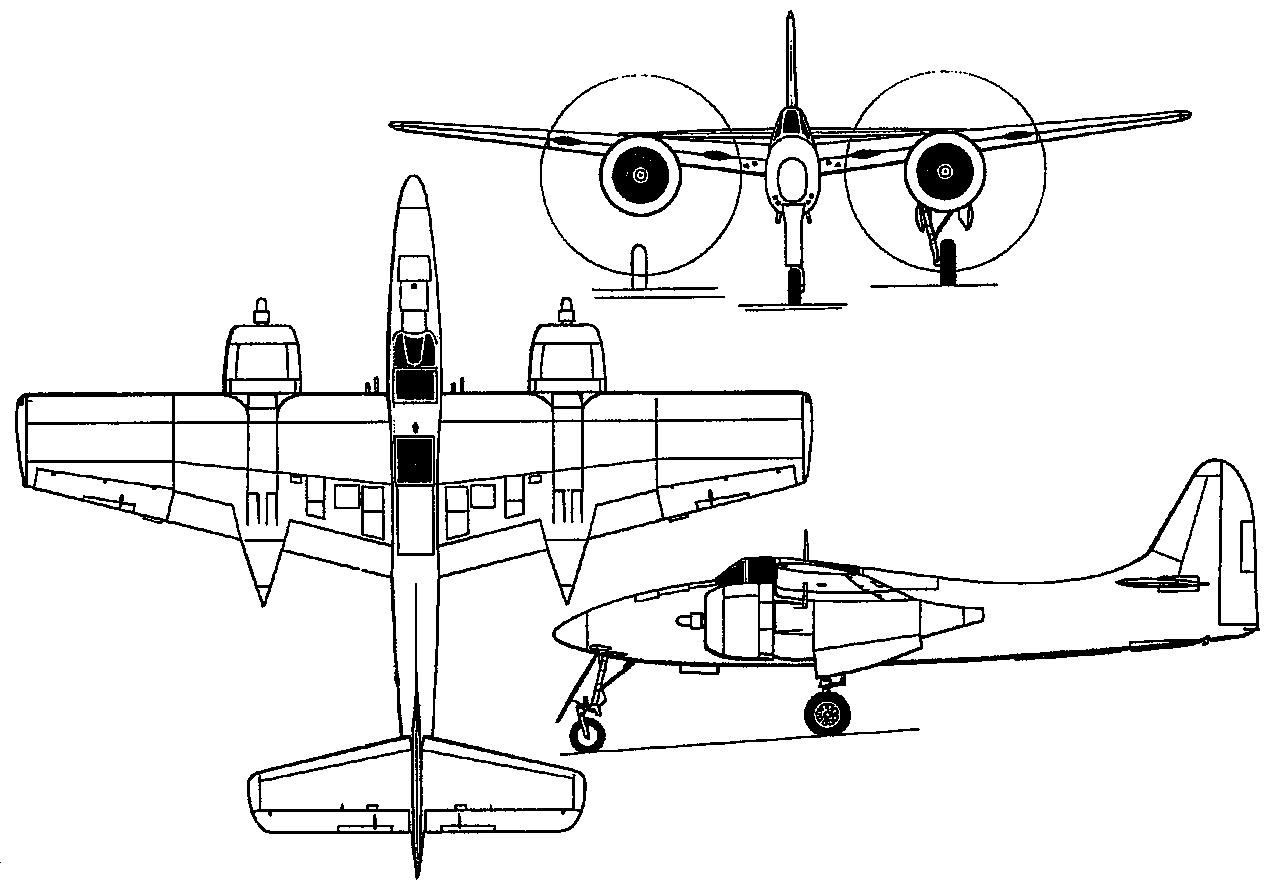
 | A three-view drawing of F7F-2N radar-equipped night fighter (1280 x 888) |
| MODEL | F7F-3 |
| CREW | 1 |
| ENGINE | 2 x Pratt & Whitney R-2800-34W Double Wasp, 1566kW |
| WEIGHTS |
| Take-off weight | 11666 kg | 25719 lb |
| Empty weight | 7380 kg | 16270 lb |
| DIMENSIONS |
| Wingspan | 15.7 m | 52 ft 6 in |
| Length | 13.83 m | 45 ft 4 in |
| Height | 5.05 m | 17 ft 7 in |
| Wing area | 42.27 m2 | 454.99 sq ft |
| PERFORMANCE |
| Max. speed | 700 km/h | 435 mph |
| Cruise speed | 357 km/h | 222 mph |
| Ceiling | 12405 m | 40700 ft |
| Range | 1931 km | 1200 miles |
| ARMAMENT | 4 x 20mm cannons, 4 x 12.7mm machine-guns, 2 x 454kg bombs, 1 x torpedo |
| eric slind, e-mail, 29.12.2016 04:14 when I was stationed at Quantico in the late 60's there was one of these in a quonset hut near the air strip...I used to go over there and peek at it at least once a week and have always wondered what happened to it. reply | | Michael Upton, e-mail, 06.02.2016 02:54 In the 1970's would ride my bike over to the Santa Barbara airport and one or two of the tanker F7F's would be sitting there ready to go during fire season. I was a very lucky youngster,I think I saw every one of the World War II,immediate post war and Korean vintage types being used as firefighting aircraft with the exception of the Martin Mars,the Savage and the Guardian. Even saw the TBMs. To think of it now, it was amazing. reply | | Bill Eudy, e-mail, 16.12.2014 05:07 What a lovely aircraft. I do wish the could have worked out the carrier landing, folding wing, engine and arrestor gear issues more promptly so this plane could have made a greater contribution. reply |
| Joseph taylor, e-mail, 07.11.2014 09:05 As a very young man maybe 11 years old my mom and I would visit Washington to spend time with her brother and family. I would get bored and ride my cousins bicycle and somehow found myself at one end of the runway at Anacostia . There was a tree outside the fence and between the fence and the bridge. I would spend the afternoon up in that tree watching the F 7's take off until all activity ceased. I am 75 now and that time is one of the greatest memories of my life. The sound of the F 7 is imbedded in my memory. reply | |
| | John Preston, e-mail, 05.10.2012 15:41 I was a combat aircrewman with vpb-116 on Iwo Jima. On August 7 1945 a squadron of F7's landed on Moto 3 airstrip, ready to "beat the Japs". Hostilities had ended. I never saw such a bunch of dejected guys. On 9 /29 /12 I saw "bad kitty" fly at Paine field. What a thrill' reply | | Reza, 24.09.2012 20:39 Did carrier landing trials in 1945. Was used to the Hellcat, had some difficulty. Got waved off twice. I was so embarassed! reply | | Bob Young, e-mail, 12.08.2012 01:21 As a reply to "Bogus" above, (Kd4cee=bellsouth.net) I too was stationed at NATTC Norman, OK. I arrived the day after Thanksgiving in 1955 and was transferred to Memphis, TN about the second week of March 1956. My memory of that F7F is very vivid but very sad. After finishing school about a week was spent doing service work before transferring. One day I watched a man stand on the starboard horizontal stabilizer and with a fire axe chop into the vertical to get to the rudder cables. The plane was being scraped. A better memory was how surprisingly narrow the fuselage was. Anything other than head on views always make the plane look much bulkier than it was. reply | | William, e-mail, 22.03.2011 23:50 I flew as RIO in the F7F-3N. I had 49 combat missions inm Korea in 1952. Got shot down on my 49th. Great airplane, little cramped in the rear, especially in really cold weather reply | | Richard, e-mail, 12.12.2010 20:35 Was aboard cv38 Shangri La when the F7F made its Quals
NG Wings came of. Beautiful bird. reply | | Ron H, e-mail, 12.12.2010 02:27 I flew 50 missions in Korea in the F7F-3n. It was one tough airplain. One of the reasons they called Grumman the aviation iron works. reply | | Aaron, e-mail, 01.10.2010 07:55 I have read that the F7F was the fastest accelerating fighter to become operational in WW2. In the August 2002 issue of Flight Journal Corky Meyers (Grumman test pilot) had this to say conserning the F7F:
"For many years Capt. Trapnell was the top test pilot in the Navy; his word was law, both in the Navy and industry flight-test circles. An example of his influence: he came for a three-hour flight evaluation of the first XF6F-3 Hellcat soon after its first flight and he gave the official Navy go-ahead for mass production on that day! The Hellcat eventually passed all of its contractual demonstrations two and a half years later, after more than 8,000 aircraft had delivered to fighting squadrons! Also, to his credit, the Hellcat racked up a record 19 to 1 kill-to-loss ratio the highest recorded in WW2.
When he came to Grumman to conduct the preliminary evaluation of the Panther in early 1948, I was the only Grumman test pilot who had flown the company's first jet fighter. At every opportunity during his three-day evaluation, I tried to pry his opinions out of him; his only responses were grunts, which I enterpreted as "Cool it, Corky!" At the end of his evaluation, as we walked out to his F7F-4N Tigercat for his return trip to the Naval Air Test Center, I proudly told him that I was the Tigercat project pilot from 1943-1946. He immediately burst into a diatribe about the Tigercat's many deficiencies: the over-cooling of the engines; a lack of longitudinal stability; excessively high dihedral rolling effect with rudder input; the high, minimum single-engine control speed, etc. He ended his oration with: "If I had been the chief of the Test Center at the time, I would have had you fired!" Each criticism of the Tigercat was absolutely correct. I was devastated and fervently wished that I hadn't gotten out of bed that day.
Just as we reached his Tigercat, I blurted , "If you dislike the Tigercat so much, why do you always fly it?" He explained: "The excess power of its two engines is wonderful for aerobatics; the cockpit planning and the forward visibility in the carrier approach is the best in any fighter ever built; the tricycle landing gear allows much faster pilot checkouts; the roll with the power boost rudder is faster than the ailerons; an it has a greater range than any fighter in inventory." Again he was absolutely right. As he climbed up the ladder to the cockpit, he turned around, grinned and told me, "It's the best damn fighter I've ever flown." I realized he had thrown the entire test-pilot schoolbook at me with his succinct triade and that we were probably pretty close in our opinions regarding the handling characteristics that define a really good fighter. I went hom happy that night." reply | | Ron, e-mail, 08.06.2010 05:38 (Sorry but I posted before proofreading sometimes)
Anyway the F7F-3 Tigercat starts looking better and better Powered as it was, 2x 1,850 hp R-2800-34W. It's initial climb was 4,530 fpm! and maximum level speed as shown above, 435 mph. 8 guns, half of them 20-mm cannons for this -3 single-seater is great!
I just wish the folding wing variant wouldn't snap the wing lose on a hot landing when the cable grabbed on the carrier.
Range may have been better than the specs above, and that ceiling isn't bad either. reply | | Ron, e-mail, 08.06.2010 00:17 I must alter some of my last post. The Wasp Major was certainly powerful, especially injected to 3,500 hp potential. A twin could thus develop 7,000 hp! But it did disappoint those expecting 500 mph +. Some put thin F2G at a climb rate of 4,400 fpm, not bad but the F4U-5 and F8F beat it. The F2G did about 431 mph. No much better than the other 2 mentioned. It was a gas hog so it carried more to maintain endurance. That and the engine plus the added strengthening necessary and you sacrifice firepower and ordnance capacity. But 4 .50s are OK against the kamakaze. reply | | Ron, e-mail, 27.05.2010 08:53 It served in WW 2 (barely) like the F2G. So it could have had the wasp major power, 6,000 hp combined! And no torque!
What fighter of the war, or even 1946 could have kept up?
Even the 2 place model could have more than held it's own.
What ground support fighter could have beaten it for survivability? Even with the Double Wasps it did have standard, the Tigercat was very good for a short while.
Too short in my book. The big problem with the Wasp Major was torque and a twin design is the best solution. It could have even put early jets to shame! Who knows?
OK that may have made this hefty plane heavier, but power to weight would've still been under 5 lb per hp vs 6+ lb for the R-2800 powered F7Fs. I'm just sayin' what if. reply | |
| | Ron, e-mail, 27.05.2010 01:40 The wasp majors from the F2G Corsair should have been hung on this Grumman to make it a real TIGERcat. The monster torque this engine had would be a non-issue with the twin. At last a prop Grumman with real speed and enough power for it's weight. It would have lasted much longer despite the jet age.
Ideal for Korea too. reply | | Joe, e-mail, 28.04.2010 10:26 Dear Shipmate,
I served in the Royal Australian Navy as an Aircraft Handler on our last carrier HMAS Melbourne during the late 70's.
I now collect copies of 'privately' filmed (8mm or video) carrier films as a hobby as well as PLAT footage, mishaps and other items filmed by Navy cameramen aboard carriers. I would like to swap copies of any carrier flying footage you may have, especially home video or mishaps film.
If you have any footage and are interested in sharing with a fellow ship mate, please reply and ask for my swapping list.
Long time Tailhook member.
Regards Joe jkaposi@hotmail.com
Sydney Australia reply | | Van Gardner, e-mail, 19.02.2010 18:41 In late 1950 just before I went into the navy about once a month I would see one buzzing Griffin, GA and land at the airport. I went to the airport and got to look it over really good. I was surprised at how big it was and as I stood under the main wheel well there was an alcohol tank there for injection into the engine.
I found out that the pilot was a Colonel in the Marines stationed at the pentagon in DC. His father was a President of one of the banks in Griffin and about once a month he would fly to Griffin and have lunch with the family and get his flight hours in to keep current. They lived on the street behind my Mother-in-law's house and he would buzz them when he arrived and they would go to the airport and pick him up. We all knew when he arrived because you can't miss the sound of two 2000 hp radials just above the tree tops.
One day I went to the airport to watch him take off. He left to the east and climbed to a few thousand feet and turned back in a shallow dive and buzzed the field at max. speed. To this day I still remember that as the fastest I had ever seen a prop plane do that.
In 1952 I was sent to the navy Fire Control Technician school in Anacostia, DC. It was just north of the South Capitol Street bridge and the Naval Air Station was just south of the bridge. This is where the F7F and F8F planes were stationed. Every time they would take off to the north they would have to climb full power to clear the approach to the bridge and this would really rattle the windows in the school building. The instructors would just stop talking until all the planes left.
The first weekend I had off I went to the NAS to see if I could get a ride to Griffin with the Colonel to see my wife. I would have loved to take that trip in the back seat of an F7F as he never brought anyone with him. The people in Flight Ops knew him but did not know when he would be going again. I was never able to make connections with him and after a few months went to Griffin and bought a house trailer and brought my wife to DC.
In May 1952 I was assigned to Guided Missile Testing Unit (GMTU-21) aboard the USS Mississippi EAG-128 at Norfolk, VA. To test the Terrier missiles we would shoot at F6F Hellcat drones launched from near Chineoteague Island, VA. The drones would be launched and guided out to the ship by a F7F Tigercat mother plane. The back seater would fly the drone. There would always be two armed F8F Bearcat chase planes to shoot the drone down if they lost control of it. When they got to the ship our plotting room would take control of the drone and fly it for the test. reply | | Richard, e-mail, 18.01.2010 02:15 An F7F converted to a water bomber crashed at Fortuna, California in the early 1970s. reply | | Tom Speer, e-mail, 07.01.2010 00:44 While in the Navy in the mid 50's I saw F7's at Gitmo. They were 2 cockpit versions flown by enlisted Marine pilots for ORI missions on surface ships and the rear seat pilot radio controlled orange target F6F's which were shot down by ship defense weapons. My first time in Gitmo I saw nearly 50 F6's and several months later on another deployment only half as many. The F7's flew frequently at that time. A beautiful sight for a young man taking lessons in a J3. Had a shipmate hitch a rideon a shore day. reply | | Don McPherson, e-mail, 28.11.2009 23:54 My father flew the first F7F in LA down from NAS Alameda. The skipper of his squadron didnt think that it would be able to land at NAF Tustin (where the blimp hangars are), because, it only had /has a 2000 foot runway and a 500 foot emergency extension. My father was a Chief AP at the time and he was told to take the bugsmasher with a co pilot and fly up to Alameda and bring the bird home...Dad read the manual when he got there and after an hour or so, cranked up those 2 R2800's and went flyin'. The bugsmasher couldnt keep up (JRB)...Chief Aviation Pilot Don McPherson, Sr. touched down on the numbers and was taxing off the duty at 1500 feet!!! the saltiest rate in the navy...later a mustang Lcdr....
Don McPherson, jr...another sly and cunning Naval Aviator who bears watching at all times....F4B's with fighting 143..world famous Pukin' Dogs....semper dog!! reply |
|
Do you have any comments?
|
| 
COMPANY
PROFILE
All the World's Rotorcraft
|




I agree! I am working on an article about this beautiful fighter-bomber for an aviation website, and always wish it could have been used during actual combat- other than the shooting down of 2 North Korea bi-planes during the Korean War...
reply