|
| In 1931 a very young American aviation manufacturing company - Grumman Aircraft Engineering Corporation - received its first contract from the US Navy for a carrier-based fighter of biplane configuration. Under the designation FF (fighter) or SF (scout), they marked the beginning of an association which seems certain of remaining unbroken for at least a half-century. In that period some remarkable naval aircraft have originated from Grumman, earning the trust and respect of those who have flown them in peace and war.
The company's first carrier-based fighter of monoplane configuration was designed to meet a US Navy requirement which originated in 1935, but it was not until July 1936 that the Navy ordered this aircraft, under the designation XF4F-2. In its developed service form it was to prove an outstanding naval fighter of World War II, but when first evaluated against a competing design from the Brewster Aeronautical Corporation, it failed to be selected for production, despite being some 16km/h faster than the Brewster design.
To overcome the shortcomings of the XF4F-2, a new prototype was built with a more powerful two-stage supercharged engine, and airframe revisions which increased wing span and brought changes to wingtips and tail surfaces. In this form the XF4F-3 flew for the first time on 12 February 1939.
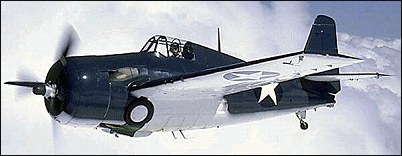
The Wildcat was first ordered by the US Navy in 1939 and the F4F-3, F4F-4 and F4F-7 (a special long-range photographic-reconnaissance version of the F4F-4) were all built by the Grumman company. Concurrently the British Martlet (later renamed Wildcat) Mk I to IV were Grumman-built.
In 1942 the manufacture of the Wildcat was transferred to the Eastern Aircraft Division of the General Motors Corporation. The first FM-1 Wildcat, assembled from parts supplied by Grumman, flew on 1 September 1942. By 11 April 1944 the Eastern Aircraft Division had produced its 2,500th Wildcat. The FM-1, fitted with a Pratt & Whitney R-1830-86 engine, was virtually the same as the F4F-4 (Wildcat IV). The FM-2 (Wildcat VI), which went into production in 1943, was fitted with a Wright R-1820-56 engine of greater power but lower weight than the previous unit, had a redesigned tail unit with a taller fin and rudder and had the oil coolers removed from the under surface of the centre-section to the cowling, which was revised in shape. The removal of the oil coolers permitted the installation of universal racks under the inner wings for bombs or auxiliary fuel tanks.
Altogether nearly 8,000 Wildcats were built, three-quarters by the Eastern Division. These were used operationally by the US Navy on a wide scale in the Pacific (FM-2 in particular serving as light escort carrier fighters), participating in the battles of the Coral Sea and Midway, and were used extensively in the attack on Guadalcanal. Although somewhat inferior to the Japanese Zero, the rugged Wildcat proved invaluable in the early stages of the war in the Pacific, until gradually replaced by more effective fighters from 1943, although the type remained in first-line service until the end of the war. British Martlets initially replaced Sea Gladiators and, like their US Navy counterparts, remained operational until the end of the war.
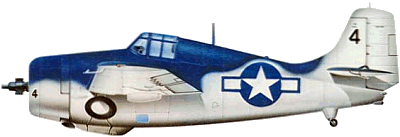
| MODEL | F4F-4 |
| CREW | 1 |
| ENGINE | 1 x Pratt & Whitney R-1830-36 Twin Wasp, 895kW |
| WEIGHTS |
| Take-off weight | 3607 kg | 7952 lb |
| Empty weight | 2612 kg | 5759 lb |
| DIMENSIONS |
| Wingspan | 11.58 m | 38 ft 0 in |
| Length | 8.76 m | 29 ft 9 in |
| Height | 2.81 m | 9 ft 3 in |
| Wing area | 24.15 m2 | 259.95 sq ft |
| PERFORMANCE |
| Max. speed | 512 km/h | 318 mph |
| Cruise speed | 249 km/h | 155 mph |
| Ceiling | 12010 m | 39400 ft |
| Range | 1239 km | 770 miles |
| ARMAMENT | 6 x 12.7mm machine-guns, 2 x 45kg bombs |
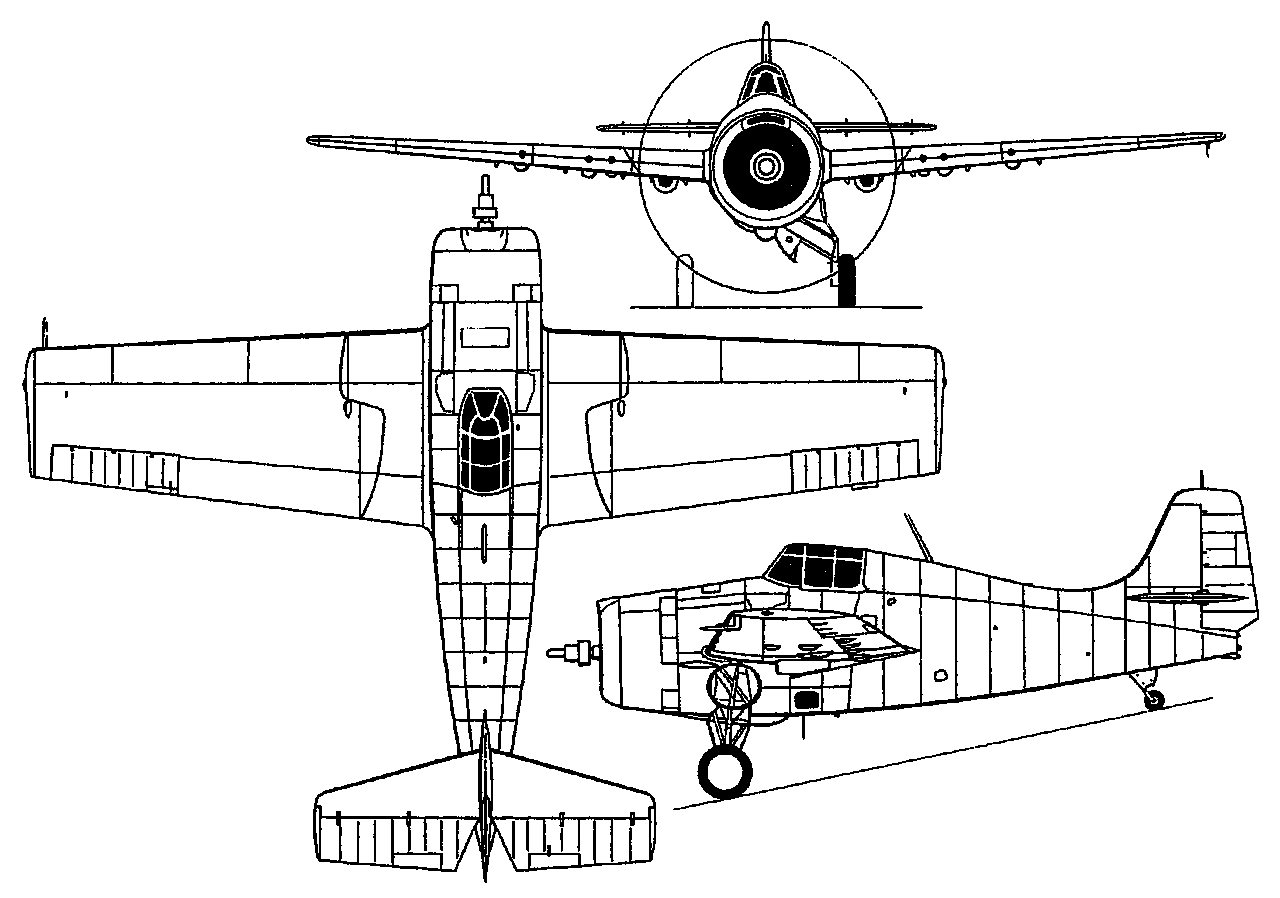
 | A three-view drawing of F4F-4 Wildcat (1280 x 898) |
| Ron, e-mail, 09.02.2017 04:52 It's amazing that both sides produced this class of obsolete fighters till the end of WW2. The A6M and Ki 43 were like the Wildcat that way. Furthermore, the claims were still higher than expected for the FM-2. Reminds me of the under-gunned Oscar garnering over 50% of all the claims by Japanese fighters. The anemic firepower 4x12.7mm armed FM-2 did quite well too. All 3 were armored in late-war models and were very slow for 1944-45 fighters. Acceleration had suffered from weight gain. Especially for the 5 gun Zeros. reply | | Ron, e-mail, 29.08.2014 10:40 To correct my post for the roll rate of the F4F-3,
the fast roll should be 62 deg /sec @ 340 mph.
The NACA REPORT No. 868 has a number of fighters' roll in deg /sec per mph in a chart on page 40. reply | | Mac, e-mail, 22.03.2014 09:47 I remember my father telling me that right before he joined the Navy during WW2, he would see these airplanes being taxied across route 1&9 from the Linden,NJ General Motors factory over to Linden airport. There they were flown to various destinations. I beleive the GM wildcats were designated F4M, and had a better top speed and a larger verticle stabilizer. Tough airplane. reply | | Hiroyuki Takeuchi, e-mail, 23.03.2012 11:23 I will add that the Zero pilots held the F4F in high respect during the Solomons fighting. At the time other Allied fighters were P-39, P-40, Buffalo, and later early model F4Us and P-38s. To the experinced pilots then piloting the Zeros, the faster but heavier Army fighters could be evaded, if watched properly, but the F4Fs could match them in dog fihgts on nearly even terms. And it shows on combat records. During the fighting in the Solomons, both sides claimed to be victorious to each other, but actual scores are very close to being even. reply | |
| | neiyi, 21.06.2011 06:09 hold on tight because many wrists were injured by letting it freefall. But what a fun airplane to fly,the narrow landing gear made landing tricky.Thanks for the memories FWP reply | | deaftom, e-mail, 04.04.2011 21:59 Phil Earl,
Grumman had a plant in St. Augustine, Florida, which is still being used by Northrop Grumman for building the E-2D Hawkeye. reply | | Aaron, e-mail, 31.10.2010 15:33 Ross,
The F4F had a floating seat which allowed the pilot to momentarily move and use the lower windows for downward vision much like the F2A Buffalo. reply | | ross graham, e-mail, 18.10.2010 01:06 can anyone explain the window in the floor? reply | | Chuck Purcell, e-mail, 13.10.2010 06:29 On December 1944,our squardon FF46 was station at Ponam Island Admiralty, just , on the island of Manus tey had a repair outfit, ad we had to furnish pilotto test there plane after repairs, I was assinged and flew the Wildcat one time reply | | Aaron, e-mail, 12.08.2010 08:46 Everything said so far is true so I don't have much to add but some stats. In an USN report titled TAIC REPORT NO. 17 dated November 17 a combat evaluation of a ZEKE 52 (A6M5) pitted against an F4U-1D, F6F-5 and FM-2 the following was reported:
The best climb of the ZEKE was about 400 fpm. less than the
FM-2 at S.L. The FM-2 was progressively slower than the ZEKE above 5,000 ft. but at S.L. the FM-2 was 6 mph. faster.
Rolls were equal up to 160 mph. then the high control forces of the A6m5 took its toll.
Turns of the two were very similar. The ZEKE could gain one turn in eight at 10,000 ft.
SURPRISE: The Zeke was slightly superior to the FM-2 in initial acceleration, then equal.
MANEUVERABILITY: ZEKE slightly superior below 175 kts. FM-2 has the advantage above 200 kts. reply | | Aaron, e-mail, 12.08.2010 08:48 Sorry, when I said SUPRISE I forgot to mention: when diving. reply | | john j cozy, e-mail, 15.08.2010 20:20 at 15 years of age,my Dad,a Navy Lt. got me on the Coral Sea for three days when the mid shipmen were on manuevers in the caribbean.Watched all kinds of planes leaving and returning for the duration I was aboard.A fond memory I still cherish to this day. reply | | Ron, e-mail, 20.05.2010 08:46 The F4F-3 could dive at a velocity of 480 mph. It needed some advance warning to climb to altitude in order to capitalize on this dive advantage. Initial climb was 2265 f /m; 1950 f /m for the F4F-4 (but it dove faster).
The General Motors FM-1 of 1943, reverted back to the 4 guns of the F4F-3 with the longer lasting ammo (and the lighter weight of less guns).
The 7487 lb FM-2 had a more powerful yet lighter 1350 hp Wright Cyclone engine and taller tail-fin. The FM-1 and -2 had initial climbs of 3300 f /m and 3650 f /m respectively. The 332 mph FM-2 was still in production till the end of WW 2! Too bad they didn't get it right earlier. By now the 487 mph P-51H was in service (if not combat) and the agile new Grumman F8F Bearcat was working up in the Navy carrier squadrons for goodness sakes. The GM lines should have accelerated F8F production instead of stringing along the FM Wildcats if you ask me. reply | | Ron, e-mail, 20.05.2010 04:22 The roll rate of the F4F-3 caught up to that of the A6M2 Zero 21 : 56 d /s @ 154 mph and peaked at 69 d /s @ 240 mph vs 55 d /s for the A6M2 a@ 240 mph. At 380 mph (limit), Roll for the F4F-3 was 65 d /s vs 42 d /s for the A6M2 model 21 Zero.
Thus the well informed US pilot could outperform the Zero in some ways (rolling dive). The A6M2 was inferior in the dive to the F4F by over 100 mph! Of course the initial climb of the Zero was about double that of the Wildcat. So climb only after diving. Same goes for turns. The A6M2 is perhaps in the 11 seconds / 360 turn range at slow speeds (180 turn in 5+ seconds). reply | |
| | Ron, e-mail, 19.05.2010 23:53 Seems the US pilots liked the 4 gun F4F-3 with over 30 seconds of ammo than the F4F-4 with 6 guns and only 20 seconds for the same total ammo load spread thinner. The extra guns also reduced agility and climb further. But the British navy liked the extra firepower against the Luftwaffe.
This wasn't really necessary against the Japanese planes in 1942. Initial climb fell under 2,000 fpm for the extra weight of the F4F-4. In FM form it was produced even after the F6F replaced it on the main carriers.
Still, the Wildcat ended the war with a kill ratio in it's favor of about 7 to 1! reply | | Ron, e-mail, 19.05.2010 23:05 As much as I disdain the cartoon looks of the F4F, I have to respect it's record. The Navy dropped the Buffalo like a hot potato in favor of the Wildcat and it didn't hit a brick wall above 15,000' like the Army P-39 and P-40 Allison powered contemporaries. It was no less vulnerable than they were and turned better. Of course, it's slow turn and climb were not as good as the enemy Zeke and Oscar but it could dive their pants off. reply | | Phil Earl, e-mail, 27.08.2010 01:22 Where in Florida did Grumman have Aircraft plants in Florida? Jacksonville was one, were there any others? reply | | Aaron, e-mail, 03.09.2010 02:02 Military report on water injection tests of Model FM-2 No.16169 (TED No.PTR 0416). U.S. Naval Air Station, Patuxent River, Maryland, May 31, 1944:
Test weight: 7418 lbs. Engine: Wright R-1820-56. Horse Power: 1,475 at 57.8 inches of boost. Initial Climb Rate: 3670 fpm. Max. Speed: 312.5mph /SL. 329.5mph /15,300ft. An accompanying graph chart shows that at War Emergency power speed could be boosted to 334mph /14,000ft.
In another report PROJECT TED NO. PTR-1115, where a Kawasaki ki.61-1 (Tony I type 3) was tested against an FM-2, F6F-5, F4U-1D, F4U-4, F7F-3 and F8F, the following were listed as advantages of the FM-2: A.Superior in rate of climb at all altitudes. B.Superior high speed roll. C.Equal or slightly smaller turning radius.
The report lists the disadvantages as: A.Slower speed at all altitudes. B.Inferior in acceleration. reply | | Electric Joe, e-mail, 24.12.2009 08:22 The F4F has been maligned largely due to fighter pilots' dissatisfaction at not having something better. No pilot likes to see another plane out-perform his in any respect. Many an F4F pilot witnessed an A6M Zero performing better aerobatically and did not like it.
In fact, aerobatic performance isn't everything. Wildcats carried better radios, permitting their pilots to employ better tactics. They were more rugged, dove faster, and packed more fire-power of a fighter-killing nature. By comparison, the A6M climbed faster and performed better aerobatics, and had slightly better level speed, but the pilots lacked the ability to coordinate by radio (at least in early models and while Japanese pilots chose to begrudge the weight to attain more aerobatic performance) and suffered from poor armament--machine-guns too light and too few to bring down a fighter effectively, and slow-firing, low-velocity cannon with limited ammunition more suitable to attacking bombers.
The fact that so many F4F pilots lived to gripe about the plane's inadequacies is a testament to its strengths. And its combat record against the vaunted Zero was hardly one of a "dog" of a plane dominated by a "stallion." It was essentially a one-for-one exchange between very different aircraft built to meet different requirements. reply | | Leo Rudnicki, e-mail, 02.06.2009 03:55 Apparently, Christian, you have not read any of Eric "Winkle" Brown's books. World record for most different aircraft types flown (457) and most carrier deck landings as well as first twin ( mosquito) and first Jet (Vampire) on a deck. When Britain didn't have a carrier fighter, the Wildcat (Martlet) was there. In production. The fact that the zero outperformed the Wildcat is explained by the fact that Japan required it as a pre-requisite of going to war. The fact that the Wildcat was a superb naval fighter is shown by the fact that it served as FM-2, right to the end as an Escort Carrier fighter. It's ONLY peer was the Zeke, an aircraft which didn't protect it's pilot, and burned readily. I'm sure Grumman and the USN would not, and did not make that sacrifice. reply |
|
Do you have any comments?
|
| 
COMPANY
PROFILE
All the World's Rotorcraft
|