|
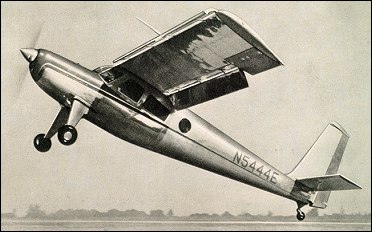
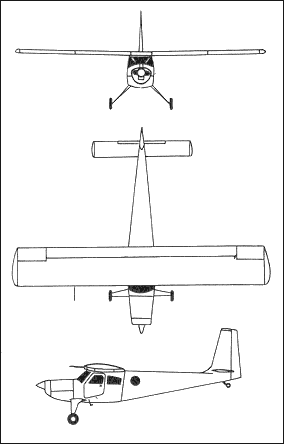
| The Helioplane Four or Courier prototype was derived from the Koppen-Bollinger two-seat lightplane (an extensively rebuilt Piper Vagabond, first flown in 1949) and production aircraft appeared in 1954. The improved five-seat H-391B Courier was followed by the H-392 Strato Courier, intended mainly for high-altitude photographic work, and the six-seat Courier Model H-250 of 1964. The latter was generally similar to the Super Courier, except for having a 186.3kW Lycoming O-540-A1A5 flat-six engine. The original H-395 and H-395A versions of the Super Courier six-seat light STOL personal, corporate and utility monoplane appeared from 1958. Three were supplied to the USAF for evaluation, under the designation L-28A. Further substantial orders were received subsequently, some aircraft being assigned to Tactical Air Command for counter-insurgency duties.
The final commercial versions of the Courier to be produced were the Super Courier Model H-295 with a non-retractable tailwheel landing gear and the Trigear Courier Model HT-295 with a non-retractable tricycle-type landing gear. The prototype H-295 flew for the first time on 24 February 1965. Production deliveries of the Trigear Courier began in 1974.
USAF Super Couriers were produced in three versions: the U-10A standard version with a Lycoming GO-480-G1D6 engine and 227 litres of fuel; the U-10B long-range version with twice the internal fuel capacity and paratroop doors as standard; and the U-10D inproved long-range version, with provision for an aerial camera and sound broadcasting equipment.
| CREW | 1 |
| PASSENGERS | 5 |
| ENGINE | 1 x Lyc. O-540-A1A5, 185kW |
| WEIGHTS |
| Take-off weight | 2000 kg | 4409 lb |
| Empty weight | 860 kg | 1896 lb |
| DIMENSIONS |
| Wingspan | 11.9 m | 39 ft 1 in |
| Length | 9.6 m | 32 ft 6 in |
| Height | 2.7 m | 9 ft 10 in |
| Wing area | 21.5 m2 | 231.42 sq ft |
| PERFORMANCE |
| Max. speed | 260 km/h | 162 mph |
| Cruise speed | 245 km/h | 152 mph |
| Ceiling | 4600 m | 15100 ft |
| Range w/max.fuel | 2000 km | 1243 miles |
| Harris Miller, e-mail, 11.03.2024 10:39 I want to use this opportunity to say a very big thank you to Dr Kuda for curing my HIV Disease. I was suffering from this disease for a very long time. I take different types of medicine from the hospital. There were no changes in my health last month. I am so lucky to meet a school mate of mine in a supermarket where I was getting some Items we spent one hour together I was telling him, what I have passed through all this time, he referring me to this gifted man Dr Kuda, how he cured his cousin with his powerful herbal medicine. i didn't believe at the moment, I went online to check about him, on till I saw a post about Dr Kuda Cured Hiv, I decided to give it a try i contact, Dr Kuda to help me with his powerful herbal medicine that a friend of mine told me about him, then I contact you for your help Dr Kuda give me his trust that he going to prepare his herbal medicine and send it to me by DHL Express after receiving the herbal medicine. I take it for two week, I go to meet my doctor in hospital for checkup after the checkup results come out that I am HIV negative, i'm so excited and happy today with the help of Dr Kuda you can also contact: drkudaspelltemple@gmail.com OR Text and Whatsapp Number +1 (346) 478-1991 reply | | qqeeprbxit, e-mail, 22.07.2020 18:45 Muchas gracias. ?Como puedo iniciar sesion? reply | | roger moore, e-mail, 19.10.2017 23:35 I flew the U10D with the Calif. ANG. It was a delight to fly and my first real tailwheel experireince. I think I was the only one in the outfit not to ground loop. It did have the highest accident rate in the USAF and was twice that of the F105. reply | | KC Hoefle, e-mail, 24.01.2016 09:45 Flew the U10B and D out of Bien Thuy in 1969. In Oct 69 all of the U10D from our base and Bien Hoa went to Thailand and turned over to the Thai Air Force. Great flight and spent a week in Thailand. All The U10B had wings removed and flown to Korea and given to Korean Air Force. I went with planes and instructed Korean Pilots in all SAW functions of the aircraft. Another great mission with 8 months in Korea and out of Vietnam reply | |
| | Joe Hancock, e-mail, 13.10.2015 03:39 To Terri Barnes, 12.06.2015 I was at Bien Hoa 64 /65 I was a radio tech. worked on all of the TWA aircraft (teny winie airplanes) as we called them U10's and O1's. all great craft.
The U10's, some had speakers and others dropped lieflets and also returned injured , many had to be washed out with water to fly agin. Hard work in bad times I guess. reply | | Terri Barnes, e-mail, 12.06.2015 09:05 I believe my father was the crew chief on a Helio U10 Super Courier used for psy-ops. He was at Bien Hoa in 1964 and 65. I have several of his photos of the aircraft, including one that shows the tail number 62-5907A. Another shows the speaker configuration, so perhaps that would be the D model? I'm finding information about these little planes and their "secret mission" is pretty hard to come by. My father's name was Jimmie Hurley. reply | | Ray Mansfield, e-mail, 27.01.2015 18:51 I knew one of the original investors in the Helio company and met Lynn Bollinger many years ago when I was just a kid. Got my first ride in one when I was 10 years old in Brooklin, Maine. The owner was Alan Bemis and he landed the plane on a grass strip up the street from my house in Brooklin. He's responsible for me being a corporate pilot today. See my email address......Great plane, I flew all over with Bemis in the late 1950s and early to middle 1960's before I had a pilot's license. He was a research professor at MIT. Last May I got to fly one belonging to the JAARS folks from NC.......still a great plane. reply | | Edward Lord, e-mail, 28.11.2013 19:25 Anyone have a lead on a Helio Courier for sale that is NOT listed for sale on the traditional aircraft web-sites... that could be outfitted with a "Tost" glider tow hook release...? I am located in Reno, Nevada. reply | | Dan Williams, e-mail, 13.10.2013 00:13 Three on board this aircraft when flipped over side of mountain in north Laos. Engine gone, one wing off, tail end almost off aircraft.
Only me had small cut on head. the passenger frame in this aircraft strong and well engineered for safety.
Was unable to exit aircraft due to shoulder harness not releasing when upside down and right seat no exit until pilot exits thru only up front door on left side. reply | | don, e-mail, 10.08.2013 19:14 i am a private pilot with a cessna 182. back in the 70's i met a guy who said he flew helios and dropped phamplets only because he refused to fly fighters as he was anti war! needless to say, we got into a terrible fight, because as far as i was concerned, he was a traitor! do any of you guys know of other pilots doing the same thing as described? reply | | richard l. taylor, e-mail, 01.08.2013 00:01 I would like to use your photo of the Courier (at the top of this page) in my memoir, soon to be published. May I have your permission to use this image with appropriate attribution?
Thank you,
R.L. Taylor reply | | Lynn Garrison, e-mail, 21.04.2013 21:26 We used on as a photo aircraft on Roger Corman's RICHTHOFEN & BROWN production, filmed in Ireland during the summer of 1970 G-ARMU had just been purchased for $4500.00 American by some Brits.
We operated the Helio with my collection of War One aircraft with the camera pointed out the port door. I would use flaps, power and then cross-control the aircraft to hold the starboard wing up, and out of shot. This was around 45 knots and the aircraft was very stable in this condition. This was really a low-budget camera mount when compared with our Alouette 111.
I flew the aircraft near its limits, and had a lot of fun. Unfortunately, the less-experienced owner took it back to the UK and tried to replicate something from the front yard of someone's country estate and broke it in three pieces. reply | | Paul Richard, e-mail, 16.10.2012 22:51 Owned two one 295 one 250 for 20 years both had cross wind gear very useful total time in helio's 2300 plus hours excellent aircraft never bent one but had one emergency landing no damage. Oil pump failed. reply | | Tom, e-mail, 20.07.2012 03:24 I belonged to an ANG Commando Sq in the 1960's.We got 4 Helio's (U10) in the Spring of 1963 with the geared 295 hp engine. Our missions were low-level night, blackout landings, etc. I became IP in them and really enjoyed flying them. AF took them away from us in 1964 saying they needed them in Viet Nam. In 1966, while at Saigon, I saw several of them. reply | |
| | Andy Pilszak, e-mail, 20.06.2012 23:21 Saw your note on Virtual Aircraft Museum web site. I was with a group that flew two helios to Panama from Ft. Bragg. These were 63-13178, and 63-13180. The Army had 15 there and we took two of them to the 8th. SFG. at Fort Gulick (Coco Solo NAS). They were all painted various colors, and bore little resemblance to Army aircraft. This was in Dec. of 1968. reply | | Paul Zimmerli, e-mail, 01.04.2012 22:54 We used to show off the U-10s at our monthly firepower displays at Hurlburt when I was in the Information Office there between 1966 and 1969. We would put our super-VIPs on a bleacher on the back of a GI 18-wheeler, out on the grass by the runway. We would have a U-10 (with the pilot only and with the speaker gear, etc., removed!) touch down even with one end of the trailer and stop before reaching the other end. (Of course, the pilot chose which direction he landed in, to take advantage of the winds.) Then we would have it turn around and taxi past the VIPs, and turn around again. Running up to full power, he'd take off into the wind and have sunlight beneath his wheels before he reached the far end of the tractor /trailer again. Really spectacular and effective display! Our super-VIPs were everyone from cabinet members to billionaires (I remember being assigned to personally explain everything that was going on to H.L. Hunt!) to film stars to foreign dignitaries. I'm just surprised there was not more investment in the Helio company... reply | | Don Smith, e-mail, 26.11.2011 02:26 I was fortunate enough to fly the U-10 with the 6th Special Forces at Fort Bragg immediatly after flight school. What a piece of machinery! Too bad the Army did not see fit to keep it, once again the Army took second place to demands from the Air Force and everyone lost out. reply | | Curt Kenner, e-mail, 05.06.2011 16:49 I met a gentleman in the winter of '81 when I was flying out of Barnstable, Mass who claimed to be the designer of the Helio Courier. He was flying a yellow Ercoupe and stated he planned to tour the US in the ercoupe. He spoke knowledgeable of the dates of development and characteristics of the helio. could this have really been Otto Koppen? Anyone? reply | | Orville C. Rogers, e-mail, 15.03.2011 20:53 I was fortunate enough to have the opportunity of ferrying many of the Couriers to South America and Africa. For many years it was the work horse of JAARS,the aviation and technical arm of Wycliffe Bible Translors.In the fields, WBT is known as Summer Institute of Linguistics, where their personnel lived with the indigenous people groups, learned the language and translated the New Testament (typically)and taught them to read and write, having the word of God in their own "heart" language. The Courier has done a great job in the areas where airstrips are short and primitive. It is still flying in some areas but the shortage of avgas has forced mission groups to turn to turboprops, since jet fuel is more abundant and cheaper. reply | | J.R. Smith, e-mail, 11.03.2011 01:17 Fantastic aircraft. I crewed one for 20 months at Ft. Benning Ga. (Test and Evaluation and Control Group TEC) when testing the 11th Air Assult prior to becomming the 1st Air Mobility Cav. to prove itself in V-Nam. Also we used it to drop wannabe rangers off in the hinterlands of Ft. Bragg for jungle training. Fun aircraft in the swamps. I had 80 bootleg hours of flying time. Easy aircraft to fly. I understand L-10 did away with the cross-wind landing gear....good move! JR (Smitty) Smith reply |
|
Do you have any comments?
|
| 
All the World's Rotorcraft |