 |
Langley Aerodrome1903 |  |
| EXPERIMENTAL | Virtual Aircraft Museum / USA / Langley |
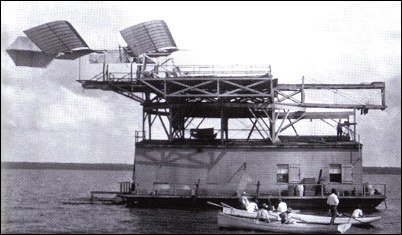 |
After success with various unmanned rubber, steam and petrol-powered model aircraft, US inventor Samuel Pierpont Langley progressed to a full-size man-carrying machine he called the 'Aerodrome'. Feeling it was safer to fly over water, Langley spent half the project cost (supplied by the War Department) on a houseboat fitted with a catapult launcher. He assembled his Aerodrome on the roof. His first attempt ended in collapse when the catapult force overstressed the airframe. On 8 December 1903 he tried again. The Aerodrome broke up and fell in the Potomac River. Nine days later the Wright Brothers flew at Kitty Hawk. As secretary of the Smithsonian Institution, Langley did all he could to promote his achievements and belittle the Wrights', leading to a long-lasting feud. FACTS AND FIGURES © Despite the perceived greater safety of flying over water, the Aerodtome had no floats or other gear for landing on either land on water. © Unlike the Wright Brothers, Langley had not appreciated the problems of control, and the Aerodrome had no ailerons or other method of steering except a rudder. © The Aerodrome was launched with the aid of a catapult, which would have ruled it out as the first self-powered manned flying machine, even if it had flown successfully.
|  All the World's Rotorcraft | ||||||||||||||||||||||||||||||||
|


|