 |
Learavia LearFan 21001981 |  |
| EXECUTIVE TRANSPORT | Virtual Aircraft Museum / USA / Learavia |
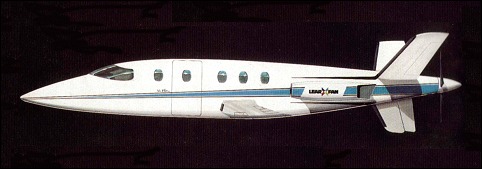 |
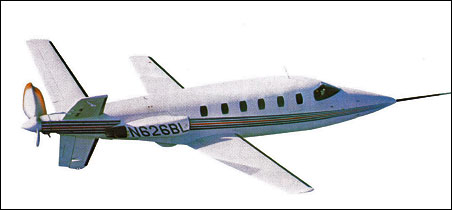
The story of the LearFan is a complex one. Designed by Bill Lear as a cheaper alternative to business jets, with nearly the same performance but a pusher propeller, the LearFan became the first business aircraft with a composite (carbon fibre) structure, as opposed to conventional metal construction. Unfortunately in the late 1970s this was all a bit radical for the Federal Aviation Administration, who repeatedly refused certification of the LearFan. Bill Lear died in 1978 and his widow carried on the programme, seeing the first of three prototypes fly in 1981. Problems with the gearbox, which managed the two PT-6 turboprops on a common shaft, and structural problems with the new composite materials caused costs to escalate, and despite orders and options at one time for over 130 aircraft, the company went bankrupt in 1984 with debts approaching 500 million dollars. FACTS AND FIGURES © The LearFan was made almost entirely of graphite/epoxy and Kevlar composite materials, and it was one of the first aircraft to make such extensive use of them. © Some critics have said the LearFan was designed too much like a conventional aircraft made of composites to make the best use of the strengths of these new materials. © Putting the propeller at the rear reduced drag and helped the LearFan approach jet speeds. © Some unfinished LearFans were used by NASA to test composite structures, being dropped from towers in controlled crashes. © To meet a deadline of the end of 1980, the LearFan's first flight was officially recorded as 'December 32nd'.
Karen Schwarz, e-mail, 13.08.2022  Reza Karamooz Reza KaramoozCool. My Dad worked on the Lear Fan. He was a structural engineer. Stress testing Reza Karamooz, e-mail, 13.08.2022 Karen SchwarzKaren, Dave, e-mail, 22.07.2023 GarryGarry- you're a complete and utter fraud. You stole my narrative from another site, copied it and called it your own. Get a life, pal and maybe you'd have something original to share. A$$hole. Karen Schwarz, e-mail, 13.08.2022 GarryDid you know my Dad Tom Schwarz and his co-corkers (Structural test engineers): Tom Schwarz, Mike Murphy, and Roy Benson? Sgt. Ronald Burcham, e-mail, 01.06.2022 GarryI'm trying to contact Trudy the wife of Bubba, Vance, Ramsey. He was a Lear painter about 1981,82 who relocated to Sparks from Savannah, Georgia. The Ramsey's tried to help me gain employment at Lear to no avail. I left a box of books and a tin of Kodachrome slides with them when I gave up seeking employment at Lear and returned to Georgia. Ronald L. Burcham, e-mail, 01.06.2022 william grahamI'm trying to contact Trudy the wife of Bubba, Vance, Ramsey. He was a Lear painter about 1981,82 who relocated to Sparks from Savannah, Georgia. The Ramsey's tried to help me gain employment at Lear to no avail. I left a box of books and a tin of Kodachrome slides with them when I gave up seeking employment at Lear and returned to Georgia. Karen Schwarz, e-mail, 13.08.2022 Larry BlairDid you know my Dad Tom Schwarz and his co-corkers (Structural test engineers): Tom Schwarz, Mike Murphy, and Roy Benson? Sgt. Ronald Burcham, e-mail, 01.06.2022 Larry BlairI'm trying to contact Trudy the wife of Bubba, Vance, Ramsey. He was a Lear painter about 1981,82 who relocated to Sparks from Savannah, Georgia. The Ramsey's tried to help me gain employment at Lear to no avail. I left a box of books and a tin of Kodachrome slides with them when I gave up seeking employment at Lear and returned to Georgia. Mahsa, e-mail, 06.11.2020 Larry BlairHello! I have a few questions of 2100 please email me if u can Sgt. Ronald Burcham, e-mail, 01.06.2022 Sgt. Ronald BurchamI'm trying to contact Trudy the wife of Bubba, Vance, Ramsey. He was a Lear painter about 1981,82 who relocated to Sparks from Savannah, Georgia. The Ramsey's tried to help me gain employment at Lear to no avail. I left a box of books and a tin of Kodachrome slides with them when I gave up seeking employment at Lear and returned to Georgia. Sgt. Ronald Burcham, e-mail, 01.06.2022 Mark WI'm trying to contact Trudy the wife of Bubba, Vance, Ramsey. He was a Lear painter about 1981,82 who relocated to Sparks from Savannah, Georgia. The Ramsey's tried to help me gain employment at Lear to no avail. I left a box of books and a tin of Kodachrome slides with them when I gave up seeking employment at Lear and returned to Georgia. Sgt. Ronald Burcham, e-mail, 01.06.2022 Tom RoseI'm trying to contact Trudy the wife of Bubba, Vance, Ramsey. He was a Lear painter about 1981,82 who relocated to Sparks from Savannah, Georgia. The Ramsey's tried to help me gain employment at Lear to no avail. I left a box of books and a tin of Kodachrome slides with them when I gave up seeking employment at Lear and returned to Georgia. Sgt. Ronald Burcham, e-mail, 01.06.2022 Dale LeierI'm trying to contact Trudy the wife of Bubba, Vance, Ramsey. He was a Lear painter about 1981,82 who relocated to Sparks from Savannah, Georgia. The Ramsey's tried to help me gain employment at Lear to no avail. I left a box of books and a tin of Kodachrome slides with them when I gave up seeking employment at Lear and returned to Georgia. Sgt. Ronald Burcham, e-mail, 01.06.2022 AntonI'm trying to contact Trudy the wife of Bubba, Vance, Ramsey. He was a Lear painter about 1981,82 who relocated to Sparks from Savannah, Georgia. The Ramsey's tried to help me gain employment at Lear to no avail. I left a box of books and a tin of Kodachrome slides with them when I gave up seeking employment at Lear and returned to Georgia. Sgt. Ronald Burcham, e-mail, 01.06.2022 AntonI'm trying to contact Trudy the wife of Bubba, Vance, Ramsey. He was a Lear painter about 1981,82 who relocated to Sparks from Savannah, Georgia. The Ramsey's tried to help me gain employment at Lear to no avail. I left a box of books and a tin of Kodachrome slides with them when I gave up seeking employment at Lear and returned to Georgia. Karen Schwarz, e-mail, 13.08.2022 ChuckI remember that!!! Sgt. Ronald Burcham, e-mail, 01.06.2022 ChuckI'm trying to contact Trudy the wife of Bubba, Vance, Ramsey. He was a Lear painter about 1981,82 who relocated to Sparks from Savannah, Georgia. The Ramsey's tried to help me gain employment at Lear to no avail. I left a box of books and a tin of Kodachrome slides with them when I gave up seeking employment at Lear and returned to Georgia. Heather Larkin Wilson, e-mail, 08.09.2020 ChuckChuck- did you happen to work with my father Larry Larkin? We were Americans at the Newtonabbey - Belfast plant Sgt. Ronald Burcham, e-mail, 01.06.2022 Dale LeierI'm trying to contact Trudy the wife of Bubba, Vance, Ramsey. He was a Lear painter about 1981,82 who relocated to Sparks from Savannah, Georgia. The Ramsey's tried to help me gain employment at Lear to no avail. I left a box of books and a tin of Kodachrome slides with them when I gave up seeking employment at Lear and returned to Georgia. asdf, e-mail, 20.04.2022 Dale LeierHi. I am going to make an aeroplane that takes some inspiration from the learfan. it will be a vtol plane. Are you interested in joining?
Sgt. Ronald Burcham, e-mail, 01.06.2022 Tom RoseI'm trying to contact Trudy the wife of Bubba, Vance, Ramsey. He was a Lear painter about 1981,82 who relocated to Sparks from Savannah, Georgia. The Ramsey's tried to help me gain employment at Lear to no avail. I left a box of books and a tin of Kodachrome slides with them when I gave up seeking employment at Lear and returned to Georgia. Ronald Lee Burcham, e-mail, 01.06.2022 Ron CampbellI'm trying to contact Trudy the wife of Bubba, Vance, Ramsey. He was a Lear painter about 1981,82 who relocated to Sparks from Savannah, Georgia. The Ramsey's tried to help me gain employment at Lear to no avail. I left a box of books and a tin of Kodachrome slides with them when I gave up seeking employment at Lear and returned to Georgia.
Karen Schwarz, e-mail, 13.08.2022 DavidDid you know my Dad Tom Schwarz and his co-corkers (Structural test engineers): Tom Schwarz, Mike Murphy, and Roy Benson? Sgt. Ronald Burcham, e-mail, 01.06.2022 DavidI'm trying to contact Trudy the wife of Bubba, Vance, Ramsey. He was a Lear painter about 1981,82 who relocated to Sparks from Savannah, Georgia. The Ramsey's tried to help me gain employment at Lear to no avail. I left a box of books and a tin of Kodachrome slides with them when I gave up seeking employment at Lear and returned to Georgia.
|  All the World's Rotorcraft | ||||||||||||||||||||||||||||||||||||||||||||
|


|
Hi Reza. I have a little history with Learfan. And a Syd Mead commissioned artwork that hung in Moya's office.
Cheers
Kevin
reply