|
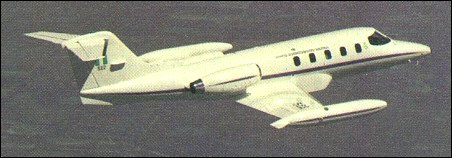
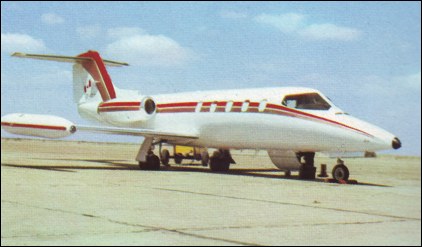
| The Learjet 25, first flown in prototype form on 12 August 1966, was basically a Learjet 24 incorporating a fuselage stretch of 1.27m to provide seating for the crew of two and eight passengers. Certificated on 10 October 1967, it was followed by improved Learjet 25B and Learjet 25C models in late 1970, the latter having additional fuel capacity; thus, the Learjet 25B and Learjet 25C corresponded respectively to the Learjet 24E and Learjet 24F. In 1976 incorporation of the new cambered wing and aerodynamic improvements introduced simultaneously on the Learjet 24 models resulted in new Learjet 25D and Learjet 25F versions of the basic Learjet 25 and, similarly, all four Learjets became available later with General Electric CJ610-8A turbojets certificated for operation at an altitude of 15545m.
In addition to civil operations, a number of Learjet 25s were acquired by air arms, including those of Argentina, Bolivia, Ecuador, Mexico, Peru and Yugoslavia. Their primary role in most cases was for high-altitude photography and remote sensing, with a large single or dual integral camera pod just forward of the wing. Such aircraft were convertible easily for high-speed cargo or VIP transport duties. Manufacture of the Learjet 25F ended during 1979, but the Learjet 25D continued to be built until August 1982, when the growing recession in the aircraft industry caused its production to be suspended indefinitely.
In January 1979 the company gained certification of the Learjet 28 and Learjet 29 Longhorn. Basically similar to the 10-seat Learjet 25D, these two models introduced a new wing of increased span. This incorporated a cambered leading edge and supercritical winglets to provide improved performance and cruise efficiency. The introduction of winglets displaced the wingtip fuel tanks of earlier models, which meant that all fuel had to be carried internally. Thus, the Learjet 28 had 10-seat accommodation, but the longer-range Learjet 29 traded two passengers for an additional 379 litres of fuel. However, wing manufacturing costs were considered prohibitive against the performance improvements gained and further development of both the Learjet 28 (five built) and 29 (two built) were terminated in August 1982. Around the same time, when sales of the Model 25 had reached 368, production was phased out in favour of the Learjet 35 and 36.
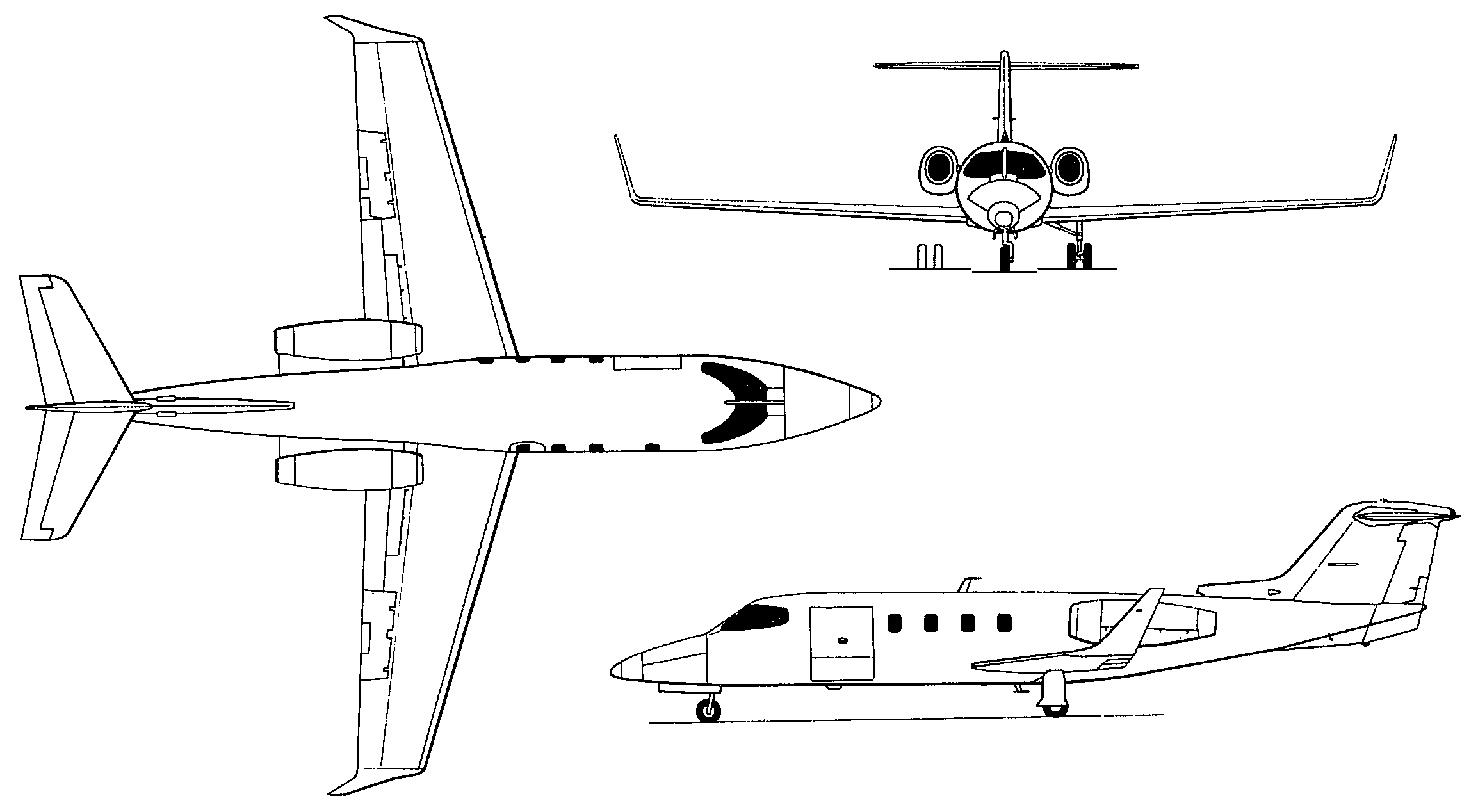
 | A three-view drawing (2308 x 1268) |
| MODEL | Learjet 29 |
| ENGINE | 2 x General Electric CJ610-8A turbojets, 1338kg |
| WEIGHTS |
| Take-off weight | 6804 kg | 15000 lb |
| Empty weight | 3730 kg | 8223 lb |
| DIMENSIONS |
| Wingspan | 13.35 m | 44 ft 10 in |
| Length | 14.52 m | 48 ft 8 in |
| Height | 3.73 m | 12 ft 3 in |
| Wing area | 24.57 m2 | 264.47 sq ft |
| PERFORMANCE |
| Max. speed | 884 km/h | 549 mph |
| Cruise speed | 756 km/h | 470 mph |
| Ceiling | 15545 m | 51000 ft |
| Range | 2549 km | 1584 miles |
| Frank Surfas, e-mail, 21.05.2013 00:43 The first jet I flew was a Lear 28. As my first F.O. job, it was quite a rare plane to get to fly. It climbed like crazy, but was fuel critical. reply | | Scott Boyd, e-mail, 06.02.2013 18:37 The wing is a single piece. A demate inspection lifts the fuselage off to check for corrosion. reply | | joe bickett, e-mail, 06.02.2013 02:03 I am curious if the lj23 wing was one single unit or two cant wings. The LJ23-25 training manual is confusing. Many pilots do not know for sure.
thanks reply | | Scott Boyd, e-mail, 07.02.2010 05:40 True the basic 25 cruises at .78M the Raisback conversion I flew could cruise at .80M. I knew a guy who was somewhat famous for flying around the World in a balloon who insisted he exceeded M1.0, but I seriously doubt it. Aerodynamically it could probably go to .90 or above, but the tip tanks and wing would keep it from getting much faster, at least in controlled flight. reply | |
| | Jock Williams, e-mail, 29.01.2010 21:13 Proof reading error!
Although the 104 and F5 could easily "cruise" around .9 and higher -If I remember correctly the Lear 25 was just in the .8 Mach range. The rest is valid -but we don't want to "gild the lily".
The Lear 25 is a good enough plane -particularly considering its birthdate -that it doesn't need to claim to do better than it does. mea Culpa!
Jock Williams Yogi 13 reply | | Mike Cook, e-mail, 15.12.2009 16:15 I was a mechanic for a Lear 25G, s /n 372. It was modified with Dee Howard extras such as saddle fuel tanks at the wing root, convergent /divergent exhaust nozzles, and some large strakes on the tip tanks and engine pylons. A real rocket and great aircraft. reply | | mike burdoo, e-mail, 26.09.2009 05:42 I was an electrical /avionics engineer on the 25 and worked on the 28 program in Wichita back in the early 70's. I believe 28-003 was in our service department recently down here at Bombardier in Tucson. 28-003 may have held a time to climb record. We built very few 28's, and even fewer 29's. reply | | bob, e-mail, 22.09.2009 21:32 jock williams yogi 13 was mistaken or real lucky, flying at .90 in a .82 airplane with a shaker and puller reply | | Richard Main, e-mail, 08.06.2009 21:29 In 1980 we chartered Lear 28 #3 for a NY to Naples, Fl. trip. It was the plane's first revenue trip. We climbed out of Westhampton, NY right on up to 51,000', and believe me, we were over grossed with people and baggage. It was an amazing trip in an amazing aircraft. I will never forget it. For my father's nurse, it was her first airplane trip of any kind - and at 51,000', no less. She never realized the event was as "record breaking" (altitude wise) as it was. I do remember alarms kept going off (chimes) up front (I was in the jump seat behind co-pilot) and as an amateur pilot, I was a little apprehensive. I would NOT do this today, being older and wiser, but I'm glad we did it then. reply | | Jock Williams, e-mail, 16.04.2009 17:36 I flew the Lear 25 for about 15 months -although sadly only 400 or so hours -but I loved every second!
It was a little rocket -cruised handily around .9 Mach but approached at no more than 120 kts. It felt like a TBird (T33).Tiptanks looked the same also -but in truth held WAY more fuel!
The only problem was that it burned fuel at low level like it was going out of style. The burn rate taxiing for takeoff was about 700 pph -the same as in cruise at 40,000 feet.
The boss always wanted us to fly at FL450 -but I kept telling him that the emergency O2 masks were inadequate should there be a depressurization.
Fortunately there never was!
I would love to have done an aerobatic airshow in this little beauty -but rules are rules...!
Jock Williams Yogi 13 reply |
|
Do you have any comments?
|
| 
COMPANY
PROFILE
All the World's Rotorcraft
|