|
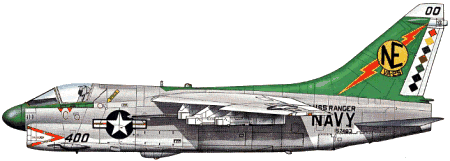
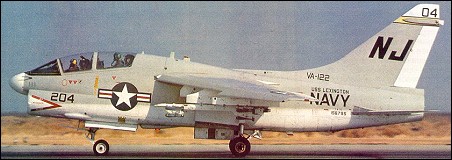
| On 11 February 1964 the US Navy named the former LTV Aerospace Corporation winner of a design competition for a single-seat carrier-based light attack aircraft. The requirement was for a subsonic aircraft able to carry a greater load of non-nuclear weapons than the A-4E Skyhawk. To keep the costs down and speed up delivery it had been stipulated by the Navy that the new aircraft should be based on an existing design; the LTV design study was based therefore on the F-8 Crusader. The first prototype flew on 27 September 1965.
| CREW | 1 |
| ENGINE | 1 x P+W TF-30-P-6, 50.5kN |
| WEIGHTS |
| Take-off weight | 16100 kg | 35495 lb |
| DIMENSIONS |
| Wingspan | 11.8 m | 39 ft 9 in |
| Length | 14.5 m | 48 ft 7 in |
| Height | 5.0 m | 16 ft 5 in |
| Wing area | 34.8 m2 | 374.58 sq ft |
| PERFORMANCE |
| Max. speed | 935 km/h | 581 mph |
| Cruise speed | 600 km/h | 373 mph |
| Ceiling | 16000 m | 52500 ft |
| Range w/max.fuel | 2200 km | 1367 miles |
| Range w/max payload | 585 km | 364 miles |
| ARMAMENT | 4 cannon, bombs and missiles |
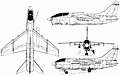 | A three-view drawing (1000 x 635) |
| Roger Chamberlin, e-mail, 08.03.2025 16:11 VA-122 SEPT 1966-SEPT 1968 VA-113 SEPT 1968-DEC-1969--I was an A-7A /B guy from day one when VA-122 received the first two at Lemoore NAS. And one of those landed(out of sight from the reviewing stands) with a smashed ray dome(bird-strike) Lots of TDA's to MCAS Yuma, then NAF Fallon and any boat down at North Island. Those first two years were interesting. Joined VA-113 in SEPT 1968 and then early in 1969 the squadron was moved to Cecil Field and in July off on a Med cruise on the Saratoga. I guess there is still some A-7 floating in my blood. reply | | Phil Butler, e-mail, 30.01.2018 06:50 I was an Aviation Ordnanceman 2nd Class (AO2) attached to VA-56 which was getting ready for its first Westpac Cruise. They had just transitioned from the A-4 to the A-7A and were going through carrier quals off the coast of California in the fall of 1969. My release from active duty date was 10 October '69, but I was a carrier rookie, never having any sea duty to that point. Several times I was chewed out on the flight deck by grizzly old chiefs who noticed I was a 2nd class AO, but didn't seem to have a clue about flight procedures or drills. They were absolutely correct! At first I didn't have a clue! One of my good buddies in VA-56 was chuck Ingram, another AO2 who was a flight deck veteran of several cruises. I tried my best to keep very close to Chuck at all times. Thanks, Chuck, wherever you are! The A-7A was a radically different aircraft from the A-4, and took a lot of heat because it was not a pretty aircraft in looks, but it really performed its tasks well, especially being an "A" model and having its share of "bugs" to be corrected in later variants. We learned very quickly to steer clear of that monstrous yawning engine intake and got very proficient at dodging all those pylons hanging from the wings. I've always loved airplanes and have a very detailed 1:32 scale model of the A-7A hanging from my basement ceiling as well as a model I hand-carved from Butternut wood. Anybody out there from VA-56, drop me a line on e-mail! reply | | Russell F McCoy, e-mail, 29.08.2017 23:03 Stationed at NAS Cecil Field with VA-64 in OCT 1967 & had just returned from a MED deployment aborad the USS America CVA-66. We were an A-4 Squadron & I was assigned TAD to the AIMD engine shop for the base. Cecil had the first A-7 RAG squadron on the east coast (I Think). Anyway the first A-7 I know of had a Hyd failure & couldn"t bring his nose gear down (so the news was traveling fast about an A-7 in trouble) so everyone in the engine shop headed out to the tarmac to watch it come in. The pilot did a hell of a job bringing it in. Held the nose up forever & did't FOD the engine and just a little skin damage to the intake. As far as we could find out it was the time the nose gear had failed on an A-7. Discharged in November. reply | | Rick (Lurch) Murchison, e-mail, 19.02.2017 06:03 If they'd let me fly the A7 again I'd pay to do it! reply |
|
| | Joe Peterman AE-1, e-mail, 24.02.2015 09:29 I worked on the A7's from 1966 -1978 out of Lemoore california. The best airplane i have ever worked on. reply |
| ERAVAHFARCHIVE, e-mail, 12.02.2015 02:07 Had the great pleasure of working A-7 enginering projects from the initial proposal (VAL) to the final design, the YA-7F. still the best "soldier helper" in aviation history.
A-7 programs had the best leader in the airplane business named Sol Love. A-7 was the best bargain the US Taxpayer ever enjoyed in a weapons system. reply | | Charles Moore, e-mail, 07.02.2015 03:44 The A-7, models A, B, C and D were years ahead of their time in its armament delivery, and arriving at their destination accuracy because of the Short Range Boresight System that was developed in the Oprical Lab where I worked at LTV Aerospace. reply | | P.R. Bullington, e-mail, 11.02.2014 20:31 I was an AME-3 in VA-105 Gunslingers from late 1963 until re-enlistment. After returning from the 1973 WESTPAC, we transitioned from the A-7A to the A-7E. While with the A-7E, we only had one incident. Our ship, the Saratoga was in the yards when we started work-ups for the Med. We started at Mayport and one of the planes had a flame out on take off. Next, we had to go to the Carib. aboard the Lexington CVT-16. Most of the ship's company flight deck crew had only worked with trainers and never a combat airwing. It was scary to say the least. I found myself jumping into the cat walks twice. While one of our planes was on the #1 cat, blue shirt went around the nose wheel while removing the chains. He was picked up feet first by the intake. The only thing that saved him was that his vest got caught on the launch bar. I loved the plane, loved the squadron. reply | | Tim Loker, e-mail, 07.01.2014 18:05 I was an apprentice at Marconi Elliott Rochester Airport facility and one of my jobs was fault finding on the HUD computer and then calibration of the HUD projector unit. After the TSR2 the A7 is my favourite aircraft. reply | | Larry Price, e-mail, 26.12.2013 23:40 Enjoyed flying the A7B & E from several carriers(Coral Sea, Kitty Hawk(VA-192),Midway & Ranger(VA-93),Oriskany & Roosevelt(VA-153), Constellation(VA-146),and Lexington. Found the aircraft to be very reliable at sea and ashore. Logged in more than 3500 A7 hrs with over 1000 traps. The aircraft could have used more power when carrying heavy ordnance loads and making carrier landings. reply | | Steve Harvey, e-mail, 18.11.2013 19:34 A-7B plane captain at Service Test, NAS Pax River. Had a British exchange test pilot take his first flight in an A-7. Over the Bay, at 42K ft. and 40 miles out he lost his engine. He called a mayday and tried to restart the engine twice. He was told by the tower to punch out several times but he refused. He managed to get the aircraft to the runway and catch a wire. I had to go out with a tow tractor and bring her back to our hanger. The Navy didn't know if they should give him a metal or a court marshal. We plane captains and the metal smith shop folks fashioned a large set of nuts and presented to him before he transferred back to England. Great stuff! Anyone else remember the incident? reply | | Ernie Brodeur, e-mail, 20.10.2013 00:35 I was in VA 174 from 1976 - 1979 and worked on the A7E . It was an awesome aircraft. We trained a lot of pilots on the USS Lexington (CV-16) in the Gulf of Mexico. Does anyone know of a place to get VA174 or USS Lexington memorabilia? reply | | Frederick Mullis, e-mail, 23.01.2013 23:16 I was an A-7E BB Stacker for the World Famous VA-82 Marauders, and to correct your data, No A7 either A,B,C,D or Bloody E ever had 4 20MM cannons. The A, B C models had two Mk-12 20MM cannons and the D and E had the M61A1 Vulcan. The F-8 Crusader had 4 20MM cannons but those were reduced on the redesign to produce the A7. The eight external racks six on the wings and two Sidewinder rails on the fuselage allowed the bird to carry over her weight (20,000 pounds) in external stores. It was one of the first combat aircraft to feature a head-up display (HUD), an inertial navigation system (INS), and a turbofan engine. reply | | Lauren Estwood, e-mail, 01.12.2012 17:05 Worked on the A-7D at Korat RTAFB, Thailand 71 while TDY to the 388th TFW wing hysrulic shop. The D's we had were from Shaw AFB in South Carolina. The swivels were different than the F-4D's. reply | |
| | Larry P Williams, e-mail, 06.10.2012 18:07 Please help me.. While hiking in the mountains of southern Nevada, I found the site of impact, where a pilot still in his ejection seat struck the ground. After 35 years there is still a 3 foot crater. I recovered a parachute inspection log which was last inspected in May 1977 and belonged to an A7d 68-8229 c /n 015. From the 152nd Tactical Fighter Training Squadron Arizona Air National Guard. This plane is suppose to be on display at a AZ Airbase but repainted as 71-0358. I smell COVER -UP. reply | | Weasel Treis, e-mail, 30.09.2012 14:04 4 cannon? They must be counting the 2 in my survival vest. reply | | Butch Werle, e-mail, 30.04.2012 01:05 I was an AE2 with VA-25. We flew out of Lemoore NAS attached to the Ranger for the WestPac tour 70-71. Fun plan to work on. Greatest thrill was taking it out to then end of the runway for a High Power turn-up. reply | | Darcy Jacobson Hainz, e-mail, 01.03.2012 05:23 I am oldest daughter of Jake Jacobson. He has passed and I am searching for Navy family. SOS. Please e-mail me, as I was raised right. No facebook. SOS, no other family left. INTRUDE. reply | | Darcy Jacobson Hainz, e-mail, 01.03.2012 05:17 I am seeking those individuals, willing to come forth, of course. My father's name is Herbert (Jake) Jacobson. He was in Viet Nam, and on other ships, namely, Corsair. We ( I am his oldest daughter, Darcy) spent time abroad. He passed of cancer and I am desperate to know what I can. Wore the t-shirt 'til the wheels fell off. Does anyone remember the slogan? WTF has happened? I refuse to believe the wheels have gone...too many people caught the ball and there are too many stories that have passed. Hey, no slack in light attack... anyone else?! reply |
| Steve Engelhardt, e-mail, 18.01.2012 21:01 After getting out of the Army, LTV hired me to write technical manuals on the A7D and E models. I specialized in the Air Data Computer and its test set. I also worked on the HUD and a couple of radars. My favorite moment was seeing 6 Air Force officers, who were A7 qualifed pilots come into the simulator and try landings on a carrier. The old Navy chief had the carrier simulator with the ship underway and a lot of pitch and roll and night time conditions. None of the Air Force guys even hit the deck. Pretty funny. reply |
|
Do you have any comments?
|
| 
COMPANY
PROFILE
All the World's Rotorcraft
|


 Rick (Lurch) Murchison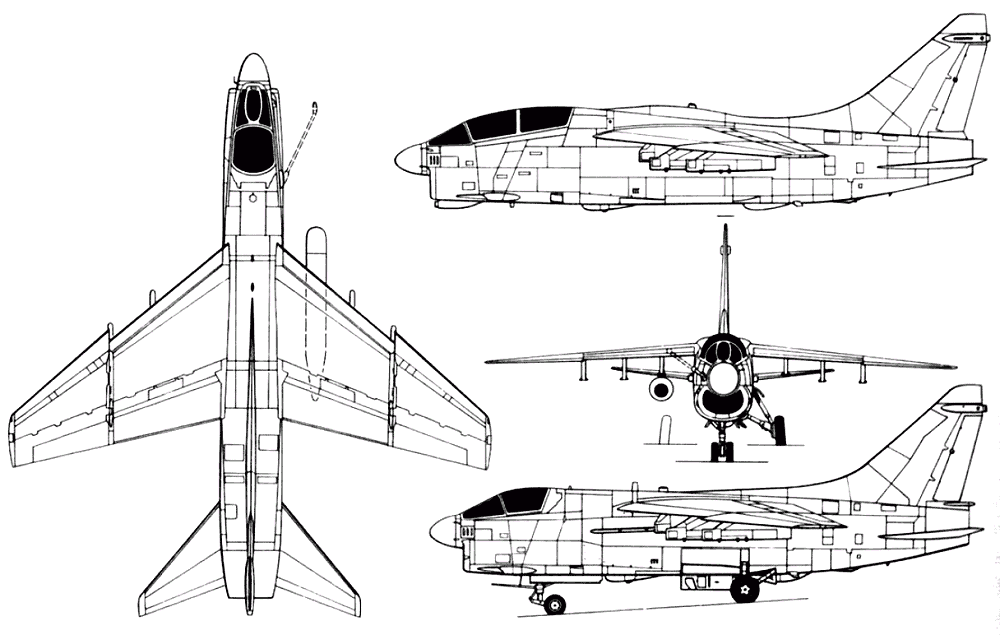


Hi Rick. I was just thinking about you and Google searched your name with navy pilot and came up with this information. I’m sure you remember you and I were roommates in basic training. I’d like to touch base with you and find out how you’ve been doing and what you’re up to and discuss the good old times with you. Look forward to hearing from you,
Bob Bonomo.
reply