 |
Lockheed 8 Sirius1929 |  |
| LIGHT TRANSPORT | Virtual Aircraft Museum / USA / Lockheed |
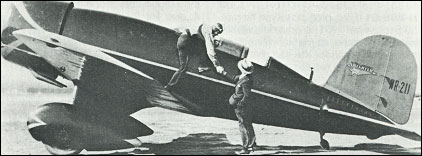 |
Developed originally to meet a requirement of Charles Lindbergh for a low-wing monoplane of high performance, the Lockheed 8 Sirius combined what was basically a Vega wooden fuselage with a new low-set cantilever wing. First flown in November 1929, and then powered by a 336kW Pratt & Whitney Wasp radial engine, the Sirius had non-retractable tailwheel landing gear and two open cockpits in tandem. Before accepting this aircraft, Lindbergh had a sliding canopy installed to enclose the two cockpits. In the following year, before Lindbergh set out on a survey flight for Pan American Airways, a 429kW Wright Cyclone engine and twin-float landing gear were installed. For its final survey flight in 1933 it was powered by a 529kW Wright Cyclone engine. The success of Lindbergh's aircraft led to the construction of 13 more by Lockheed, comprising four similar Sirius 8, eight Sirius 8A with enlarged tail surfaces, and a single four-seat Sirius 8C aircraft which had an enclosed cabin for two between the engine and pilot's cockpit. One Sirius built by the Detroit Aircraft Corporation, with a metal fuselage and Lockheed wooden wing, had the designation DL-2 Lindbergh's Sirius spanned 13.04m, weighed a maximum of 3220kg, was capable of a maximum of 298km/h, and had a range of 1570km, all in landplane configuration.
|  COMPANY PROFILE | ||||||
|


|