|
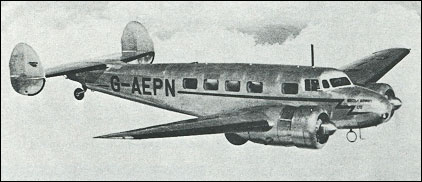
| Lockheed's first major move towards becoming a significant manufacturer of transport aircraft came with design of the Lockheed 10 Electra. Providing accommodation for 10 passengers, the Electra was a cantilever low-wing monoplane of all-metal construction, with retractable tailwheel landing gear and a tail unit incorporating twin fins and rudders. Powered by two Pratt & Whitney Wasp Junior SBs, the prototype was flown for the first time on 23 February 1934, and was followed by 148 production aircraft. The Electra entered service during 1934, initially with Northwest Airlines, and in the late 1930s was used by eight American operators. By the time that the USA became involved in World War II, however, few remained in national airline service for the rapid growth in air travel had already shown these small-capacity aircraft to be uneconomical. In addition to those built for the home market, Electras were exported to Argentina, Australia, Canada, Chile, Colombia, Japan, New Zealand, Poland, Romania, USSR, UK, Venezuela and Yugoslavia. Small numbers also saw service in the Spanish Civil War and with the outbreak of World War II the type was impressed for service with the Royal Air Force and Royal Canadian Air Force. Use of the Electra by small civil operators continued after the war, as it was cheap to buy and operate, but few remained in service after the late 1960s.
| MODEL | Lockheed Electra 10-A |
| ENGINE | 2 x Pratt & Whitney Wasp Junior SB radial piston engines, 336kW |
| WEIGHTS |
| Take-off weight | 4672 kg | 10300 lb |
| Empty weight | 2927 kg | 6453 lb |
| DIMENSIONS |
| Wingspan | 16.76 m | 55 ft 0 in |
| Length | 11.76 m | 39 ft 7 in |
| Height | 3.07 m | 10 ft 1 in |
| Wing area | 42.59 m2 | 458.43 sq ft |
| PERFORMANCE |
| Max. speed | 325 km/h | 202 mph |
| Ceiling | 5915 m | 19400 ft |
| Range | 1305 km | 811 miles |
| Slawomir Bialkowski, e-mail, 07.04.2025 15:38 In Poland.
Polish Airlines "Lot" purchased 10 Lockheed L-10A "Electra" aircraft. Four L-10A aircraft arrived at the port of Gdynia in January and February 1936. They received registration marks SP-AYA, -B, -C, -D, and in March 1936 they entered foreign and domestic routes. In March and April 1937, PLL "Lot" received another 6 aircraft of this type (SP-BGE, -F, -G, -H, -J, -K). PLL "Lot" used the "Electras" until the outbreak of World War II. They had three disasters during that time. The SP-AYB aircraft crashed on December 1, 1936 near Malakasa near Athens. The second accident occurred on 28.12.1936 near Tomaszów Lubelski, where the SP-AYA aircraft crashed due to icing. The third aircraft, SP-AYD, crashed on 11.11.1937 near Piaseczno near Warsaw. Lockheed L-10A "Electra" aircraft (and Lockheed L-14 "Super Electra") were delivered by sea to Gdynia, where they were assembled in the repair shops of the Gdynia-Rumia airport. In 1936, 4 L-10A aircraft were assembled. In the following years, the assembly station services were used not only by aircraft imported for PLL "Lot", but also for Yugoslav and Romanian airlines. In 1937, 12 L-10A "Electra" aircraft were assembled (including 6 for PLL "Lot", 4 for the Romanian company Lares and 2 for the Yugoslav aviation company Aeroput). In 1938, another 8 aircraft were assembled, including 6 L-14 "Super Electra" airframes for PLL "Lot" and 2 L-10A "Electra" airframes for the Yugoslav company Aeroput. In September 1939, two L-10A aircraft (SP-BGJ, SP-BGK), damaged during landing, were left in the country. They were captured by the Red Army and used in the special purpose squadron of the GWF until the early 1940s. Five L-10A aircraft (PS-BGF, SP-BGE, SP-AYC, SP-BGG, SP-BGH) were evacuated to Romania (1-12.09.1939). Since the aircraft in Romania were interned, the management of PLL "Lot" in order to get some of them back, made a fictitious sale of L-10A (and Lockheed L-14H, Junkers Ju-52 and Douglas DC-2) to the British airline Imperial Airways, giving them English registration marks. However, as a result of pressure from the German embassy in Bucharest, the aircraft were not returned. After several months, they were taken over by the Romanian air transport. They were probably used until 1946.
During World War II, Polish ferry pilots from No. 1 ADU /ME- Polish Detachment Takoradi, after delivering the planes, flew their return flights (Cairo-Takoradi) in groups, among others, on board the Lockheed L-10A "Electra" civilian planes of the British overseas airline BOAC (British Overseas Airways Corporation). Polish pilots often flew these machines, flying as part of BOAC crews. reply | | madmax, e-mail, 12.12.2011 01:23 union airways flew lockheed 10s in new zealand reply | | Gary Gordon, e-mail, 29.11.2011 00:33 In the mid sixties I got some right seat time in a L12A which while similiar to a Beech 18 was slightly larger. It was purported to be Juan Trippe's (Pan-Am)persomal a /c in the late thirties. Great flyer and fast for the time. This was with Metcalf Aviation at the old Sacramento Muni (SAC) reply | | Clarence Braddock, e-mail, 15.06.2011 18:35 I had the pleasure of working on sevaral 10A's while imployed by White-Crow Inc. in the early 70's. We maintained the aircraft for PBA in Naples, Fl. They also had 12A's reply | |
| | Ray Sanderford, e-mail, 19.03.2011 00:04 The long wire antennae that h. van asten is referring to was removed by Earhart and Noonan prior to their disappearance. (Source: Wikipedia.org) reply | | h.van asten, e-mail, 09.03.2011 22:05 @ Capurso. The radio antenna of NR16020 ran from a mast on the cabin roof to both tailplanes. There was no belly aerial present. reply | | Al Capurso, e-mail, 24.12.2010 13:47 The design of the radio antenna laying underneath the plane was a serious flaw and probably contributed to the loss of Amelia Earhart and Fred Noonan. Evidence indicates the antenna snapped off on a bumpy runway upon takeoff for the last leg of the ill-fated trip and Earhart could no longer receive radio transmissions. reply | | Al Capurso, e-mail, 20.12.2010 15:33 You said "these small-capacity aircraft (where) uneconomical", then you said "Use of the Electra by small civil operators continued after the war, as it was cheap to buy and operate". reply | | Eric C. Loveday, e-mail, 19.11.2009 16:32 Can you say which New Zealand Airline used the Lockheed 10 Electra in 1937 /38? A picture would be much appreciated. reply | | Karl, e-mail, 29.04.2009 18:02 Do you know what model was used in the movie "Dive Bomber" with Errol Flynn and Fred MacMurray, circa 1941? reply |
|
Do you have any comments?
|
| 
COMPANY
PROFILE
All the World's Rotorcraft
|