|
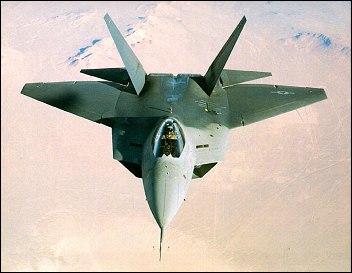
| Without doubt, the most exciting combat aircraft of the early twenty-first century is the Lockheed Martin F-22 Raptor. In the late 1970s, the US Air Force identified a requirement for 750 examples of an Advanced Tactical Fighter (ATF) to replace the F-15 Eagle. Flown by a single pilot, it must be able to survive in an environment filled with people, both in the air and on the ground, whose sole purpose is to destroy it. To test the concepts that would eventually be combined in the ATF, the US AF initiated a series of parallel research programmes. The first was the YF-16 control-configured vehicle (CCV) which flew in 1976-77 and demonstrated the decoupled control of aircraft flight path and attitude; in other words, the machine could skid sideways, turn without banking, climb or descend without changing its attitude, and point its nose left or right, or up or down, without changing its flight path. Other test vehicles involved in the ATF programme included the Grumman X-29, which flew for the first time in December 1984 and which was designed to investigate forward-sweep technology, and an F-111 fitted with a mission adaptive wing (MAW) - in other words, a wing capable of reconfiguring itself automatically to mission requirements.
Flight testing of all these experimental aircraft came under the umbrella of the USAF's Advanced Fighter Technology Integration (AFTI) programme. In September 1983, while the AFTI programme was well under way, the USAF awarded ATF concept definition study contracts to six American aerospace companies and, of these, two - Lockheed and Northrop - were selected to build
demonstrator prototypes of their respective proposals. Each company produced two prototypes, the Lockheed YF-22 and the Northrop YF-23, and all four aircraft flew in 1990. Two different powerplants, the Pratt & Whitney YF119 and the General Electric YF120, were evaluated, and in April 1991 it was announced that the F-22 and F119 were the winning combination. The F119
advanced technology engine, two of which power the F-22, develops 155kN and is fitted with two-dimensional convergent/ divergent exhaust nozzles with thrust vectoring for enhanced performance and manoeuvrability. The first definitive F-22 prototype was rolled out at the Lockheed Martin plant at Marietta, Georgia, on 9 April 1997. There were numerous problems with this
aircraft, including software troubles and fuel leaks, and the first flight was delayed to 7 September 1997. The second prototype first flew on 29 June 1998. By late 2001, there were eight F-22s flying.
The F-22 combines many stealth features. Its air-to-air weapons, for example, are stored internally; three internal bays house advanced short-range, medium-range and beyond-visual-range air-to-air missiles. Following an assessment of the aircraft's combat role in 1993, it was decided to add a ground-attack capability, and the internal weapons bay is also capable of accommodating 454kg GBU-32 precision-guided missiles.
The F-22 is designed for a high sortie rate, with a turnaround time of less than 20 minutes, and its avionics are highly integrated to provide rapid reaction in air combat, much of its survivability depending on the pilot's ability to locate a target very early and take it out with a first shot. The F-22 was designed to meet a specific threat, which at that time was presented by large numbers of highly agile Soviet combat aircraft, its task being to engage them in their own airspace with beyond-visual-range weaponry. It will be a key component in the Global Strike Task Force, formed in 2001 to counter any threat worldwide. The USAF requirement is for 438 aircraft.
Robert Jackson "The Encyclopedia of Aircraft", 2004
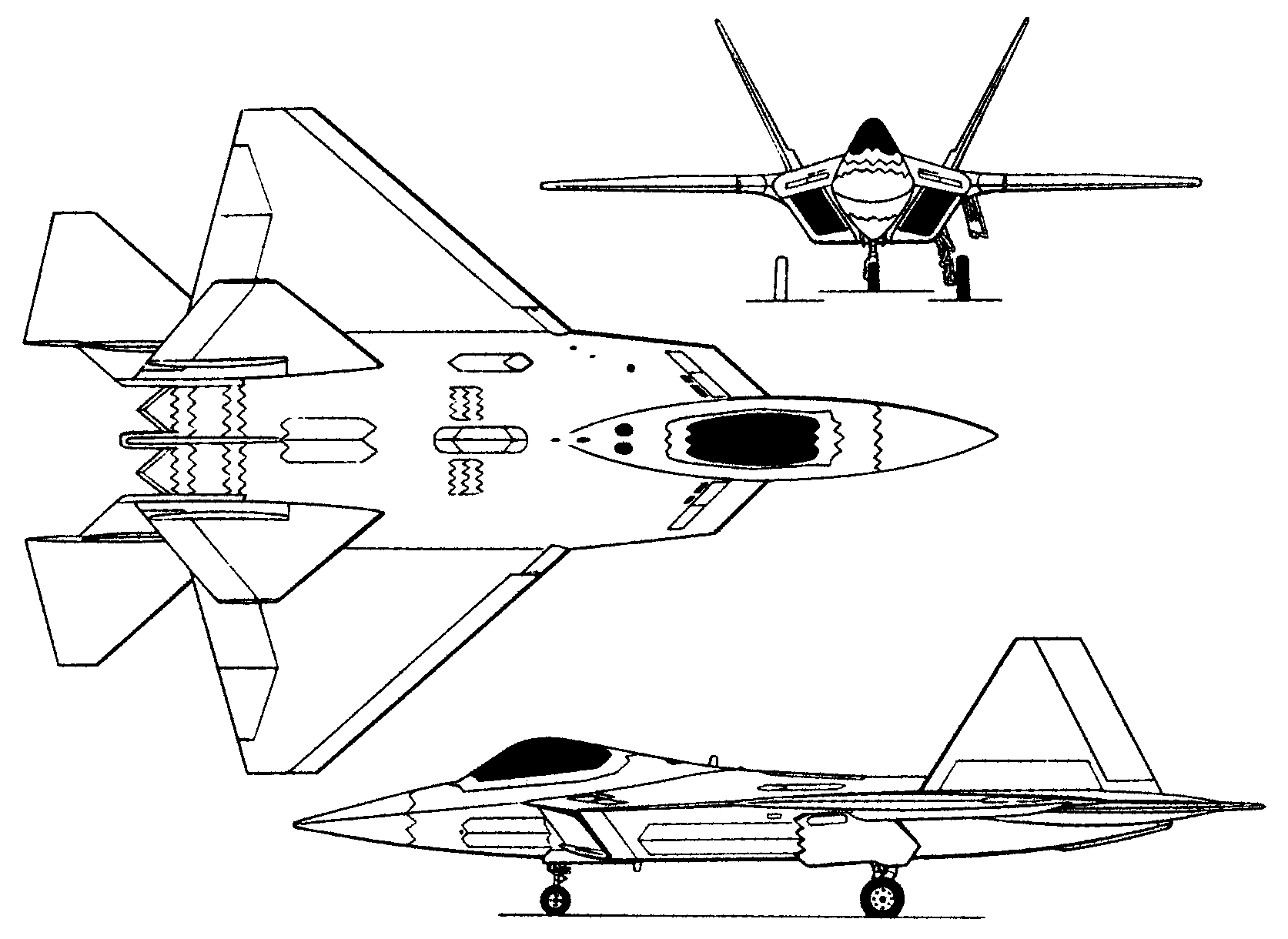
 | A three-view drawing (1673 x 1220) |
| CREW | 1 |
| ENGINE | 2 x P+W F119-100, 155.7kN |
| WEIGHTS |
| Take-off weight | 28123 kg | 62001 lb |
| Empty weight | 15422 kg | 34000 lb |
| DIMENSIONS |
| Wingspan | 13.6 m | 45 ft 7 in |
| Length | 18.9 m | 62 ft 0 in |
| PERFORMANCE |
| Max. speed | 2655 km/h | 1650 mph |
| Range | 3700 km | 2299 miles |
| ARMAMENT | 1 x 20mm cannon, 6 missiles |
| angella, e-mail, 18.09.2015 21:21 I have a 1 /72 model of YB-22. It was only a conceptual design. This is one of a kind model we will be auctioning off at 2015 Gathering of Eagles in Lancaster. Http: / /EdwardsMuseum.org. email me or message me on our FB page if u want photos or more info. reply |
| New American, e-mail, 25.06.2015 06:33 Russia is 30 years behind in airplane design and can only send trolls to comment on sites like this. But we here also are willing to spend hundreds of billions on stupid I-phones, but not willing to finance research on technology that is indeed needed. F-22 is a great continuation from F-15 and is totally dominating any battle field. Just a hundred of them will take out the entire Russian airforce. reply | | Carl Grimm, e-mail, 09.12.2014 00:28 USSR-the good(?)one,
The F4U and F6F were no match in maneuverability with the Mitsubishi Zero and we all know how that came out. reply | | PO'ed Taxpayer, e-mail, 21.07.2014 13:55 Never in the history of aviation has so much been spent to protect so few from so little. reply | |
| | Mike Trout, e-mail, 10.04.2013 20:00 Shrek is love; Shrek is life reply | | USSR-the good one, 03.07.2012 19:21 Mickey Rigney, in term of maneuverability f-22 is no match to the three-times-as-cheap su-37 DUH! reply | | Mysery?, 03.07.2012 19:18 I am 11 and I know an important fact: this 'foamplane' costs 240 million$ to build, and here :another fact : Russia made a planes just a cool but it cost 60 million$
Reminder:Ukraine actually beat England in Euro 2012 but the referee was bribed and refused to believe it (the referee is a foxbeard)
signed: Mystery? reply | | a.machiaverna, e-mail, 01.10.2011 23:04 As good as the f-22 is , the xf-23 was the better airplane during flight evaluation trials. Politics? reply | | Dave McNulty, e-mail, 11.02.2011 03:52 Nice fighter /bomber, but the F15 was better.. reply | | Allen, e-mail, 17.10.2010 02:49 This is one of the coolest planes I have ever seen in my entire life (even though I'm 13.) One day I would love to see the F-22 Raptor fly at Dobbin's Air Force Base in the air show. If you read this thanks for doing so, if you can please respond. Have a nice day , bye. reply | | Mickey Rigney, e-mail, 07.10.2010 20:37 This has turned out to be a great aircraft, it sees everyone and no one sees it, in flight. First Look,First Shot, First Kill. I was one of the first Lockheed Tech Reps on the program and Lead Rep when USAF got first aircraft at Nellis AFB. Early on we went thru a lot of software issues (and there is a lot of software on this aircraft), but we and the USAF work thru these issues and now have an aircraft that is untouchable in Air-to-Air and it can put the bomb on the target any where any time. Oh yea, you need to catch it at an Air Show - WOW, it's maneuverability is not matched!! The RAPTOR is the threat to all others!!! reply | | Steve, e-mail, 10.01.2010 18:55 The 3-view isn't an a production F-22, but actually one of the YF-22 prototype--cockpit placement, horizontal stab shape, and vertical stab sizes are different in the production F-22. reply | | paul scott, e-mail, 17.09.2009 22:25 A great potential for the USA to retain the highest technological prowess - sadly, there have been simple problems not forseen. Though it has excellent stealth characteristics, recent problems showed in just the radar-absorbing material coming off in the rain. Also, major concern is now that the USAF is encountering a staggering 30-hour maintenance schedule PER HOUR per aircraft. congress, it has now been reported, has only agreed to roughly 187 aircraft being now procured from an original 600 + order. The cost overun also has had a major impact. it was also reported that a journalist was laughed in his face when he quoted each aircraft could cost $180 million per unit (As the defense departemtn quoted just $40 million at that time). The former has proved correct. A real shame for the USAF. Instead, it looks like they're pinning more hopes on the F-35 JSF. reply | | Anonymous, e-mail, 25.11.2008 08:36 Callum i am not sure but the YB22 doesnt exist its just a spyrofoam little made up plane in the shape of a f22 reply | |
| | Ben Thurston, e-mail, 18.08.2008 19:40 I helped develop the initial test airspace for the production of this aircraft. As Military Liaison for the Atlanta ARTC Center (1989-2004), I was deeply involved with the initial as well as the production testing of all the F-22 aircraft produced. reply | | calum morris, e-mail, 16.02.2008 23:52 has anyone got pics of the YB-22?!
its a delta attack version of the raptor,
but im not sure about service reply |
|
Do you have any comments?
|
| 
COMPANY
PROFILE
All the World's Rotorcraft
|


 angella

comment6,
reply