 |
Lockheed XF-901950 |  |
| LONG-RANGE PENETRATION FIGHTER | Virtual Aircraft Museum / USA / Lockheed |
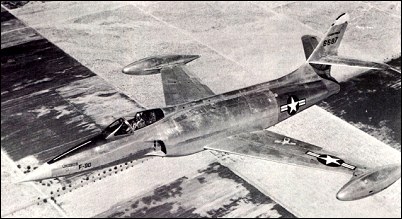 |
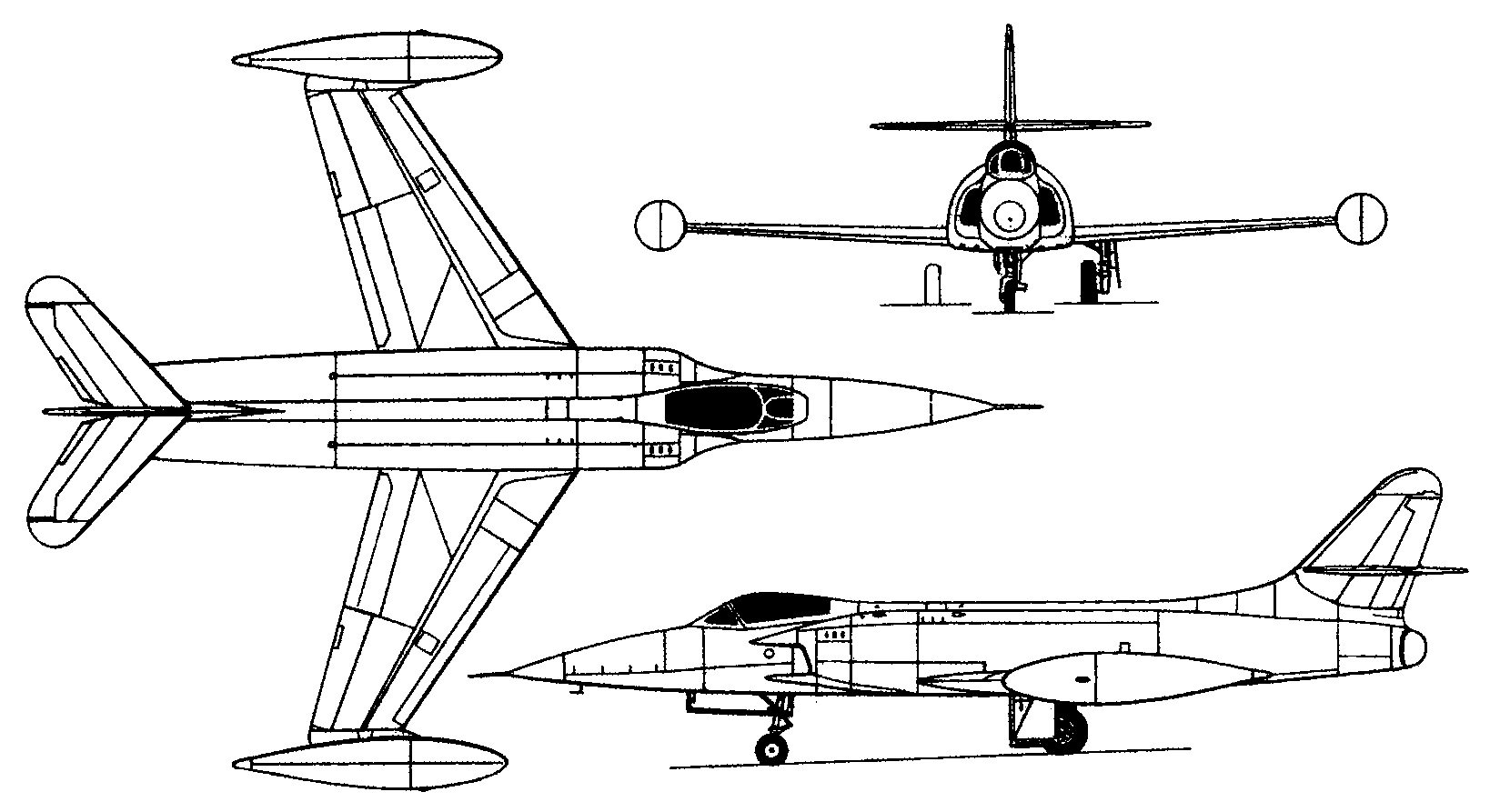
The Lockheed XF-90 was built to meet a USAF requirement for a long-range penetration fighter (along with the McDonnell XF-88 and North American YF-93A). Developed by Clarence L. (Kelly) Johnson's Lockheed fighter team, known in later years as the 'Skunk Works', the XF-90 combined swept-wing technology with the experience gained in producing the straight-wing F-80 Shooting Star. It was intended as an almost-all-purpose fighter, capable of handling the ground-attack role in addition to its prime task of escorting bombers deep into Soviet airspace. The two prototypes were to be tested in a fly-off competition with the McDonnell and North American designs. Actually, the XF-90 evolved over two years and resulted from 65 different designs created by Johnson's engineers. These included butterfly-tailed aircraft, three-engine aircraft, 'W' winged designs and, finally, the big, tough craft that was chosen. The final XF-90 had 12.7mm rivets in the wings and weighed as much as a DC-3. Its powerplants, sadly, were twin 1406kg thrust Westinghouse J34-WE-11 turbojets, the same engines which simply offered too little 'push' to so many fighter designs of the period. Still, the XF-90 reached 1070km/h at 9784m in level flight and could easily be pushed through the sound barrier in a shallow dive. Throughout April and May 1950, the air above Muroc Dry Lake, California, exploded in sonic booms as Lockheed test pilot Tony LeVier put the XF-90 through high-speed dive tests. LeVier dived the XF-90 to Mach 1.12 on 17 May 1950. The XF-90 stalled at 204km/h, making it no easy machine to control on the approach. Its take-off performance enabled it to clear a 15m obstacle in 2629m without the rocket-assisted take-off (RATO) units used in some tests, hardly a spectacular getaway from the ground. In the 1949 fly-off, the XF-88 came in first, the XF-90 second, and the YF-93A third, but by then the results were academic. With the September 1949 detonation of the Soviet Union's first nuclear weapon, the USAF penetration-fighter concept died. A nuclear fate befell the second XF-90 which was rigged with instruments on the ground and destroyed in the 1952 atomic bomb tests at Frenchman's Flat, Nevada. Lockheed records indicate that the first XF-90 was shipped in 1953 to a National Advisory Committee for Aeronautics (NACA) laboratory in Cleveland, Ohio. Apparently, it was eventually broken up in tests at that NACA facility.
|  COMPANY PROFILE | |||||||||||||||||||||||||||||||||||||||||||||||||||
|


|