|
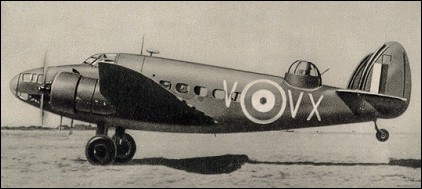
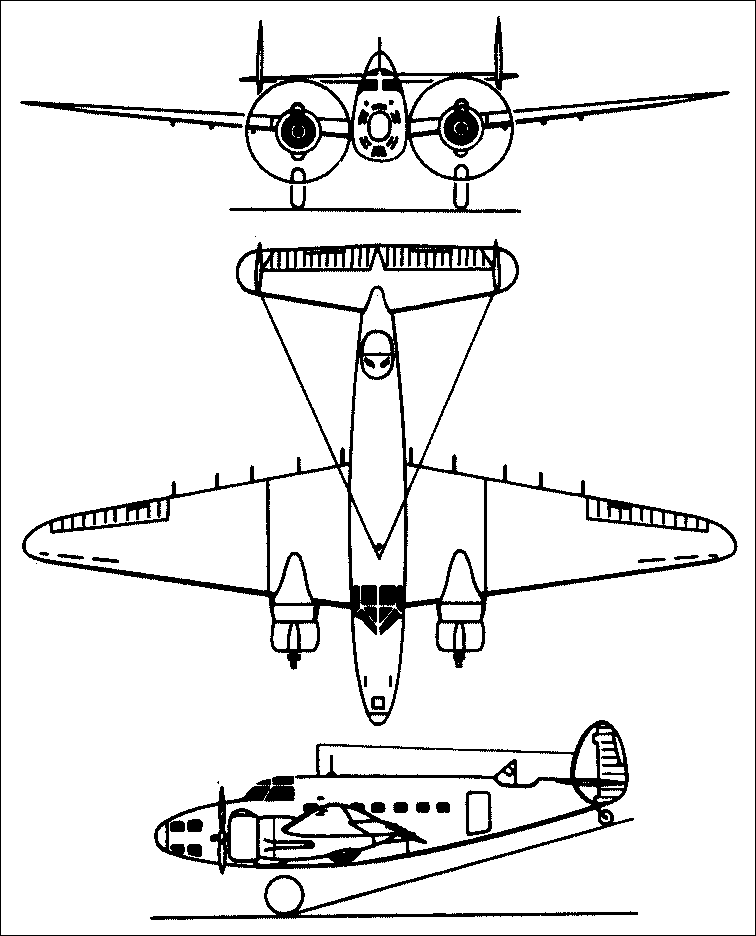
| The Hudson was originally built to the order of the British government as a military conversion of the L.14 transport. The first Hudson flew on 10 December 1938. Production lasted from 1939 until June 1943, thousands being built and delivered to the British, Australian, New Zealand, Canadian, Netherlands, Chinese and US forces.
Six versions of the Hudson were delivered to the British government, the majority of which arrived by air across the Atlantic. The Hudson I was powered by two 745.2kW Wright GR-1820-G102A Cyclone engines driving Hamilton-Standard two-position propellers. It first entered service with Coastal Command, RAF in mid-1939. The Hudson II was similar to the Mk I but had Hamilton-Standard Hydromatic constant-speed propellers fitted.
The Hudson III represented the first major revision, having 894kW GR-1820-G205A Cyclone engines with Hydromatic propellers and a retractable rear-firing ventral gun position. Large numbers of the Hudson III were delivered to the RAF under Lease-Lend (resulting in the use of the USAAF designation A-29) with 894kW Wright R-1820-87 Cyclone engines. Like earlier Hudsons, the Mk III was basically a maritime-patrol bomber and reconnaissance aircraft, but A-29A were fitted with benches for troop carrying. A-29/29A were also used by the USAAF and by the US Navy (as PBO-1).
Powered by two Pratt & Whitney R-1830-SC3G Twin Wasp engines, the Hudson IV was produced for the RAAF, but a small batch was diverted to the RAF. These had the ventral gun removed but received a D/F loop aerial in a transparent blister. The Hudson V for the RAF had R-1830-S3G4G engines driving Hamilton-Standard two-position propellers and a retractable ventral gun (as fitted to the Mk III). The final version was the Hudson VI (designated A-28 by the USAAF) which was convertible to troop transport or cargo carrier with the turret removed.
After withdrawal from combatant service with the RAF, USAAF and US Navy, the Hudson continued to be used for miscellaneous duties, including transport, air/sea rescue, training, target-towing, etc. As a trainer for air gunners, the USAAF operated a special version with a Martin dorsal turret as the AT-18.
The Hudson III was the first aeroplane to be fitted to carry the British-developed Mk I airborne lifeboat. This lifeboat was first used operationally in May 1943 by an RAF air/sea-rescue squadron to rescue the crew of a downed bomber in the North Sea.
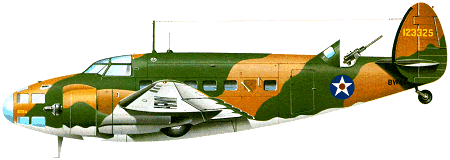
| MODEL | "Hudson" Mk.I |
| ENGINE | 2 x Wright GR-1820-G-102A, 820kW |
| WEIGHTS |
| Take-off weight | 7938 kg | 17500 lb |
| Empty weight | 5276 kg | 11632 lb |
| DIMENSIONS |
| Wingspan | 19.96 m | 66 ft 6 in |
| Length | 13.51 m | 44 ft 4 in |
| Height | 3.61 m | 12 ft 10 in |
| Wing area | 51.19 m2 | 551.00 sq ft |
| PERFORMANCE |
| Max. speed | 396 km/h | 246 mph |
| Ceiling | 7620 m | 25000 ft |
| Range | 3150 km | 1957 miles |
| ARMAMENT | 4 x 7.7mm machine-guns, 635kg of bombs |
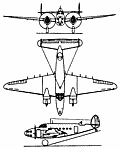 | A three-view drawing (756 x 936) |
| Nigel Parkinson, e-mail, 13.11.2016 15:21 My Uncle was a wireless operator / air gunner in 269 Squadron (Tom Parkinson), whose Hudson was unfortunately lost off the southern coast of Iceland on 11th February 1942. No wreckage found.
(My father was a Flying Officer, who was invalided out with a fractured skull. Lucky for me.) reply | | Mike kingdon, e-mail, 09.05.2016 19:37 My dad piloted one of these during the war. He was based I believe Delhi and flew against Japanese positions,,,,,I forget the squadron name but will look in his papers,,,, reply | | Dusty Mack, e-mail, 06.06.2014 16:25 My Dad served with the RAF (269Sqn)in Iceland during the War years and was an engine fitter. This squadron bombed and brought to the surface U-Boat507 which surrendered. It was towed and beached at Iceland where it was refitted and re-commissioned as HMS (His Majesty Ship)`Graph!. Incidentally my father-in-law served with the same squadron at the same time and played on the same football team as my Dad! reply | | John Howell, e-mail, 13.05.2014 02:17 Having lived near Lockeed during WW 2 we would see the Lockeed airplanes all the time. I can remember seeing the Hudson bombers fly over the housr about every 5 mins or so and we would lay on the garage roof and count them. We were told they were flown by women pilots to test them. They would take off at Lockeed fly out over the desert and back to Lockeed then they were shipped to England. We were told that was the only test flight they would get before shipping reply | |
| | Randy, e-mail, 14.10.2012 07:02 Derek
interesting note in that I know a guy that lost his life along with 7 others in a hudson in england 1942 runway approach, stall and crashed reply | | Klaatu, e-mail, 10.07.2011 18:36 These were often used in war-time Hollywood movies to depict RAF bombers. However, in reality they were actually used by Coastal Command for Maritime Reconnaissance and Anti-Submarine Warfare missions. reply | | Derek Joseph, e-mail, 10.03.2011 19:02 I don't have very fond memories of this aircraft as my brother, was a RAFVR Observer, who, along with the pilot and six passengers, was killed in 1945 after the engines cut out on landing in Djubuti. reply | | airboss, e-mail, 01.10.2010 17:47 There is a Hudson Mk.I at Bomber Command Museeum RAF Hendon.
It is marked as Australian A16-199. reply | | Fred F Smeaton, e-mail, 22.07.2008 18:27 We have a Hudson ar the North Atlantic Museum in Gander, How meny more are their left in the world? Is there any parts available,such as insterment panel Bomb Bay doors reply |
|
Do you have any comments?
|
| 
COMPANY
PROFILE
All the World's Rotorcraft
|