|
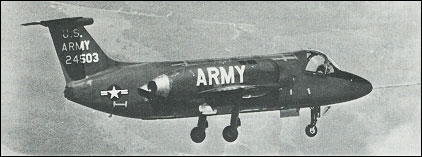
| Under the company designation Lockheed VZ-120, Lockheed designed and developed two prototypes of a VTOL aircraft using turbojet engines to provide direct lift. The centre fuselage formed a giant ejector duct, more than doubling lift. The first of these was flown on 7 July 1962, but it was not until 20 November 1963 that a first successful flight involving transitions from vertical to horizontal flight, and vice versa, were completed. By then redesignated XV-4A, the two prototypes were handed over to the US Army for whom they had been built under contract. In late 1966 Lockheed modified one of the XV-4As to a new XV-4B configuration, the major change being repalcement of the XV-4A's two 1361kg thrust engines by four each of 1368kg thrust. Testing began in August 1968, but when the aircraft was destroyed in an accident in early 1969 further development was abandoned.
| MODEL | XV-4B |
| WEIGHTS |
| Take-off weight | 5706 kg | 12580 lb |
| DIMENSIONS |
| Wingspan | 8.25 m | 27 ft 1 in |
| PERFORMANCE |
| Max. speed | 745 km/h | 463 mph |
| Dennis Dellovade, e-mail, 14.03.2014 16:22 I came across this site a few weeks ago. I was an Engineer for General Electric Corporation, Light Military Department, responsible for the Flight Control System from design, final assembly, through the flight test and participated in the accident investigation.
The XV4B had a couple of unique features, the most being the first primary Fly by Wire Flight Controls system, that became the standard, although more sufficated on future aircraft flight control system starting with the F-14 Tomcat.
I remember Hal very well throughout the total program. Bernie Dvorsak was the primary test pilot and Hal was the backup. Both participated in all of the tests, fix based simulator, static test, run up, etc. Bernie did most of the flight test, with Hal and the project director duties as chase plane monitors.
The day of the crash, Hal was flying with Bernie as chase. Most of the flight test staff were all in the tower, and mostly not paying much attention since the aircraft was on the way down to the restricted area to begin the flight test when Bernie began yelling to Hal to get out!
Bernie reported that Hal had a full chute(at about 900'), and that the aircraft crashed in a safe location. He circled Hal's position until help arrived.
The report was that the aircraft was cruising to the restricted area with the on board telemeter system turned off since the record time was about 20 minutes on a 30 minute flight. Chase planes visual reported was that the aircraft, without warning, began rolling hard to the right. Hal later reported that he became disoriented though the aircraft rolling to the left and push the stick hard to the right, adding to the roll.
Final report read that, though not proven, that a mechanical occurred on the right side failed (suspected to be the right side flap failed in the down position) and read primary failure was mechanical unknown, with pilot error as secondary failure. reply |
| scottb60, e-mail, 03.06.2012 07:24 I always tell anyone computer challenged to go find a six year old, they know more about it then any of us.
Somewhat more complex then it's rival. reply | | Sylvia Johnson Hopper, e-mail, 03.06.2012 04:50 I have had a very different work career. I moved to Atlanta from Memphis where I graduated with a BS in Math and English from Memphis State in 1964. I tried teaching, but eating was a habit that began early in life and difficult to break. I lasted a semester and a half and then, because I had to work, I went to work as a Playboy Bunny. From there I went To Lockheed in the spring of 1966 as a technician through an introduction of one of my customers at the club.
I was tested the first day and told that I was going to be a programmer. They put me into night school and I learned COBOL, PL1, etc. I was in two different departments over the course of my five years there- aero and thermo. I worked for Dick Leslie and Raymond Wilkes. Both were wonderful supervisors.
During my time there I did dust ingestion and bird ingestion testing on the Hummingbird and remember its' demise. I remember that one of the engineers in another department went to California as part of a team to study why it crashed. His story upon his return whether fact or fiction was sabotage.
Dick Leslie transferred me out of his organization into a promotion and then lateralled me back into an engineering position. I was coding, but had the title of engineer. They did not think a female should have the title of engineer back then. Very kind man.
I stumbled upon this site while attempting to explain annular jets to my grandaughter. Earlier this week I was in conversation about laminar flow with another ten year old. They are getting smarter and more curious!!! reply | | Kim Quamme Miller, e-mail, 06.11.2011 19:32 I'm the youngest child of the late Harlan "Hal" Quamme. I have a short article from the AJC mentioning the March 14, 1969 crash "20 miles from Dobbins AFB" of the XV4B Hummingbird. I was 2, but remember playing on the ejection seat in the basement in the Woodstock house in the country that my dad built. Tim Barnes, you went to prom with my sister Carolyn and Cheryl was buddies with Colleen as I recall. I believe they may have officially termed that crash "pilot error" though my dad did take off 2 more times than he landed... ("pilot error" could've been that other crash). My dad definitely had great passion for flying. He suffered almost 20 years with Parkinson's Disease before passing 2 days after my birthday on Oct 9, 2009. I miss his adventurous and fun spirit. reply | |
| | Lou Nevola, e-mail, 17.09.2011 23:14 My dad, Louis M. Nevola, Sr. was in Marietta on the Prototypes
e
Any knowledge uncovered please send an email; Thank you reply | | Bob Surrency, e-mail, 11.05.2011 03:49 Working on the Hummingbird and meeting the Mooney brothers was a truely unforgettable experience. It was also my first opportunity to work with E.B.(Gibby)Gibson, a fine engineer and manager who later lead the design of the C-5A. reply | | William Clark, e-mail, 07.03.2011 22:34 I graduated from the University of Florida in 1961 with a
degree in aeronautical engineering. My first job was at
Pratt & Whitney, West Palm Beach. In 1966 I moved to Atlanta and started working at Lockheed as a structural
engineer on the C5A project. I was asked to transfer to
the Hummingbird project because of my jet engine experience. We worked in a bank building in Sandy Springs
one mile from where I lived on I285. I worked in the thrust diverter section and was there when the project was shut down forcing me to go back to the B95 building and
the C5A project in Marrieta. reply | | Janie Brewer, e-mail, 09.12.2010 22:09 I am researching another plane crash from the end of the runway at Atlanta Road there in Marietta, GA. It crashed into a home killing a woman who had been my kindergarten teacher when I was a small child. I am trying to remember her name and cannot for the life of me remember. The house was located in the "Fair Oaks Community" behind Twilley Animal Clinic where Atlanta Road and Austell Road intersect. The house, I am sure, had an Austell Road address. Does anyone remember this. I can not find any information on this crash in Cobb County, Georgia. Maybe someone can remember and tell me. That would be great. Thanks so much! reply | | Will Farmer, e-mail, 14.11.2010 04:25 My memories are of the Mooney brothers leading the XV-4B design and manufacturing. I was hired from McDonnell Aircraft in St Louis to do the preliminary design of the crew station, including the life saving Ejection Seat. I have a photo of the cockpit mockup I designed in wood that was nicknamed "Farmer's Hog Trough". After the proposal was complete, I went over to the C-5A Oxygen Group working for Bill Payton. When the AV-4B contract was let, I gave a reference for Gill Grietens and he worked the electrical engineering, while I stayed with the C-5A. reply | | William E. Galbreath, e-mail, 14.11.2010 00:31 Dave Takacs, yes, hello yes! I remember you boys very well and also your mom and dad. Please recall that your parents, who were Canadian, became sworn citizens of the US of A at the same time that my wife became a naturalized citizen back in 1966. You guys were small back then, the same ages as our three off spring, who spent all out $$$$ going to school to get an education. Your dad owned an electrical supply distribution business. Oh, those good ol' days!!!...Lockheed, good friends and fantastic memories of the past. All history now, but not forgotten. Here's to all the ex's and present employees who will read these words, especially those in Engineering Flight Test. Bill G. reply | | Dave Takacs, e-mail, 13.09.2010 03:39 Hi Bill and Rob. Bill will remember me as the oldest of four boys that lived next door. We moved in a few months after the crash. I'm now working at Lockheed and the Hummingbird is still regarded as a breakthrough aircraft despite it's rocky history. That's the price you pay for "pushing the envelope". As Rob says, the house at the crash site wasn't there at the time. If you want to pinpoint the crash site on Google Earth, the address is 3141 Suholdon Drive, Marietta, GA 30066. reply | | William E. Galbreath, e-mail, 11.07.2010 18:14 Goodness sakes! Here I am on the net and the Hummingbird project just bangs me in the head. So happens that I joined up with Lockheed-Georgia Co. in Marietta, GA. (formerly the old Bell Bomber Plant). Still wet behind the ears and fresh out of the US Air Force having been trained in Flight Test Electronic Instrumentation, there was a need for my skills. The XV-4A was one of the projects to which I was assigned and later became the Lead Flight Test Electronics Tech. What memories I have from the Lockheed experiences! Sadly, the day that #1 bird went down, I had signed off the A /C as ready for flight to the pilot who was a civilian working for the US Army, whose home was in Newport News, VA. He was ready for flight. I went up to the control tower, as I always tried to do, in order to monitor the conversations. The aircraft did not have a telemetry system for us to remotely monitor, it had an on-board flight test data recorder, which was later recovered intact. It was horrible to listen in on the banter and last words of the pilot who was to perish doing what he loved to do. The crash which occurred happened to be in the Addison Heights area across from the Blackwell School, and the home being built was mine. We later moved into the home after it was built and also purchased the lot next to us as an investment. Ship #2 was taken to the NASA facility in CA., which trip I made, to the wind tunnel for wind tunnel tests. The tests were very successful, however as we know now, the A /C design was flawed. If only vector thrust had been in an engineers mind at that time, the XV-4A would have been one hellava machine.I had a very CLOSE association with the XV-4A. Those memories have not faded. What has faded are the names of the many good people whom I worked with. reply | | Tim Barnes, e-mail, 17.08.2010 04:34 My father is Oliver Garland Barnes, Jr. and he was an aeronatical engineer at the Marietta plant from the late 1950's until he retired in the early 90's. He worked in flight dynamics at the end of the runway, by the wind tunnel (I think). I think he was an important part of the design team on the hummingbird. He was also a close freind with Harlan Quamme (sad to hear of his passing). In fact my date to my prom was his daughter Beth in 1978 and my older sister Cheryl was good freinds with his daughter Carolyn (I hope I got the names right!). Mr Harlan used to fly a helicopter to our house in Woodstock and land in our riding rink and take Dad flying. I never got to go but I think this is correct. I have photos of his kids riding our pony and surrey around the yard. Dad is 82 now and has advanced dementia. He is currently in the ICU on a vent with double pneumonia but we expect him to recover. He can't verify any facts because of his illness. As he recovers I am thinking of his life and thought of his Lockheed days and the Hummingbird and found this sight. What a treat. I have some items some who visit this site may find intresting. I have a wind tunnel test model, many photos, technical data sheets and info, paper weights, tie tacs, cuff links, and other memorabillia Dad collected from the progect. Dad would be proud to see folks still think of the Hummingbird as he worked hard on and loved the plane and all the good people who worked on the project. reply | | Rob Elliott, e-mail, 19.02.2010 15:53 Video showing Hummingbird test flights can be seen at:
www.liveleak.com /view?i=577_1243691437 reply | |
| | Rob Elliott, e-mail, 18.02.2010 19:19 [NOTE: The following was posted on www.aero-web.org yesterday (my recollection of the crash event).]
It crashed in my neighborhood (Addison Heights Subdivision, Cobb County) on Verney Drive. If you go to Google Earth and search on Verney Drive, and then look in the SW quadrant of the intersection of Chance Road, Suholden, Shannon and Verney Drives, the Hummingbird crashed between the 1st and 3rd houses on the right side of the road (assuming you have "vitually" driven down Chance Road and turned left onto Verney at the intersection of Suholden with Chance /Shannon; I'm not sure where Chance changes to Shannon). The second house (driveway shows up as VERY white compared to the other two on Google Earth) was not there at the time. I'm willing to bet that a metal detector might hit "pay-dirt", so to speak, on the northern side of that newer driveway.
I was at home at the time (we lived on Kelly Drive, one block north). As I remember, the crash occured in the morning, and it was loud. My dad (a Lockheed production supervisor at the time) was also home, and was on scene within minutes (I remember looking out the South window of the family room and seeing his red Carmen Ghia speeding up Suholden Drive towards the crash site). The crash made the national news and there were cars up and down the street for days after it happened. A guy working on the roof of the last house on the left (Chance /Shannon address) just before Verney, fell off of the roof and broke his arm. I also remember perfectly round burn marks, a few feet in diameter, in the front yard of the 1st house on right (Verney address, previously alluded to in the first paragraph); I suppose these were from "blobs" of jet fuel. Our neighbor's daughter, Marilyn (Shannon address) was riding her bike at the time near the intersection when the plane crashed. She was unhurt, but hysterical.
[end of aero-web.org post]
Additional info not included above...
- The area where the crash occurred was about half-developed at the time. It was either pure luck, or determined effort on the part of Mr. Ingram that he crashed midway between two houses in that then-vacant lot (probably the latter; he was widely thought of as a hero, and rightly so in my opinion).
- The elevation of the crash site is a little less than 1000 feet (978 feet according to Google Earth). reply |
| Carlton Collins, e-mail, 09.02.2010 18:15 Mr. Duncan, the last Hummingbird was flown by Harlan J. Quamme and he survived by ejecting. The Hummingbird program was scrapped after that. Harlan passed away October 8th 2009 and was laid to rest at Magnolia Baptist Cemetery, Whigham, Georgia. Flying was Harlan's life and we miss him! reply | | Carlton Collins, e-mail, 09.02.2010 18:04 Kenneth Paul, kpaul5(@)triad.rr.com, 28.08.2009
Just remembered the last name of "Ernie," below. It's Brooks! Any one know him? Also, a test pilot who flew 24504 (XV-4B) on its final flight is Frankie Quamme. He DID punch out when this plane got into trouble, and it crashed into Lake Lanier. I never knew him, but have made contact with he and his brother, as well as Glenn Gray.
+ + + + + + + + + + + +
Mr. Paul, your info is incorrect! The last pilot of the Hummingbird was my late brother in law Harlan J. Quamme. Harlan's widow Frankie is my sister. I was living in the Atlanta area and working for Lockheed when the crash occurred. We were very happy that Harlan survived the crash as you might surmise. Harlan was a good man with a great soul. Just wanted to let you know who was flying that death trap.. Cheers, Carlton Collins reply | | Kenneth Paul, e-mail, 28.08.2009 18:10 Just remembered the last name of "Ernie," below. It's Brooks! Any one know him? Also, a test pilot who flew 24504 (XV-4B) on its final flight is Frankie Quamme. He DID punch out when this plane got into trouble, and it crashed into Lake Lanier. I never knew him, but have made contact with he and his brother, as well as Glenn Gray. reply | | Kenneth Paul, e-mail, 27.08.2009 20:53 I joined Lockheed Marietta in June, 1963, fresh out of the Army. I was assigned to the Hummingbird project as a flight test engineer (this is not a flying position). I had a degree in A.E. (U Ala, 1960) and had worked for Boeing for about 10 months in the aero staff (707 days!) No pilot training whatsoever, just a sliderule jockey, so don't know why Lockheed saw fit to put me in such a hands-on position with such a radical new project. Nonetheless, under the guidance of Ernie (?) and Wynne Daughters, the only other flight test engineers on the project, I was right there for the early tethered hovers, right through the crash of 24503, pictured above. Daughters was the lead FTE on 24504, the second plane, later to become the doomed XV-4B; Ernie was lead and I his #2 on 24503. The Lockheed test pilots for these craft were Glenn Gray and Bernie Dvorak. They were both in the T-33 chase plane when the Department of Army test pilot Bill Ingram crashed 24503 in the summer of 1964. Yes, it was totaled and Bill was killed, and it did hit the ground in a small construction site where new homes were being built; no one on the ground was injured.
I wrote the test plan for that day (with Ernie's sign-off, I'm sure). It called for reverse transition training for Ingram, wherein he was to take off in conventional mode, maintain at least 3500 feet AGL, and practice diverting first one engine, then both to vertical flight mode; this would result in "flying" at 30 kts or less. After feeling out the aircraft in such a strange regime, he was to return to normal flight by un-diverting first one, then both engines. On a previous similar flight, he had remarked that 'you get such a kick in the ass when those 6600 pounds of thrust kick back in' that you would never have to eject from this airplane; just push those buttons and zoom! On the fatal flight, as he was down to 30 kts or so, a duct carrying high pressure bleed air from the engines to the nose thruster blew out, and he immediately lost pitch control. Both Lockheed pilots in the chase plane barked "Bail out! Punch out!" but there was no reply. He instead flipped both engines back to conventional mode, the nose fell through, and he experienced a high speed stall just as he pancaked into the ground. He was at 3500 ft MSL, but the area was about 1500' so he just didn't have enough air under him to blast out of the problem. reply |
| Donald Perdue, e-mail, 26.05.2009 07:26 My cousin William Ingram was the pilot of the original Hummingbird. He did indeed give his life to keep the aircraft from hitting in a residential area. This is according to my aunt, his mother. He also flew P-38's out of England during WWII. He loved flying more than life. reply |
|
Do you have any comments?
|
| 
COMPANY
PROFILE
All the World's Rotorcraft
|


 Rob Elliott

Hi Dennis, Thank you for this column. I just read on another column that I was flying this aircraft...me FRANKIE!!! NOT TRUE!!! HARLAN WAS MY HUSBAND AND MY family was glad Harlan made it out safely that day!
Some people just don't get the name correct....
Frankie
reply