|
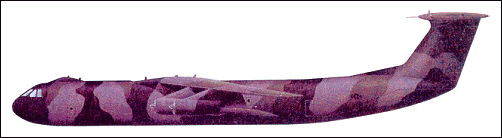
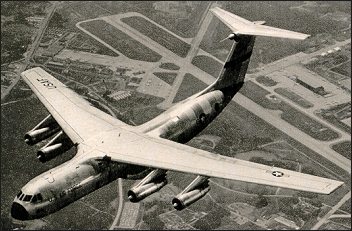
| The Lockheed C-141 Starlifter is a military strategic airlifter in service with the United States Air Force. Introduced to replace slower piston-engined cargo planes such as the C-124 Globemaster II, the C-141 was designed to a 1960 requirement and first flew in 1963; production deliveries of an eventual 248 began in 1965, and the aircraft is still in service almost 40 years later, although the USAF plans to withdraw the C-141 from service in 2006 when sufficient C-17 Globemaster III aircraft are available.
The original Starlifter model, the C-141A, could carry 138 passengers, 80 litters for wounded, or ten standard 463L pallets with a total of 62,700 pounds (28,900 kg) of cargo. The C-141 could also carry a Minuteman missile. It was soon discovered that the aircraft's volume capacity was relatively low in comparison to its lifting capacity; it generally ran out of physical space long before it hit its weight limit.
To correct this and use the C-141 to the fullest, the whole fleet of aircraft were stretched, producing the C-141B. Additional 'plug' sections were added before and after the wings, lengthening the fuselage by 23 ft 4 in (7.11 m) and allowing the carriage of 103 litters for wounded, 13 standard pallets, 205 troops, 168 paratroopers, or an equivalent increase in other loads. Also added at this time was a boom receptacle for inflight refueling. The conversion program took place between 1977 and 1982. It was estimated that this stretching program was the equivalent of buying 90 new aircraft, in terms of increased capacity.
More recently, 63 aircraft have been upgraded to C-141C status, with improved avionics and navigation systems, to keep them up-to-date until C-17s are available to replace them.
In 1994, thirteen C-141Bs were given SOLL II (Special Operations Low-Level II) modifications, which gave the aircraft a low-level night flying capability, enhanced navigation equipment, and improved defensive countermeasures. The USAF operates these aircraft for the Air Force Special Operations Command. These aircraft are slated to be replaced by special-purpose new-build C-17s.
On 16 September 2004 the C-141 left service with active duty USAF units, being confined to reserve units for the remainder of its service life. As of September 25th, 2005, there are only 8 C-141 aircraft still flying (All from Wright-Patterson AFB) near Dayton, Ohio. One of them is the same aircraft that was used at the end of the Vietnam War to repatriate American POWs from North Vietnam, and will soon be moved to the National Museum of the United States Air Force, also at WPAFB.
| CREW | 4 |
| PASSENGERS | 154 |
| ENGINE | 4 x turbo-jet P+W TF-33-P-7, 93.5kN |
| WEIGHTS |
| Take-off weight | 143610 kg | 316608 lb |
| Empty weight | 61898 kg | 136462 lb |
| DIMENSIONS |
| Wingspan | 48.7 m | 160 ft 9 in |
| Length | 44.2 m | 145 ft 0 in |
| Height | 12.0 m | 39 ft 4 in |
| Wing area | 299.8 m2 | 3227.02 sq ft |
| PERFORMANCE |
| Max. speed | 920 km/h | 572 mph |
| Cruise speed | 885 km/h | 550 mph |
| Ceiling | 12500 m | 41000 ft |
| Range w/max.fuel | 11400 km | 7084 miles |
| Range w/max payload | 6440 km | 4002 miles |
| Guy E Marvin, e-mail, 14.12.2025 22:00 I was an Avionics Instrument Systems Specialist (AFSC 32551) and my first duty station was Norton AFB, March 1967. I was there one month before we got our first 2 C-141's in April of '67; -0176 & -0177. I loved working on these planes! I went to the All Weather Landing System (Cat.II) classes at Norton with Everett M. Hadley, AFETS instructor and qualified as an AWLS System Analyst along with my buddies in the Autopilot shop. I got PCS to Clark AB, PI with the 604th MASS in July '69 and continued to work on the 141 as they passed through to and from Viet Nam. What a great experience and what a great aircraft! I miss it.... reply | | Francur07@aol.com, 07.06.2022 07:06 I am writing to see if anyone can give information on a C141flight
I took from Yokota to Travis in 1969-70?
There were only five of us on the plane. The remaining were
our blessed comrades who gave their full measure of service out
of RVN! The flight originated at Tan Son Nhut. I was on emergency
leave up country in Japan and picked up the flight at Yokota.
I remember we left at midnight and flew all night into Travis.
No one met or greet us. The flight parked away from the terminal.
No one spoke much during the flight, all young guys in uniform
from the war zone, escorting our comrades home from the war zone.
All I recall is the pilot was a Lt. Co., a 1st lt co pilot and a MSgt load master.
We were 2 Army, 1 Marine and 2 Air force (myself AF) on board.
Apprec any comments on how I can trace this flight. reply |
| Robert Isabelle, e-mail, 24.08.2021 23:54 I am looking for a copy of the C-141B dash 1 and 1-1. I want the manuals that were used by pilots on the line /during Altus training. reply | | Bob Archer, e-mail, 15.03.2021 16:10 I would like to contact former C-141 personnel, especially anyone with stories of sorties into Vietnam. Also operation Home Coming. Plus the 1976 sortie involving 65-9402 (from Norton ??) that is reported to have exceeded Mach One in a dive over north western Canad.
I am researching the C-141 for a project, which I hope will culminate into a book on the operations, and individual markings of the C-141. The book will be aimed at the enthusiast and modeller market.
Please reply to me on my email carlscroop@aol.com. Many thanks for any help. Bob Archer near RAF Mildenhall. reply |
|
| | CMSgt Lewis H. Fountain USAF(R, e-mail, 27.01.2017 20:35 I was an aircraft and engine mechanic at McGuire AFB for a period of time.Then I was stationed in the Middle East and Europe there I became a flight mechanic,on C-47's. My whole world changed when I started flying.I Returned to the states went to 141 Engineers school, retired from Active Duty. Then Joined the Air Force Reserves and stayed until 1992. I was fortunate in the Reserves to have flown the most flight hours in history in the C-141,a total of 16441.6. My total hours in all aircraft flown are 17,309.2 My total military time was 39 years. reply |
| Bob Schlegel, e-mail, 19.01.2017 22:27 It was a beautiful plane - Subsonic, Swept Wing, T-Tailed Four-Engine BUGSUCKER! As Navigator, the 17 years at Travis - Reg and Reserve were idyllic - the crew harmony, the great peer groups, the awesome bases we served, all spoke to a career of great and pleasant memories. A great plane to crew! reply | | Jim Parks, e-mail, 11.11.2016 18:43 I came out of Chanute to Norton in January of 1969 as an Environmental Systems Tech. Loved to work on the 141. Great memories. Left the Air Force in August of 1972 as a SSGT. reply | | Bob Humphress, e-mail, 28.08.2016 17:47 I was assigned to the 15 th MAS at Norton from July 74 to Sep 92. I was a Loadmaster on this great aircraft both the A and B models... Wonderful experiences and surperb crew and maintenance personnel. Due to the closure of Norton I went to the AMC /IG, finished my career in Mar 95.. I was attached to the 14th MAS at Charleston during this time... More class act reply |
| David M Miller Sr, e-mail, 17.08.2016 20:43 I was at Norton AFB 1977-1979 63rd OMS Alpha 6 When I got there Joe Balogh's acft 0176 was still in it's Bicentennial colors with the Thunderbird Logo near the crew door Joe was also on Alpha 6 He was my sponsor when I arrived. Left Norton in Nov 1979 and went to Incirlik CDI Turkey the 63rd was my best assignment worked with awesome people and flew with some great crew dogs especially freom the Blackjacks. reply | | Joseph Balogh III, e-mail, 23.03.2016 19:52 The C-141A was the first plane for me out of tech school at Norton AFB. I was the assistant crew chief on 66-0176 during the Bi-centennial year. I spent many an hour sanding he tail, stripping the interior from front to back, getting it ready for it's facelift for '76'. She was the lucky bird that was used as the support bird for the Thunderbirds in 1976. I really missed that plane. reply | | William Childress, e-mail, 07.02.2016 04:50 I am looking for information on the crew chief who was killed in the t-tail on aircraft 0199. Who was he, when did it happen, and where did it happen? I thank all of you who served ont he 141; I miss her greatly! The 2nd reunion is coming up in July 2016 at McGuire - Come on out! reply | | Roger Bringhurst, e-mail, 01.02.2016 02:54 Forgot to mention my flying buddie, Spence Isa, We roomed and worked togeather At Travis AFB 66-69. We flew LTF and spent lots of time on The golden Bear now on Static display. The other LTF bird we meched on was 63-8075. Lots and lots of memories of Nam flights, and Heavy munition hauls out of Hill field. Some loads 80-90 thousands, heaven forbid if we collided with someting!! As Mark Twain wrote "it's better to be careful a hundred times than to be dead once! reply | | Roger Bringhurst, e-mail, 01.02.2016 02:05 Roger B.
arrived At Travis in early 66 from shepard, Trained on c-130's great Bird
for props. Crossed Trained in the 602 0ms to 141's. A great Jet Bird.
Worked flight line 3 shifts, decided to Fly, got qualified, as i completed Jet Runup on the flight Sim, Was scheduled for Trip to Nam. Flew 60-70 sorties, including several Embassy runs around the world, later to find primarily a CIA courier service. At the time 600 agents in the Embassy in Saigon. Lots of stories, and was very hectic 2 1 /2 years of flying class 3.
estimated, i flew 1.25 million air miles. All pilots and crews and maintainers on this craft were the best.
God bless you all. Flew with the 44th, 86th, and 75th squadrons at The T. reply | | ron kagan, e-mail, 28.11.2015 08:48 I Was the admin specialist in the c-141 building, I did all flight manuals, simulator logs etc from 1966 to Aug 1967, does anyone know if Maj John Hamilton is still around. Was a great place to work busy. I also did manuals for the C-124 sim reply | |
| | Jeff Larsen, e-mail, 23.10.2015 07:33 As a former C-124 loadmaster at the 8th MAS at McChord I rotated back from VietNam to Mcchord AFB to the 4th MAS in November 1966 and assigned to the first squadron of C-141s at the base. Flew 1100 plus hours in and out of Vietnam until my discharge in August 1968. Staged mostly out of Yokota Japan during that time. Lots of stories about the early days in the airplane. Most memorable was being alerted at Clark to fly into a closed Tan san Nhut AB in VN in Jan.1968 during the Tet offensive to evacuate the passenger terminal. Heard later it was the first legitimate combat operation by a C-141. Remarkable pilot and skilled crew under extremely difficult combat circumstances (Saigon was under siege and we were being shot at as we had to abort a landing and roll out over downtown Saigon during the siege). Had to offload ten pallets and onload distressed troops (including the assistant secretary of the navy) and evacuate all to Taiwan. All 4 engines running during the entire ground operation, max-performance takeoff after the evacuation. Amazing story. Also in Yokota when the Pueblo was seized off Korea in 1968. All of the aircrews were frozen at Yokota. We participated for 10 days in an amazing 2-3 sorties per day into a variety of airbases on the DMZ in Korea delivering surveillance jeeps and troops. Also flew support missions all over the US after Dr. Martin Luther King was assassinated in 1968. Our main mission was to distribute National Guard troops to Washington DC and other important logistical centers. In 1967 our crew departed Yokota enroute to Cam Ranh Bay when we heard the C-141 in front us crashed on takeoff into the bay. Attended the subsequent investigation board hearing at McChord that told us about the faulty spoiler selector switch (documented). Tough times in tough years. Jeff reply |
| Sunshine Kid, e-mail, 29.06.2015 21:47 I first worked on the C-141A at Charleston AFB, right out of tech school. I still love the looks of the "A" model, and think someone hit the "B" model on the head with a club, raising an ugly lump. That "A" model could fly circles around the "B" model! Many a skid pad had to be changed when the A /C left the ground with no cargo, and the pilots put it into a max climb. I've seen the plane go vertical during climb out, and for a four engined cargo plane, that was something to see! reply | | James Rosenbaum, e-mail, 13.02.2015 00:17 I flew the C-141 out of Norton AFB CA from 71'-93' - Seven years active - the rest Reserve. It is an incredible A /C - great engines - good reliability (with respect for the Lockheed hydraulics) - and good flexibility for the different missions. I don't know of anyone who flew her that does not have good things to say about her. The A /C that brought the POW's back, and is now at Wright-Pat museum, was discovered to have the 'autographs' of the POW's in the wheel-well - and when she 'retired' they invited all the surviving POW's and families to the ceremony - and showed the 'autographs' still installed in the wheel well to them. Very moving! reply |
| Bill Myers, e-mail, 02.02.2015 15:55 As Pneudraulic Tech at CHS (1967-70, 1972-76), I loved this sleek, overpowered beauty! Really showed their reliability and toughness during ALCE TDYs airdropping the 82nd Airborne. Acft 64-0624 flew a U.S. Embassy support mission that took it around the world ever week. It rarely failed to make the mission. Once flew from Ramey in Puerto Rico back to CHS with the landing gear pinned down, through the Bermuda Triangle. Our rum rations kept everyone calm! BEST BIG JET EVER!!! reply |
| James Hill, e-mail, 14.01.2015 19:14 I flew the C141A out of McChord with the 8th MAS from 1966-68, before leaving for Nam to fly an O1E as a FAC - loved both birds, but the 141 was a great airplane and had that great big comfortable cockpit. reply | | Leslie Eichhorn, e-mail, 30.12.2014 04:59 I flew on the c-141 when stationed at the 55th Aero Medical Evacuation Squadron at Elemendorf AFB Alaska in 1971. I was a Medical Technician. I was honored to fly on the C141 and help care for our wounded warriors returning from Viet Nam. The c141 would fly from Clark to Viet Nam loaded with cargo, Once on the ground it was quickly unloaded and reconfigured with seats for our ambulatory patients and litter sanctions for our litter patients. There was also a Special Airborne Medical Care Unit that could be put on like a comfort pallet. But it allowed us many of the benefits of an Intensive Care Unit. Then we would fly into Japan. From Japan patients normally would be flown to Elemendorf, crews would change and the new medical crew would be briefed about out patients on the plane.
By the time we where briefed the plane was serviced and we were on our way to a conus route. I never had a breakdown with the C141. Great plane, great crews, great maintenance and support. For our returning wounded warriors. Thank you for your service and by the way Welcome Home and God Bless reply |
|
Do you have any comments?
|
| 
COMPANY
PROFILE
All the World's Rotorcraft
|

 Bob Archer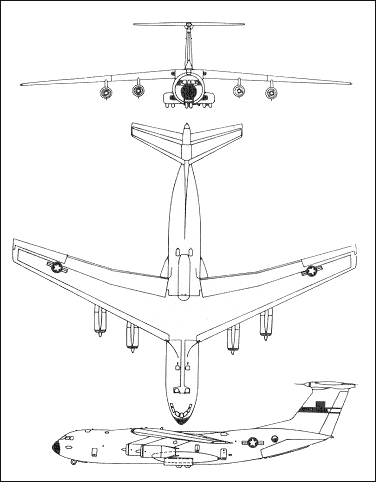


Stake Casino gameathlon.gr is among the best online gambling platforms since it was one of the first.
Online gambling platforms has expanded significantly and players have a vast choice, but not all casinos provide the same quality of service.
In the following guide, we will examine top-rated casinos you can find in the Greek market and the benefits they offer who live in Greece.
The best-rated casinos this year are shown in the table below. You will find the top-ranking gambling platforms as rated by our expert team.
For any online casino, it is important to check the licensing, software certificates, and security protocols to guarantee safe transactions for users on their websites.
If any of these factors are absent, or if it’s hard to verify them, we exclude that website from our list.
Gaming providers are another important factor in choosing an online casino. Typically, if the above-mentioned licensing is missing, you won’t find trustworthy software developers like Play’n Go represented on the site.
The best online casinos offer known payment methods like Visa, but should also provide electronic payment methods like Paysafecard and many others.
reply