|
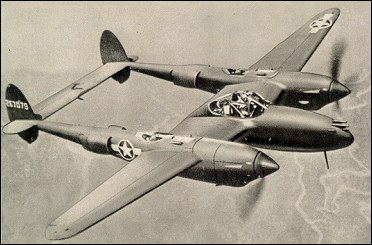
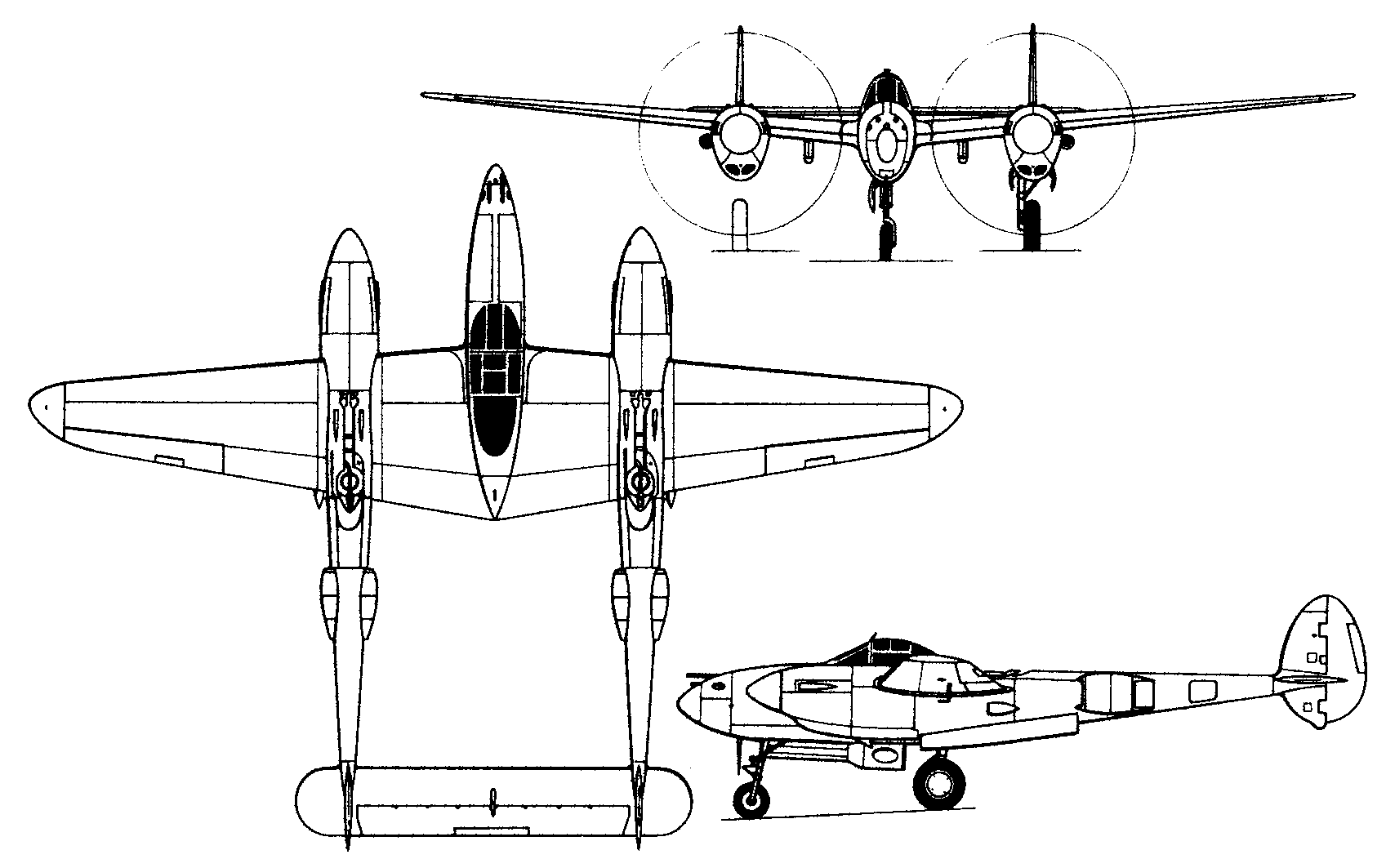
| The P-38 was the only American fighter built before World War II to be still in production on VJ Day. Developed through many successively improved versions, the Lightning was used in all US combat zones as a high- and low-altitude fighter, fighter escort, bomber, photographic-reconnaissance aircraft, low-level attack and rocket fighter, and smoke-screen layer.
The first aeroplane developed from the start as a military type by Lockheed, the P-38 was designed to meet an Air Corps specification issued in 1936. The XP-38 prototype flew for the first time on 27 January 1939 and the first YP-38 service-evaluation aircraft of a limited procure-ment order for 13 was delivered to the USAAF in March 1941.
The P-38D was the first version of the Lightning to go into service in the war - an aircraft of this mark was the first American fighter to shoot down an enemy aeroplane, flying over Iceland a few minutes after the US declared war on Germany. The P-38L was the last fighter version to see combat service, which took in the final stages of the Pacific War. Two P-38L Lightnings escorting a Boeing Fortress were actually the first Allied fighters to land on Japanese soil after the surrender.
Built in large numbers throughout the war, the Lightning - as the type was first named by the RAF- appeared in 18 variants. The RAF, however, received only three of 143 aircraft similar to the P-38D which followed the P-38 into production - their performance being unacceptable to the RAF. This resulted from the fact that Lockheed were not permitted to export aircraft with turbocharged engines, making it necessary to install the unsupercharged 775kW Allison V-1710-33 engines which had proved to be underpowered in the XP-38 prototype.
P-38D in US service differed from the original P-38 by introducing self-sealing tanks and tail-unit revisions to overcome buffeting. P-38E had armament changes and were followed by the P-38F with more powerful engines and underwing racks (between engines and fuselage nacelle) for drop-tanks or weapons: late production examples introduced Fowler-type flaps which had a 'droop' setting to enhance manoeuvrability. P-38G had more powerful engines, as did the P-38H and -38J - the latter introduced an improved cooling system and powered ailerons. Most extensively built version was the P-38L (3,923), equipped to carry rocket projectiles beneath the outer-wing panels. Some P-38J were converted to serve as two-seat 'Pathfinders'; some P-38L as P-38M night fighters or TP-38L two-seat trainers; and other versions included F-4 and F-5 photo-reconnaissance aircraft.
The Lightning is remembered especially as a long-range escort for Eighth Air Force bombers making deep-penetration daylight attacks on targets in Germany, as well as for the long-range interception and destruction of the Mitsubishi G4M1 (Betty) bomber carrying Japan's Admiral Isoroku Yamamoto.
| MODEL | P-38L |
| CREW | 1 |
| ENGINE | 2 x Allison V-1710-111/113 V-12, 1100kW |
| WEIGHTS |
| Take-off weight | 9798 kg | 21601 lb |
| Empty weight | 5806 kg | 12800 lb |
| DIMENSIONS |
| Wingspan | 15.85 m | 52 ft 0 in |
| Length | 11.53 m | 38 ft 10 in |
| Height | 3.91 m | 13 ft 10 in |
| Wing area | 30.47 m2 | 327.98 sq ft |
| PERFORMANCE |
| Max. speed | 666 km/h | 414 mph |
| Ceiling | 13410 m | 44000 ft |
| Range | 724 km | 450 miles |
| Range w/max.fuel | 3640 km | 2262 miles |
| ARMAMENT | 1 x 20mm cannon, 4 x 12.7mm machine-guns, 1451kg of bombs |
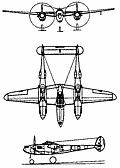 | A three-view drawing (1697 x 1063) |
| GARY BEDINGER, e-mail, 31.03.2010 07:36 THE LOCKHEED P-38"LIGHTNING" WAS TRULY ONE OF AMERICA'S FINEST FIGHTER PLANES THAT WAS EVER BUILT.THE JAPS IN WW2 WERE TERRIFIED OF THE P-38,AND FOR VERY GOOD REASON.THE P-38 WAS FAST,414 MPH,GREAT RANGE,1,000 MILES,AND HAD GOOD ALTITUDE,38,000 FEET.WHAT A PLANE!!!!! reply | | James Penny, e-mail, 21.03.2010 18:19 My uncle Fred M. March, was a line chief in New Guinea for the 482 Service Sqdn., I have numerous photos of him and Maj Bong, and his P 38, with 27 Jap flags on the fuselage. Uncle Fred's comments about Bong were not glorious, because he lost so many wingmen. "Not a good team player". reply | | Lyle Sparkman, e-mail, 19.02.2010 23:20 A number of good period photos of P-38s in the Pacific can be found at www.flyingknights.net, a site focused on the 9th fighter squadron, the very outfit of aces Bong, McGuire, and Johnson. reply | | Ben, e-mail, 02.02.2010 19:01 My good friend and neighbor, Harry T Hanna, became an instant ace while flying his P-38 in North Africa while on a mission with his comander William Leverett. Harry shot down 5 German planes while Leverett up staged him by shooting down 7.
I am trying to convince him to go to the Fantasy of Flight event in Lakeland FL on April 14th where they will have other Aces, but he will not commit to giving me the honor of taking him. I believe he's just too humble.
He is now 89 y.o. and in great shape. reply | |
| | John Webber, e-mail, 02.02.2010 08:54 My dad started flight training in Stearman biplanes, then A6 Texans, then B25's for multi-engine experience, then the P38 /F5 photo recon variant solo, the way most other P-38 pilots learned. He was scheduled to ship out to Japan in August 1945 when the war ended. He never got to fly overseas. He too never sat in another cockpit after the war. In the 1970's a few people he worked with wanted him to go in on the purchase of a Cessna. "Why would I want to drive a Volkswagen after I've driven a Ferrari" he replied. The P-38 initially got a bad rap for no cabin heating in early models (the plane was developed in California where heat was not normally an issue), and it was the first fighter plane capable of flying fast enough in a dive to consistently encounter compressibility, a phenomenon then known but little understood. Today that problem is solved with fully floating horizontal stabilizers and other aeronautical engineering advancements from lessons learned the hard way with the P-38 and some other fighter planes of later WWII vintage. The F5's had dive flaps, cabin heat, an enormous camera in the elongated "droop snoop" nose, and breakable safety stops on the throttles. They had no armament. Their only defense was speed. If the throttles were pushed through the safety stops the plane would go fast, rapidly consume large amounts of fuel, and immediately be rolled into the shop for engines to be changed out if the pilot was able to return from the mission. Emergency bailout procedures NOT inverted were part of pilot training. Actual practice bailouts were not performed during training, but the procedure was successfully proven in combat. Like others, I too have wondered why the P-38's contribution to the war effort in both theaters became a mere footnote in the final history of WWII. The Germans and Japanese were both aware of the plane's vulnerabilities, but P-38 pilots were trained to fight on the P-38's terms, not the enemy's, to exploit the enemy plane's weaknesses, and that's still practiced today in the Air Force and Navy. And yes, Richard Bong's 40 kills were all in a P-38 in the Pacific theater. A celebrated war hero in his time, he returned to the US late in the war, helped sell war bonds, then served as a test pilot in Lockheed's first jet plane, the F-80 Shooting Star. He was killed in an F-80 test flight crash before the end of the war. That may be one reason the P-38 did not receive the credit it was due; its most famous pilot didn't survive to keep its fame alive. reply | | BOB DICKSON, e-mail, 22.01.2010 00:23 MY DAY WENT FROM B-25s TO P-38 PHOTO. HIS PLANE CAUGHT FIRE OVER TEXAS ON A PRACTICE MISSION JUST BEFORE HE SHIPPED OUT. BADLY BROKE HIS ARE WHEN PULLING THE CANOPY RELEASE - THAT ENDED HIS WAR. ARMED WAS NEVER THE SAME BUT HE WAS ALIVE - THUS I AM HERE TODAY! HE LOVED THE PLANE, BUT NEVER SAT IN A PILOT'S SEAT AGIAIN. reply | | Sandford Weiler, e-mail, 05.01.2010 03:34 Leo: You're right about the "little flaps" on the J. Made all the difference in the world I know first hand.
Lori: There is no recorded instance of a bailing-out-pilot getting hooked on the elevator. We were not taught to bail-out upside down. Two of my squadron buddies had to bail, and not upside down. The first one was injured, not by the elevator, but by "friendly" fire from the ground as he descended in his parachute.
Willmatt22: At Williams AFB (advanced training, single engine) we transitioned through (what I recall as) a UC78 (twin-engined troop /supply), then the RP-322, the prototype P-38 ordered by and sent to England (and it was a poor performer). I graduated as P-38 proficient, and went straight to an F-5 (same thing as P-38E, but without guns).
Hang in there, kids. reply | | paul scott, e-mail, 15.10.2009 22:35 The 'forked-tailed devil' reigned supreme! reply | | David Sloan, 16.09.2009 04:54 My grandfather, Herman Sloan, worked on P-38s during WWII here in the US. He carved a model of the Lightning out of a piece of windshield that came off one of the planes. I still have it!!! It is the centerpiece of my office. reply | | patrick kuntz, e-mail, 11.09.2009 19:56 hello
i need advice on how to convince a know it idiot that it is 38 not 32 reply | | Ronald, e-mail, 24.08.2009 05:18 Though red-lined at 450 mph in a dive for early models (at 15 degrees), late war models were test flown to a terminal dive of 518 mph. The dive flap finally dealt with the compressibility that plagued the P-38 until late in the J model run. reply | | Sam, e-mail, 05.08.2009 01:32 I have two P-38 remote control aircrafts, they look great in the air!! My project is to make these two P-38's as real as possible, I have managed to get alot of info from the web but, the only item I do not have is a birds eye view of the P-38's engine, would anyone have a pic of the engine? It would be greatly appreciated, thanks Sam. reply | | Leo Rudnicki, e-mail, 12.06.2009 00:27 18,000 and change Lightnings gets you a B-2, used. And yet, there are more B-2's than Lightnings flying today! reply | | Leo Rudnicki, e-mail, 11.06.2009 02:53 Lockheed P-38-$115,000 vs NA P51D $54,000. P-40's only $45,000. 6 Lightnings gets you a B-29. Its only money. reply | |
| | Ronald, e-mail, 10.06.2009 09:29 The P-38 was something different! Sometimes I love it after all, the Japanese rated it the best U.S. fighter up high. That's high praise for this 10 ton P-38L fighter judged by the pilots of the lightest, most nimble fighters in the war. But sometimes I don't love it. Look at how Tom McGuire died. 4 P-38s in a scrap with 2 or 3 Nakajima fighters. And at least Tommy was a top notch ace, perhaps most of them were quality Lightning pilots flying the latest P-38s. Only 2 return from their unauthorized flight after getting whipped by a couple of Japanese army pilots late in the war. Granted, one of the Nakajimas was a Frank. Perhaps Tom only saw the Oscar when he chose to engage at low level without jettisoning the drop tanks first, to save a wingman. The borrowed P-38L failed to complete the turn when he went into the ground.
The reputation of the Lightning was mainly earned by the earlier models. They were dicey in a dive of over 15 degrees or for any distance. They were slow to roll and turn, and climb was shallow. One 20mm hit on the tailplane where it attaches to the fin could knock it down. But they were fast and hardhitting with no torque stall. Performance was best at medium altitudes and the supercharged Allisons were unreliable. The L was the last model and it was the most produced. It was much improved in all respects mentioned. It could dive down a Bf 109's neck ...and pullout. It could even roll and turn with most fighters. But it still required a steep learning curve for pilot and mechanic, it now excelled up high but it was still difficult to harmonize the twin superchargers up there. Plus you could buy 2 Mustangs for the same price and P-51s had heating. reply | | Lori, e-mail, 28.05.2009 09:55 Hey Gary, I've been watching a documentary on TV and they said that Richard Bong was certainly a big player. When surfing the web his name comes up most of the time. My dad also flew a p38. His plane was shot down over Hungary, he was held captive for a year. You know you can't eject from that plane, you have to turn it over and fall out. My dad is my hero. reply | | Lori, e-mail, 28.05.2009 09:50 Hey Gary, I am now watching a documentary on the p38 and they do say that Richard Bong was indeed a major player. And when surfing the web his name comes up most of the time. It is a super interesting program. My dad also flew a p38 in wwll. He was shot down over Hungary and was captured and held captive for a year. You know they can't really eject from the plane, have to turn it over and fall out. reply | | Willie, e-mail, 11.05.2009 00:36 Can anyone tell me if the pilots trained to fly the P-38 were selected from the advanced twin engine (bomber) or advanced single engine (fighter) schools. reply | | leo rudnicki, e-mail, 07.04.2009 20:33 The big scoops on the booms are coolant radiators,which gave aerodynamicists shivers. Lightning pilots in Europe commonly shot at Mustangs. One advantage of the P38 was that it didn't look like any other plane. One disadvantage of the P38 was that it didn't look like any other plane from a great distance.A big problem in Eupope, the cockpit was unpressurised, drafty and cold. Few people behind providing the a /c,Air Ministries, DoD's manufaturers or designers gave any consideration to pilot comfort, even tho it has a real relationship with efficiency. P38E was pressurised and P49 locked a bit more comfy but didn't happen. The P38 had a learning curve before a pilot was proficient. some great planes are like that. Tommy MacGuire was dog-fighting an Oscar, one of the dog-fightingest airplanes ever, without dropping his tanks, when he lost it. If he hadn't been just above the trees, he probably would have recovered. Just that onetime, he had too much confidence in himself and his plane and stalled into the ground. The airplane suffered from "compressibility" in a dive from great altitude, like Hawker Typhoon. The temporary fix kits sent to Europe on one ship, sunk by U-boat. No replacements were sent. The little under-wing flaps appeared in production only into P38J run. Robin Olds encountered this effect. He survived, some didn't. When I finally perfect my Time Machine, I'll get rid of the outer tailplane stubs and fit an all-moving stabilator, then move the radiators into the cockpit and then... reply | | samp, 23.12.2008 18:23 My grandfather almost got killed by one of these in a friendly fire incident. reply |
|
Do you have any comments?
|
| 
COMPANY
PROFILE
All the World's Rotorcraft
|