|
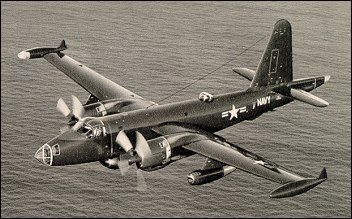
| The first US Navy contract for two XP2V-1 Neptune maritime-reconnaissance bombers was placed in April 1944. The first prototype flew in 1945. From then Lockheed received contracts for the P2V-1 to P2V-7 versions which were subsequently redesignated in the P-2 category.
Last versions in operational service were the P-2E (formerly P2V-5) which introduced the glazed nose, MAD tailboom, Julie/Jezebel ASW systems, etc, and later fitted with auxiliary underwing turbojets; SP-2E, as for the P-2E but with modernised equipment; P-2H, the first version to introduce auxiliary underwing turbojets and incorporating equipment and detail changes; and the SP-2H, as for the P-2H but with modernised equipment. These served with the Argentinian Navy (P-2H), Australian Air Force (SP-2H), Brazilian Air Force (P-2E), French Navy (P-2H), JMSDF (P-2H, and Kawasaki P-2J), Netherlands Navy (SP-2H), Portuguese Air Force (SP-2E) and the US Navy (SP-2H).
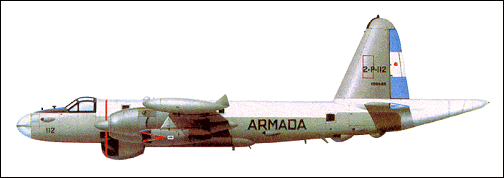
| CREW | 7 |
| ENGINE | 2 x Wright R-3350-32W, 2575kW |
| WEIGHTS |
| Take-off weight | 36191 kg | 79788 lb |
| Empty weight | 22592 kg | 49807 lb |
| DIMENSIONS |
| Wingspan | 31.7 m | 104 ft 0 in |
| Length | 27.9 m | 92 ft 6 in |
| Height | 8.9 m | 29 ft 2 in |
| Wing area | 92.9 m2 | 999.97 sq ft |
| PERFORMANCE |
| Max. speed | 648 km/h | 403 mph |
| Ceiling | 6800 m | 22300 ft |
| Range w/max.fuel | 5930 km | 3685 miles |
| ARMAMENT | 2 x 12.7mm machine-guns, bombs, missiles, torpedos |
| James Zeiner, e-mail, 11.02.2024 19:44 I served in VP-4 from mid 1963
through early June of 1966, as an AX 4 then 5. Was first tech when I discontinued flight duties, accumulating approx. 2500 flight hours. We served in Viet Nam during 1965. VP 4 was deployed in Okinawa, Iwakuni, Japan and Barbers Point, Hawaii. The squadron transitioned from P2's to P3's in mid 1966 soon after my discharge so I never flew in the P3's. Flight crews that served in Viet Nam were awarded Air Medals. reply | | Thomas Kinder, e-mail, 21.08.2022 19:40 I flew with VP 42 NAS Whidbey Island, Washington from Dec 1966
to Sept 1969. Member of the P2000 club. Aircraft Commander of
crew #11. Served two tours in Vietnam. Tan Son Nhat airbase on
Saigon and Cam Ranh Bay 1967, 1968
Lots of great friends from squadron I would love to hear from. reply | | 0ilqnoZDnu, e-mail, 16.08.2022 12:13 ayC2nBwPfIqXI3VNySAeqJPlGA5xCrggefwjVbtGDJPovspqYx2oVwloyWPsdMRj3G9IuJCiuMtltMDKBWQiItKcbuVS7238WnTpN4stwOWOipPxpqVXGT1M9bewv1eiO4qXnpb3elJG5jjtfHx21iMZ5QMM1rioZUst2IQOj4g reply | | Jim Jabbusch, e-mail, 09.02.2022 18:17 Was in Vp-21 in Brunswick from 1963 till 1969 was the ordance man on crew 7 & 1 ratation with the skipper and then exec. flew 147952 148352 did make the Canadian P2 thousand club,with 2000thousand hours. Long patrols but allways got us home. We were launch from Rota Spain when the B52 and Tanker collided over Spain. reply | |
| | Ralph Spaulding, e-mail, 30.04.2021 01:59 I flew the P2V-5 and 5f with VP-28 In 1954-1956. We deployed to Iwakuni and Kodiak during those years. In the mid 60's, I flew the SP2H with VP-17. We deployed to the Philippines twice to support detachments in Viet Nam flying Market Time patrols. I left the squadron when they left Whidby Island to transition to the P3 and move to Barbers Point. I was the last pilot to leave Whidby, so became the last P2 driver in the squadron. Great airplane. Never lost an engine. reply | | Paul Scott, e-mail, 27.05.2020 20:31 Nice underrated 'plane. reply |
| Joe Wagner, e-mail, 07.02.2020 03:35 VP-42 Crew 11 and 4A 65,66,67 reply | | Edwin Burdick, e-mail, 20.02.2018 03:40 I was stationed with VP-6 at Barbers Point Hawaii from 1957 to 1960. Made a deployment to Iwakuni Japan. Upon my return to Barbers Point I was assigned to Crew 12 as a radio operator. The P2V-5f was a fantastic aircraft. reply | | cecil pearson, e-mail, 26.08.2017 23:38 trying to contact AMS1 Bruce R MacNair who flew ADAK Search and Rescue in 1967 in SP2v May have been in my crew reply | | Wes Crook, e-mail, 06.07.2017 00:53 My father, F. Wesley Crook, was the xo of VP-28 Barbers Point. The squadron deployed to Kodiak in early 1953, to the best of my recollection. He thought the P2V was one of the finest airplanes he had ever flown. He was plane commander of crew #2, VP-28. Once, upon letting down below a 400 foot overcast to photograph a Soviet ship one of the engines swallowed a valve resulting in, according to his words, "big bloopers of flame" streaming over the wing. He said he had never seen his crewmen don their survival suits so fast! He flew it back to Adak (?) 400 nautical miles on one engine. (No jet assist engines on this plane). He loved the Navy and went on to fly Super Connies out of PAX River. He retired in 1967. He had two other close calls in the P2V, (one in a foreign country) but the plane was tough. The foreign country story probably still can not be told. He loved the Navy and this country and was buried in his dress blues with a military funeral. reply | | Nick Hallinan, e-mail, 02.04.2017 20:40 I went through P-2 training at VP-31 in San Diego in 1969 then it was off to VC-5 on Okinawa flying in the DP-2E. We flew all over the place even into Vietnam. Our flight suits were olive green and we had LPAs, not the orange may wests. We flew many Drone launches dropping BQM-34s and we also had 2 P-2s modified for the BQM-34E. One memorable flight we were out training our skipper in the P-2 as he was an A-4E pilot. We did a bunch of primary training and my PPC said let's do an inflight shut down of the right R3350. We did and flew around on 1 recip and 2 jets then we restarted the right recip. We went back to Naha for some touch and goes. We touched down, the skipper pushed the jets up to T /O, I rezoed the Varicam and toke the recips up to takeoff Wet. As we broke the main gear off the right recip decided to shutter, oil pressure, BMEP and Chips light came on and then over the ICS came, "We are on Fire" well the pucker factor went sky high, I pushed the right feather button and like it should the prop feathered. Needles to say when we turned down wind we declared an emergency and landed with fire trucks following us. All the flames went out when we shut down the engine. Lucky us. We taxied into our regular spot and all our squadron mates were out to welcome us back. They thought we were going to crash as we trailed flames about30 feet behind the aircraft. I found out later that # 13 cylinder had broken a valve and hammered a big hole in the piston. Needless to say we had a ton of aluminum in the oil filters. Man what a flight. reply | | William Reynolds Dalton, e-mail, 24.03.2017 08:16 My Dad flew the PBY4-1 for 35 missions during WW2 in England. After the war we were in SanDiego . He was flying the P2V Neptune . We were in SanDiego at least two years. He was LtJg Forrest Adolph Dalton Jr. I remember the patch with Neptune and his Trident coming out of the sea. Later , around 49 we were in Milton Fl at Whiting where he served as a Navy Flight Instructor. He had also graduated from Pensacola in 1944 as a Aviation Cadet. We then moved to Langley where he transitioned to the Air Force and A26. He served as a Capt. In Korea flying Night Interdiction mission over N. Korea , receiving the DFC. He was killed April 4 th , 1957 when the B57 he was piloting lost an engine in severe weather near Van Cleave, Mississippi. He was assigned to the Inspector General Headquarters Staff at Eglin Air Force Base. reply | | Donald L Ward, e-mail, 19.03.2017 21:49 My uncle who was my Mom's brother was assigned to Patrol Squadron Seven, stationed at a base in Iwakuni, Japan in December, 1953. His squadron was sent home, I think to San Diego, in Jan 1954. He volunteered with seven other crew members to stay with the last P2V which had been cannibalized for parts, and got it ready to bring home. They left Japan and were attempting to land at Barbers Point on Oahu to refuel, Jan 21st, 1954. They missed their approach, and the pilot steered left to attempt a go around. The plane plowed full throttle into the side of a 3000' mountain in the Waianae Range, behind Schofield Barracks at 9:30 PM. His name was Richard (Dickie) Brown, from Waverly, Ohio. I have the last letter from him, all the telegrams from the Navy, and a couple items recovered at the crash site. The remnants of the plane are still there, you can even read the aircraft number, 124874 on the fuselage. David Trojan, who is retired from the Navy, and I think lives near San Diego, sent me the full report of the crash with pictures of the site and wreckage. He has been to the site at least four times. I have asked questions about this crash all my life, I am now 65, and have learned more from Mr. Trojan than from anybody else. I would love to find out if there is anyone still living who might have served with Uncle Dick. Uncle Dick's high school sweetheart flew to San Diego to meet him, he had bought a ring in Japan, and the were going to get engaged. She stayed a close family friend all my life. I would love to learn more if anybody is out there. Thank you, Don Ward / Cincinnati, Ohio reply |
| Tony Roberts, e-mail, 24.02.2017 01:40 I was on final assembly /check out P2-7 & then on a mod line P2-5 @ Lockheed, Burbank, early 60's. The crews were great & it was a fun airplane to work on. Don't remember any armament though (guns, bombs, etc.) but the a /c did have the MAD gear, sono buoy stuff & a huge searchlight built into the r /h wingtip tank. Also had the jets which were modified to burn avgas. Lockheed also had a P3 line going at the same time. That a /c was based on their L188 Electra airliner. reply |
|
| | Gordon Lothrop, e-mail, 17.02.2017 21:32 Hey Bo, (Palmer Bowling I remember when the Capt. got lost in the woods. a funny story all ended well. reply | | Gordon Lothrop, e-mail, 17.02.2017 21:28 I can mirror Joe Rokowski's comment from above. made the tours to Key West, Argentia, Keflavik, Norway. Never made Sicily, though. I was second tech, ("2nd tron")on Crew 6. I mustered out just as that deployment was leaving. I wish that I could revisit those days for just one more patrol. Where did all those years go? reply | | Curtis W Lambert, e-mail, 13.01.2017 00:55 VP-26 was my first duty station at NAS Brunswick, Maine. 1959-1962. Started flying as an AEAA ECM operator and left VP-26 as an AE2 in 1962. In 1969 it was back to P2V aircraft as an AE1 at NAS Alameda, CA as the Work Center 220 Supervisor. The flying years were great and so were the non-flying years. For those interested, I have a blog. Memoirs of a U.S. Navy Chief Petty Officer at curtislambertmemories.blogspot.com reply | | James H Melville, e-mail, 01.12.2016 06:06 I was in P2V7's and transitioned to P3A. Served in VP10 1963-1966. Both great planes. Does anyone know where I can find the noise level inside p2v and P3A
Thanks,
Jim reply | | Larry LaCoursière, AO2, e-mail, 29.11.2016 07:39 Why Are We Here?!
A new squadron was assembled at the Whidby Island Naval Air Station (Washington) - 1954. Their objective or mission was a complete mystery! It appeared that they were only recruiting farm-boys! The main objective appeared to be "No police reords of any kind". Also, we had no idea what our next station would be! Finally, we are flying to Alameda California and Hawaii with a final destination of Kwajalain, Marshall Islands. So......we drop a few torpedos which are being developed and a ga-zillion tiny, rubber rafts. Also, we are asked to report the presence of natives on certain islands. After a couple weeks, the officer-of-the-day tells everyone that we should be awake, bright-eyed and bushy-tailed at 1 AM. [We STILL have no idea what the prime reason was for our presence in this part of the world!]
The time was 1AM [100 hours] and.............the sun came up! Twenty minutes later we felt a shock wave. We had experienced a nuclear experiment.
The P2V Neptune was an exceptionally reliable aircraft.
While patrolling the Aleutian Islands, we lost one engine (One of 2 IS alot!!). ANYTHING, which was not nailed down, was "tossed" and we went home without a problem.
Larry LaCoursière, AO2 reply | | Dan Mc Knight, e-mail, 08.11.2016 16:28 Don't see many photos of P2V2's and 3's They were unigue to what I see now. They had (6) 20mm cannon in the nose, and 2 20's in the tail turret along with the twin 50cals in the top deck turret Dan Mc Knight VP7 1950 /1953 dm15389@frontier.com reply |
|
Do you have any comments?
|
| 
COMPANY
PROFILE
All the World's Rotorcraft
|


 Donald L Ward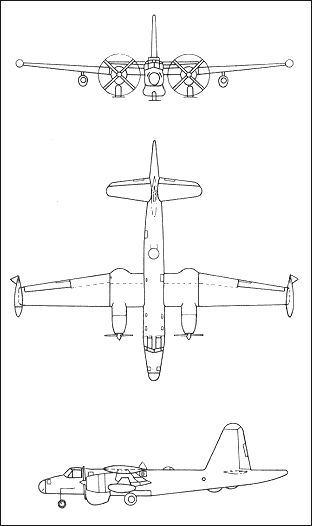


I was an AE3, I did a lot of maintenance on P2's. I also was a Jez operator on a reserve training base in MA., NAS South Weymouth from march 66 thru march 69. The performance of those birds was extraordinary to say the least. Note much on creature comforts (heaters didn't work most of the time.) We got the job done.
reply