|
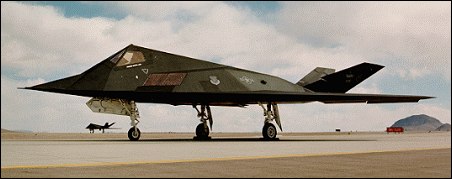
| Successfully kept secret for nearly 15 years, the Lockheed F-117A was the
winning submission for the 'black' XST (Experimental Stealth Technology) competition of 1975-76 sponsored by the US Defense Advanced Research Projects Agency. Both Northrop and Lockheed were contenders for the programme, but in 1976 Lockheed was awarded the contract and built two technology demonstrator prototypes under a programme codenamed 'Have Blue'. Powered by General Electric CJ610 turbojet engines, the first XST made its initial flight in December 1977 from Groom Lake, Nevada, piloted by William C. Park, but both prototypes ultimately crashed, one in May 1978 and the other in 1980.
Promising test results led to the development of two scaled-up YF-117A-LO prototypes which were followed by 57
production F-117As ordered in batches during the fiscal years 1980 to 1986 plus 1988. The first pre-production aircraft flew for the first time on 18 June 1981, and the first F-117A was handed over to the USAF in August 1982. Despite much worldwide speculation, the air force resisted confirming the existence of the programme until November 1988 when they released a rudimentary and misleading photograph of the aircraft, and confirmed the designation. The next logical 'F number' should have been the F-19, and many agencies used this for some time when identifying the spectral aircraft. The USAF had allocated F-112 to F-116 to Soviet fighters acquired clandestinely for evaluation, and the designation F-117 was thought to be in use for the same purposes and consequently attracted less attention. The F-117A was declared operational
in 1983, but the aircraft flew only at night from its secret base at Tonopah, 225km north-west of Las Vegas, Nevada, to preserve programme secrecy, until late in 1989 when daytime flying began. Two aircraft were lost in accidents in July 1986 and October 1987 and these were attributed to pilot disorientation associated with fatigue.
F-117As, reportedly nicknamed 'Wobblin Goblin', but more usually referred to by its pilot as the 'Black Jet' and officially named Night Hawk, first went into action in December 1989 as part of Operation Just Cause mounted by the US to remove from office General Manuel Noriega of Panama. The aircraft's performance in placing ordnance onto specific targets with absolute precision was considered a vindication of the whole programme. Further action came in January 1991 with the Gulf conflict and a major proportion of the USAF fleet (42 out of the surviving 54) were eventually based in Saudi Arabia with 415th Tactical
Fighter Squadron 'Nightstalkers', the 416th TFS 'Ghostriders' and the 417th Tactical Fighter Training Squadron 'Bandits', all comprising the 37th Tactical Fighter Wing, one of whose aircraft dropped the very first bomb of Operation Desert Storm on 17 January 1991.
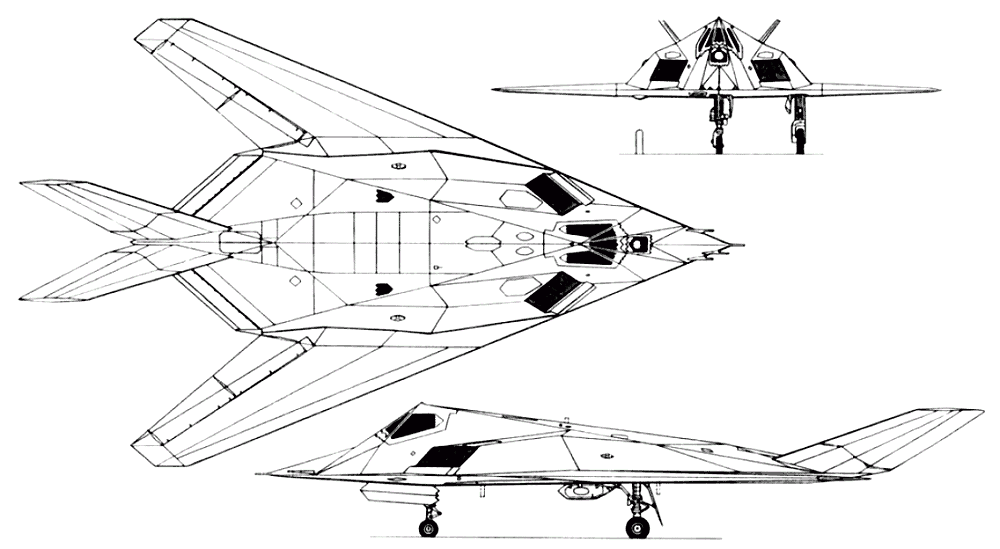
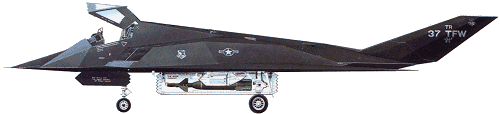
The result of a radical design philosophy which seeks to minimise the radar signature of an aircraft, the F-117A features angular multi-faceted air frame panels designed to deflect and in some cases absorb radar energy. The heavily-swept wing of just over 67° illustrates highly-complex aerodynamics and the intakes, doors and access panel shapes are all optimised to reflect radar signals. Wing and fuselage are aerodynamically blended and made of conventional aluminium but specially coated with radar absorbent materials. Tail surfaces, or 'ruddervators', are made of composites, and the whole aircraft is controlled by a quadruplex fly-by-wire system. The comprehensive avionics fit includes forward- and downward-looking infra-red
systems; head-up and head-down dis
plays; a retractable laser designator;
multi-function CRTs; a mission compu
ter and flight control comouter/naviga-
tion system interface, plus a global posi
tioning system. Powerplants are
non-afterburning variants of the General
Electric F404 engine used in the F-18
Hornet.
| CREW | 1 |
| ENGINE | 2 x General Electric F404-GE-F102, 4900kg |
| WEIGHTS |
| Take-off weight | 23814 kg | 52501 lb |
| DIMENSIONS |
| Wingspan | 13.2 m | 43 ft 4 in |
| Length | 20.08 m | 66 ft 11 in |
| Height | 3.78 m | 12 ft 5 in |
| Wing area | 105.9 m2 | 1139.90 sq ft |
| PERFORMANCE |
| Max. speed | 1M | 1M |
| Cruise speed | 0.9M | 0.9M |
| ARMAMENT | 1800kg of weapons |
 | A three-view drawing (1000 x 549) |
| tom willoughby, e-mail, 19.09.2016 04:55 I would like to purchase dimensioned drawings of the F22 Nighthawk so that I can
make a Haloween costume (probably out of corrugated card board) for my 6 year old grandson.
Any ideas ,offers,help?
Tom Willoughby phone 614 638 6983 reply | | Jay Deneane Cornell, e-mail, 05.08.2015 06:43 I was in Aerospace engineering for fifty years and was working at National water Lift in Kalamazoo, MI. as an RM&S specialist. My first project there was on the fly-by-wire flight control Servoactuators for the F-16. After Qualification was completed we were asked to do a supplemental Qual. test on a slightly modified F-16 unit. To make a long story short, the modified units were used on the F-117. reply | | NARP, e-mail, 30.03.2015 00:33 Kyle, only one aircraft on a pedestal - a pre-production A /C at Freedom Park, Nellis AFB. When the jets were retired from Holoman, they were all sent back to TTR, and sit in their air-conditioned hangars, once again.
Bmilic, when you use AAA like a shotgun, you're bound to hit something. reply | | m.n., 29.05.2011 15:02 it can only carry 1800 kg of weapons compared to 8000 kg on su-35 reply | |
| | deaftom, e-mail, 05.04.2011 04:30 To clarify, the F-117's faceted design was based on theoretical mathematical computations by a Russian (I don't have his name handy) that showed that careful placement of facets and edge angles could drastically reduce radar reflections. His published paper got translated into English and attracted the attention of some Pentagon wonk, who then asked Lockheed's Skunk Works what they might be able to come up with. The result was the XST, a small proof-of-concept aircraft that led to the F-117.
Even though the original idea was from a Russian, as far as we know the Soviets never adopted the same faceted concept for even an experimental aircraft of their own.
Today, the faceted design is considered obsolete; computing power has increased to the point where computer-designed 3-D curved shapes can be made stealthy (witness the B-2 and F-22). reply | | Dick JOhnson, e-mail, 21.12.2010 11:03 Ben Rich once told me it was a Russian engineer's design that made it so stealthy. To prove it, they had to verifiy it with a flag pole. reply | | Nitehawk 6, e-mail, 02.11.2010 20:27 bmilic is not very well informed in his comment. He has no idea how many sorties were flown in various places in the world and no one knew we were even in the area. Take a look at the two buildings in downtown Beograd. The army Hq and the national police hq were gutted and we did not lose any aircraft. Been there, done that, left burning holes!!! Nitehawk 6 reply | | Petar, 30.05.2010 00:57 To Bane ponovo te podržavam !!!
Inače ruski tu-144 je takoÄ'e teško vidit na radaru mada je puno veći od ovoga i nema stealth tehnologiju (mada mislim da i sami rusi neznaju zbog čega je tako). reply | | nifis, 06.01.2010 08:17 F-117 is a unstable aircraft,without computer it can't fly.
This aircraft has a good design and it can hide from radar coz of this aircraft shape. reply | | Kyle, 02.03.2009 20:12 The F-117 was a revolotinary airplane in the 70's and 80's, but it is now obsolete. The F-117 is now out of service and the only way to see one is to look for them on pedestals outside Air Force bases or in museums. reply | | Pater, 13.11.2008 18:56 "Stealth" technology is based on russian research. Without it there would have been no F-117... reply | | WShedd, 18.06.2008 02:55 Considering the number of sorties and conditions in which this aircraft has flown, only one loss is amazing.
The Serbian air-defense uses old, long pulse radar systems that are not widely in service. It is also less stealthy in rain. Despite these limitations, nobody else in the world has anything close to its capabilities. reply | | bmilic, e-mail, 19.05.2008 12:49 This Lockheed F-117 Nighthawk is shit. He is down 1999 in Serbia, Budjanovci with Serbian anti air defense out of 1969, NEVA. Write by BANE & STEVA reply |
|
Do you have any comments?
|
| 
COMPANY
PROFILE
All the World's Rotorcraft
|