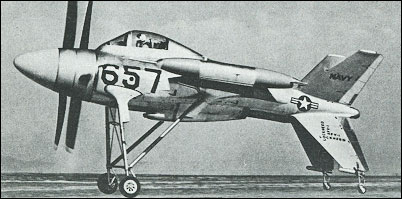
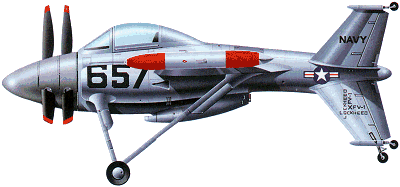
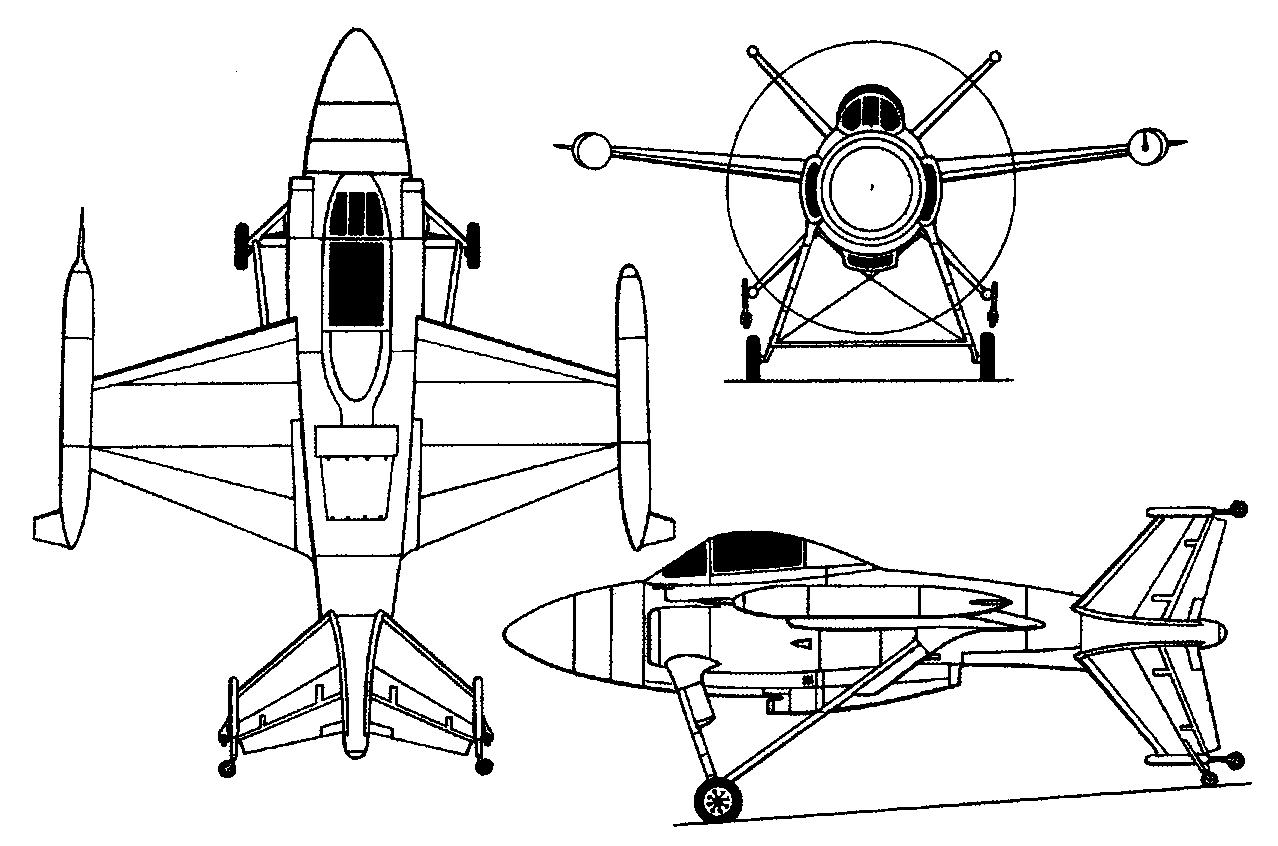
Under the designation Lockheed XFV-1, the company completed and flew the first of two prototypes of a single-seat VTOL research aircraft. Powered by a 4362kW Allison XT40-pA-6 turboprop engine, the Salmon was one of a number of tail-sitter designs originated in the early 1950s. Basically, the aircraft was a conventional mid-wing monoplane without normal landing gear. The tail had equal-span cruciform surfaces each incorporating a shock-strut and castoring wheel, and the aircraft was intended to
stand vertically on its tail unit for take-off and landing. However, as the 5294kW T54-A-3 engine intended for the proposed XFV-2 VTOL fighter derivative did not materialise, the XFV-1 was fitted with a temporary conventional undercarriage and operated from this until the whole programme was cancelled in June 1955 and construction of the second prototype abandoned. Span was 9.40m, maximum take-off weight 7358kg and maximum speed estimated at 933km/h.
I served at NRAS Los Alamitos from 1963 till 1968. I passed the XFV-1 every time I entered or exited the Building I worked in. I was always interested in the experimental aircraft of the 1950’s I do recall being told “our” XFV-1 was the non flying 657 . If the information provided above is correct then the one in Florida is probably airframe 657 renumbered as 658. Anyone know the true story of the Florida airframe?
During the 1980s, 658 was abandoned in situ at OLF Imperial Beach, near the US Mexico border area of San Diego. During helicopter flights to that base, I routinely saw this unique bird, painted red & white, shifted around from the shade of one hangar to the next, other times sitting forlornly between cars in the Border Patrol impound lot. I urged our museum (SDASM) to try to obtain it for restoration but couldn't get any interest. I checked on the aircraft often, more because I was afraid it would be scrapped than any other reason. In the end, one day in the early 1990s, I visited and the XFV-1 was missing. I went ape, begging the base C.O., the PAO and anyone else for info. The man in charge of security told me a large NASA flatbed had come to pick it up. I have several photos of it from that era if anyone is interested. I would love to know what became of my old friend. BTW, "Salmon?" No, sorry. v /r Gordon
I found a news item in Naval Aviation News that stated the SDASM was given the XFV-1 but couldn't sort our a space to display it. The Navy then sent it on to the National Naval Aviation Museum in Pensacola who in turn loaned it to the EAA Museum in Lakeland, FL. I'd love to see your pics from OLF Imperial Beach.
I think applying the name "Salmon" to this airplane is a bit of revisionist history whimsy. It was NEVER referred to by that name by any knowledgable person. Don't think Fish Salmon would be amused either.
This aircraft, and the Convair XFY "Pogo", were designed to satisfy an ill-conceived Navy requirement for a fighter that could take off and land in a vertical attitude from small platforms on Navy or Merchant ships. Both were powered by a turboprop engine, the Allison T-40, that fell far short in terms of mechanical reliability. Apart from that difficulty, however, the entire concept was flawed by the near impossibility of taking off and landing any aircraft in a vertical attitude from a small platform on the rolling deck of a ship at sea. The Lockheed design was never flown that way, even on land. Although the Convair design actually was taken off and landed vertically, it was only done from land, and then only by an extremely experienced test-pilot. The chances that a regular military pilot could have managed to fly either aircraft successfully from the heaving deck of a ship at sea were extremely slim. In any case, both aircraft were so top-heavy when standing on their tails that, if they ever were placed on the deck of a ship at sea, they stood an excellent chance of toppling over of their own accord.
Aircraft number 657,the flight test aircraft was moved to North base,Edwards,after completion of flight tests. It was then moved to Hiller Aircraft at Palo Alto, California, (Hiller Helicopters)in September 1856. It had the engine removed for use in the Hiller X-18 twin engine tilt wing transport. (The other engine came from the Convair XFY-1 Pogo.) I was an engineer working on the X-18. I was asked on October 1,1956 to takea a look at the XFV-1 as it sat in the back 40 of the Hiller plant and see if the ejection seat could possibly be removed and applied to the X-18. The airplane was sitting in the horizontal position as you see it in the picture. I climbed up the scafold steps and entered the cockpit in a kneeling postion,looking aft,in order to look at the rail mounting of the seat. This was a modified seat that still used cables to pull the safety pin and to pull a cam with a pin that fired a 75mm charge. The cables were disconnected, but as I moved them aside to see better, the charge fired off and then shot me about 30 feet into the air. I landed on the aft end of the wing in a sitting postion and then bounced off the side of the fuselage and then off the X tail and tehn onto the ground. Because the canopy was not completely open the leading edge of the canopy and the seat nearly sheared off my right wrist. I received a broken knee and back and many lacerations. Thanks to nearby workers that came to my rescue I did not bleed to death. I spent three weeks in the Palo Alto Hospital and several more months recouperating at home. Upon investigation it turns out the Navy civil employees did not drain the fuel,or depressureize the Hydraulics, and of course, did not disarm the ejection seat. All are requred by law before transporting the aircraft. Strangely, (umm, maybe not strange.) the records were lost. The aircraft was eventualy cut-up and scrapped out after Hiller used the componets needed for the X-18. The only thing left today is the ejection seat firing mechanism,which sits on top of my nearby bookcase. The engine or engines are located at the Hiller museum In San Carlos California. One other note: I have no idea where the name Salmon came from for the name of the aircraft. "Fish" Salmon was the test pilot on this aircraft, but I have never known his name connected to the name of the aircraft, otherwise.
you may want to contact the current owners at Sun N Fun, They would be able to give you the complete history of Aircraft 658. This instalation performed the restoration of the XFV in question, there for they could tell you where they had acquired the aircraft
Dear sir, I have the same question that Mark has about the history of the XFV-1 at the museum at Lakehead Florida also. To my knowledge, there were only 2 prototypes built. One flew about 32 times and had a fusalage number 657. The other, which didn't fly, was incompleted at the time the project was cancelled but apparently is the gate guardian at NAS Los Alamitos CA. My question is: is the airframe at the Lakehead museum actually fusalage number 657 (renumbered to 658) or is it the second prototype that never flew? If it is the one that flew, why was the fusalage number changed to 658? I'm currently building a scale model of the Lakehead XFV-1 and would really like to know it's history. Thanks, Andy.
This aircraft is located at Lakeland FL where the EAA chapter has its facilities. However, it is painted with the number 658 on its fuselage. Could this be the 2nd prototype which was abandoned?






I found a news item in Naval Aviation News that stated the SDASM was given the XFV-1 but couldn't sort our a space to display it. The Navy then sent it on to the National Naval Aviation Museum in Pensacola who in turn loaned it to the EAA Museum in Lakeland, FL. I'd love to see your pics from OLF Imperial Beach.
reply