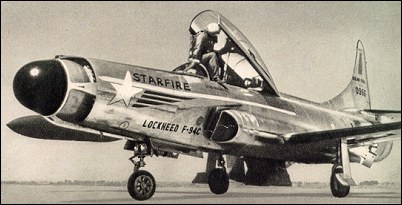
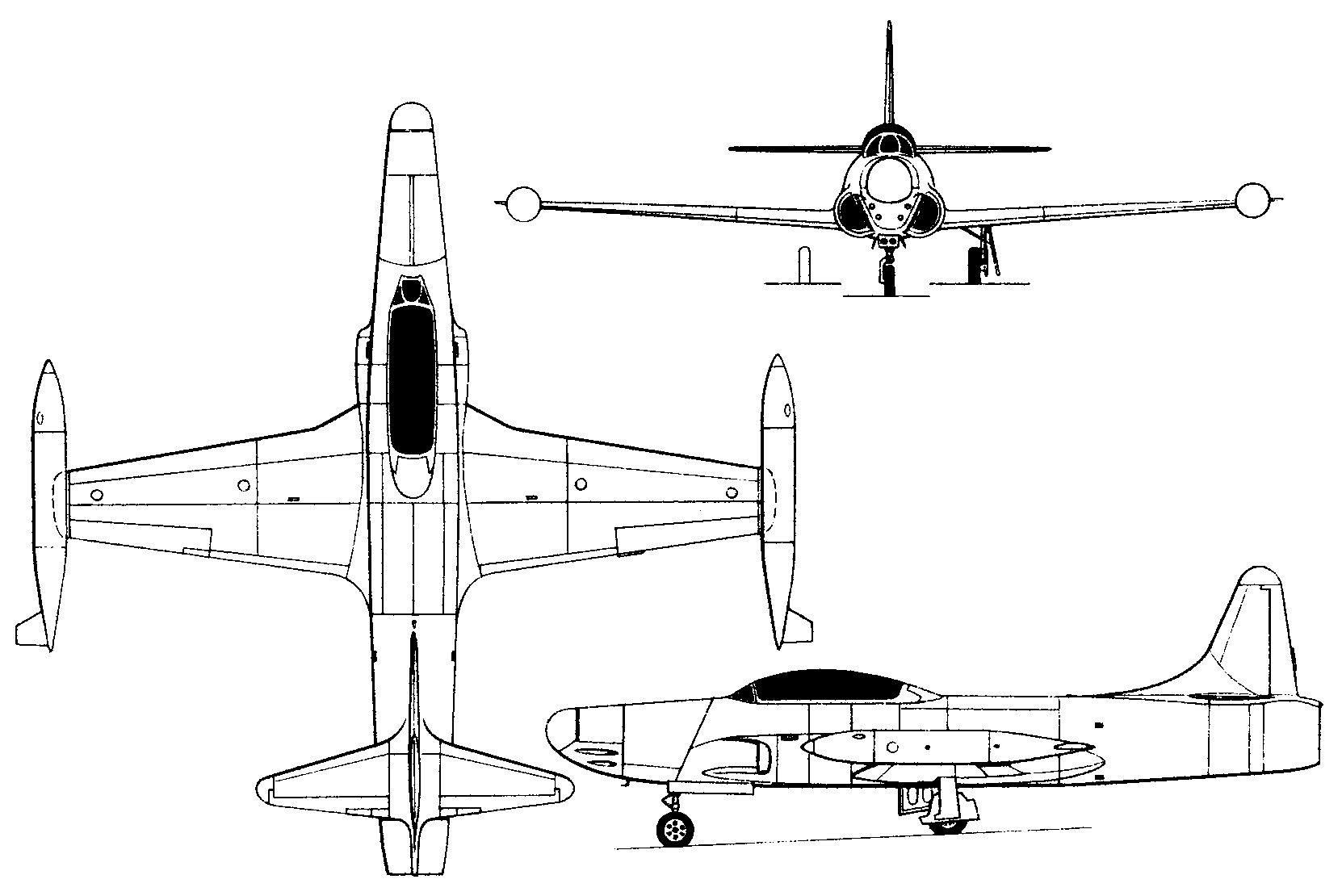
Third member of Lockheed's F-80 family, the F-94 Starfire was evolved to satisfy a requirement for a two-seat all-weather radar-equipped fighter. It was evolved from the two-seat T-33 trainer and originally used many of the main components and the production facilities of its predecessor. The prototypes were converted T-33, each with a new 26.69kN Allison J33-A-33 turbojet, radar equipment installed in the fuselage nose and suitably equipped accommodation for the radar operator in the rear cockpit. Armament of four 12.7mm guns was retained in the forward fuselage.
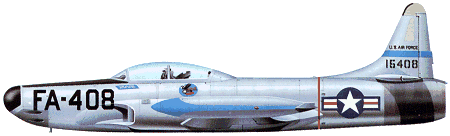
Deliveries of production F-94A began in June 1950. These incorporated the wings, landing gear and centre fuselage of the T-33, with a new nose and rear fuselage (former to house the radar and the latter for the afterburner installation). All hydraulic, electric and control systems were similar to those of the F-80C. The F-94A were followed in 1951 by F-94B which differed in having square wingtips with centrally mounted Fletcher tip-tanks of larger capacity and improved shape, raised to the wing centre-line, and a revised hydraulic system. Final version was the F-94C with a thinner wing, longer nose, swept horizontal tail surfaces, larger vertical surfaces, a more powerful engine, and the radome centred in the fuselage nose and surrounded by a ring of 24 air-to-air rockets housed in firing tubes, faired by a retractable shield. Two pods (one mounted on each wing) could together accommodate 24 more rockets. A total of 544kg of electronic equipment included automatic locating, tracking and firing instruments, Westinghouse autopilot, Sperry Zero-Reader, ILS, etc. A total of 854 production Starfires were built. The USAF's first turbojet-powered all-weather interceptor, the type served primarily with Air Defense Command for national defence.
To Fritz Adam, my father then LT. Donald Cohn was stationed at that same time at Otis flying for Chappy James.Just wondering if you knew him. Thank you for your service. Stephen Cohn
Stephen, I only now discovered your email. I was in the 58 FIS in the summer of 1952 and got transferred in the fall to he 59th FIS that went to Goose Bay. I'm 92 years old now still remember Chappy James but no other names any more. Sorry, can't help. Fritz
I was a F94B Mechanic assigned to the 319th FIS at Suwon K-13 Korea in 1953. My first assignment to service the F94B and what a great aircraft to maintain. The aircraft was nose number FA-416 ("Kiss of Fire" - S /N 51-5416) and was later shipped back to the States and transferred for flying assignment with the New York ANG 136th FIS.
I am a historian /archaeologist writing a report on a crash site on Tyndall AFB property about six miles from center of the runways. The remaining fragments are consistent with a Lockheed T-33 or F-94, but I have not located a serial number on site so I am narrowing it down by crash site location. If anyone has any information about a T-33 or F-94 crash please email me directly. Thanks in advance for your assistance.
GRADUATED CLASS 55C, WENT THRU ADVANCED AT L;AUGHLIN AFG AND THEN ASSIGNED, DUE TO SIZE, TO THE 94TH AT ELMENDORF AFB 1952-1953 THEN RETURNED FOR PILOT TRNG TO MARANA, ARIZONA. ENDED UP TRG IN F-86 AND THEN ASSIGNED TO SAC IN RF84F'S AT MOSES LAKE, WASHINGTON. LIKE TO HEAR FROM ANYONE FROM THE AIR DEFENSE COMMAND, ALASKA. DURING 52-53
After a 16 month tour in Korea, Japan, and a few other places in the Far East, came back to Bunkerhill AFB in Indiana in 1955 to the 319 FIS, was crew chief on the F-94C Starfire. Did a lot of flying in the rear seat where the Navigator sits when he didn't fly, we flew a lot at night and our Motto was (We Get Ours At Night) shoulder patch was a circle with a black cat in the middle,couple of my friends were Charles Rayburn, who in now deceased and Jimmy Sauls. am now 84 and retired. anybody there ant that time remember me.
Class 51-F Goodfellow AFB and Reese AFB Flew T-6, T-28, B-25, T-33, F-94 Would like to hear from old friends. I was assigned to the 317th FIS and the 449th FIS
I graduated from Aviation Cadet class 51-H and was assigned to the Air Defense Command. My first outfit was the 58th FIS at Otis AFB (Chappy James) and then I was transferred to the 59th FIS (Robert Dow). The 59th went to Goose Bay and Thule late in 1952. I have some great pictures of the F-94b
I also was a member of the 60th FIS stationed at Otis AFB. Our CO was nonother than the famous (Chappy James} During this period of time we had the F94C aircraft. Our neighboring squadron the 58th FIS flew the F89H.
I was ten years old when my mom took me to an open house at Langley AFB in the summer of 1953. I remember running down the flight line pass rows of B-25Js. Then I watched a B-25J running up its engines for takeoff, then I ventured to a dock that had USAF rescue boats and there I saw the weackage of a F-94C Starfire that had crashed.
Hi, I am the daughter of Maj. Walter Cleary USAF RET. My parents have passed and I'm looking for information on where to send some photos I've found.
It appears my father flew the F94-C> My Father was stationed at Moody AFB when he won the Rocket Meet in Yuma. I have some photos that pertain to that, as well as other ones that have a number and a last name. If anyone knows my Dad or has information as to what musuem would appreciated these photos, please let me know? Thank you so much! ~ Eileen ..
I was a F89D /F94C radar mechanic for the 3630th A&E Maintenance Squad starting in 1956 through 1958 at Moody AFB. Loved working on the F89 and drying out the wiring in the sub-cockpits of F94's after a rain without the canopy cover properly installed. I also had the pleasure of working on a F94 with Kent VanDeMark when a fellow technician, Joe Dean, sitting in the front cockpit, released the tip tanks at the radar "Dock" maintenance area. Can you believe that someone didn't check the wing pins or CB interlocks that evening? Our boss, C C Bates was fit to be tied. I later followed the F89's to JCAFB and worked there for a couple more years on both the F89's and B25's used for RO training. Anyone interested in interacting about Moody or James Connally during the late 50's, shoot me a note at george.leiby@comcast.net.
George M. Boyd, Maj-USAF, e-mail, 13.05.2014 13:03
I flew with the 318th FIS at Thule, Greenland 1952-1953. Flew 58:25 in a one month flying period in F-94Bs. Wmn O. "Jug" Belton was the CO, George C. McCleary was DO and Travis Greenwood was Assistant DO. "Shorty" Graham was Lead RO. We enjoyed the F-94Bs our first all weather Jet Fighter.
Richard Daniels, e-mail, 28.12.2024 George M. Boyd, Maj-USAF
Hello, My dad was in the 59th in Goose Bay, 1953 , 2nd LT. Richard Daniels Trying to locate any photos one may have. Thank you for your time, Richard Daniels
Saw your post of 4-8-13. My name is Donald Harvey, I was in the James Connally class of 52-4 as well. After Tyndall crew training I was assigned to the 84th FIS at Hamilton AFB in Novato, California which is in the San Francisco bay area. Flew in F-89 B and C's then in the F-94B and C's. There were other members of class 52-4 in the 84th also. John Forney, George Rost, Cliff Reiner and Don Schneeman.
From the 84th I went back to Tyndall for intercept director training and then the 666th ACW Squadron at Mill Valley AFS, California, also in the Bay area. At the 666th I worked with Jim Hrabetin who had been at Elmendorf flying in F-94s in the back seat. Possibly you may have been in the same unit at Elmendorf.
Donald Harvey 2nd Lt 84th FIS Sq 1952-1953 1st Lt 666th ACW Sq 1954-1955 1955 to present date in civilian life
Saw the comment from George Butler RO class 53-7. George were you the red headed guy with freckles?--I was in your RO class went to Tyndall then eventually Dover 46th FIS. From their went to Pilot training---class 53-B ended up at New Castle Air base would you beleive back in the 94-c---Loved it but haven,t been able to contact anyone either from our RO class or my pilot traing class. I am retired and living in the Villages Fl. How are you doing????


 (Benny) Benjamin



Stephen,
I only now discovered your email. I was in the 58 FIS in the summer of 1952 and got transferred in the fall to he 59th FIS that went to Goose Bay. I'm 92 years old now still remember Chappy James but no other names any more. Sorry, can't help.
Fritz
reply