|
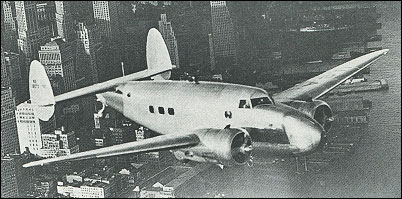
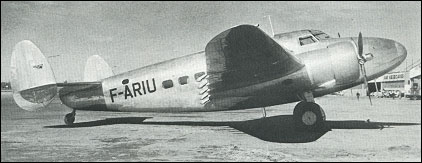
| Designed to compete against the DST/ DC-2/DC-3 series being developed by the Douglas company, the Lockheed 14 Super Electra failed, by reason of its smaller capacity, to present any significant competition. Of the same general configuration as the earlier Lockheed 10 Electra, it differed primarily by having a much deeper fuselage accommodating a maximum of 14 passengers, a mid-set wing, and introduced such advanced features as integral fuel tanks in the wing, Fowler-type trailing-edge flaps, fully-feathering propellers and, at a later stage of production, fixed wing slats. These improvements, combined with powerful engines and high wing loading, gave the Super Electra excellent performance but, by comparison with the important and larger-capacity Douglas DC-3, it was less efficient in operation, with the result that only 112 were built by Lockheed. First flown in prototype form on 29 July 1937 and certificated on 15 November 1937, initial deliveries were made shortly afterwards. By far the majority of the Super Electras were exported and, in addition, a total of 119 was licence-built in Japan for use by the Imperial Japanese Army. These, powered by 671kW Mitsubishi Ha-26-l radial engines, were designated Army Type LO Transport and were later allocated the Allied code name 'Thelma'.
| MODEL | Lockheed 14-H Super Electra |
| ENGINE | 2 x Pratt & Whitney Hornet S1E-G radial piston engines, 652kW |
| WEIGHTS |
| Take-off weight | 7938 kg | 17500 lb |
| Empty weight | 4672 kg | 10300 lb |
| DIMENSIONS |
| Wingspan | 19.96 m | 66 ft 6 in |
| Length | 13.51 m | 44 ft 4 in |
| Height | 3.48 m | 11 ft 5 in |
| Wing area | 51.19 m2 | 551.00 sq ft |
| PERFORMANCE |
| Max. speed | 398 km/h | 247 mph |
| Ceiling | 7405 m | 24300 ft |
| Range | 3315 km | 2060 miles |
| Slawomir Bialkowski, e-mail, 07.04.2025 15:36 In Poland.
Polish Airlines "Lot" purchased Lockheed L-14 "Super Electra" aircraft in 1938, as the first airline in Europe. In April and May 1938, 6 L-14H-05 aircraft arrived in Poland. They received the registrations SP-BNE, -F, -G, -H, -J and SP-LMK. The aircraft were delivered by sea to Gdynia, where they were assembled in the repair shops of the Gdynia-Rumia airport. In May 1938, the SP-LMK aircraft, piloted by a crew under the command of Wacław Makowski, made an experimental flight from the USA to Poland. The crew took off from Burbank (Los Angeles) to Warsaw. The distance of the flight was 24,850 km. The flight was made along the route: Central American countries (Mexico, Guatemala, Panama), South America (Lima, Santiago, Buenos Aires, Rio, Natal), through the South Atlantic, Africa (Dakar, Casablanca, Tunis), Italy (Rome). The flight lasted 85 hours between May 13 and June 5, 1938, of which over the Atlantic (from Natal in Brazil to Dakar in Africa) lasted 11 hours and 10 minutes (3,070 km). It was a great feat of Polish pilots. In 1940, PLL "Lot" intended to use these planes on the planned South Atlantic route. In June 1938, L-14H planes entered PLL "Lot" foreign and domestic routes. Another 4 L-14H-05 aircraft arrived in Poland in May 1939 and received registration marks SP-BPK, -L, -M, -N. L-14H aircraft had two serious accidents during their use in PLL "Lot". The SP-BNG aircraft crashed on 22.07.1938 in Campulung near Chernivtsi. The crew and passengers died. On 18.08.1938 SP-BNJ burned down at the airport in Bucharest while taxiing. In 1938, as part of preparations for war, a project was developed to arm L-14H aircraft. However, no modifications were made to the aircraft. After the outbreak of war, in the first days of September 1939, L-14H aircraft performed a number of courier flights for the Ministry of Foreign Affairs to Stockholm, Helsinki, Budapest and Bucharest. Four aircraft (SP-BNH, SP-BPK, SP-BNE, SP-BPL) were evacuated to Romania on 1-6.09.1939. Since the aircraft located in Romania were interned, the management of PLL "Lot" in order to get some of them back, made a fictitious sale of L-14H (and Lockheed L-10A, Junkers Ju-52 and Douglas DC-2) to the British airline Imperial Airways, giving them English registration marks. However, as a result of pressure from the German embassy in Bucharest, the aircraft were not returned. After a few months, they were taken over by the Romanian air transport. One L-14H (SP-BPN) was interned in Estonia on 4.09.1939. In 1939-1940 it was used by the Estonian air force as a dispatch aircraft. In turn, taken over by the Soviet Air Force, it was crashed in Riga in October 1940 during take-off for a flight to Moscow. On 4.09.1939, three Lockheed L-14Hs from PLL "Lot" landed in Helsinki: SP-BNF, SP-BPM and SP-LMK. All three Lockheeds later flew to Great Britain. The first two of them served from February 1940 in English military transport in France and took part in the evacuation of troops from France in 1940. SP-BPM did not return from France to England. At the request of the Air Force Commander, General J. Zając, who wanted to use the L-14H for courier flights from France to Poland, SP-BNF was withdrawn from France in the spring of 1940 and transferred to the English company Airwork General Trading in Heston for conversion. The aircraft was armed with 2 Browning machine guns and 2 Vickers K machine guns, and two fuel tanks with a total capacity of 600 l were added. The conversion was not completed before the capitulation of France in June 1940. Given the impracticality of such flights from England, the aircraft was restored to its initial condition. The SP-LMK and SP-BNF aircraft were taken over by the British BOAC airlines. One of them was written off in February 1946. In 1946, SP-BNF was placed at the disposal of the Polish authorities, who did not repatriate the aircraft. It was then used for air transport successively by several English companies, and in 1951 it was sold to Sweden, where it ended up crashing the same year. reply | | Glenn Ashton, e-mail, 02.03.2023 03:15 This plane features in my thriller about the signing of the Munich Accord in 1938 - the good guys fly in it! My novel's title is Churchill's Ferret (eBook available on my Amazon author site). reply | | Ken Watkins, e-mail, 21.11.2012 21:37 For an intriguing story about the Lockheed 14, read Chapter 21 of F.W.Winterbotham's book "The Ultra Spy". The title of the chapter, "Spy Plane", would suit its adaptation into a screenplay about the aircraft's imaginative use, for a very original pre-WW2 film, set in 1939. reply | | Lee Korb, e-mail, 16.11.2011 00:40 I spent a lot of time polishing a corporate L-14 back in the late 50's in Pgh,Pa. Belonged to Mesta Machine Co., and had an NC# registered between the one H. Hughes flew around the world(loaded with pingpong balls for buoyancy)...and the one that had been ordered for Amelia Earhart to use after her around-the-world flight. Actually got to fly as co-pilot a few times, and was talked through a landing! Sometimes wonder where this aircraft ended up at..... reply | |
| | Klaatu, e-mail, 10.07.2011 18:47 An armed version of this airliner became the highly-successful Lockheed Hudson. reply | | James, e-mail, 16.04.2011 04:33 Hello. I am interested in the instrument panel of the Lockheed 14 Super Electra. I'm having difficulty finding a picture with enough detail that I can identify the layout. Do you happen to know where such pictures might be on the web? reply | | David Scarth, e-mail, 17.12.2008 22:06 I am researching the Lockheed Hudson aircraft as flown in England by RAF Coastal Command in the 1940's.My uncle, S /L William (Bill) Coulson who flew Lockheed 14 Super Electras for Trans Canada Airlines ( TCA ) in 1938 in Canada and was based at No.1 (Coastal) Operational Training Unit (OTU) at RAF Silloth in England in 1940,was training pilots to fly Hudsons.Based on his experience with TCA, Bill preferred the 'wheeler landing'( land on main wheels and then drop the tail wheel) over the '3-point' landing ( nose up attitude with all three wheels touching down at same time) advocated by the RAF.The landing instructions for the Electra /Hudson were included in the Lockheed 'Book' or Operation Manual I believe.Could you please tell me how and where I can access a copy of this document, or specifically the landing instructions for the Electras and /or Hudsons.Please acknowledge receipt of this information request....I thank you and look forward to your prompt response. David Scarth reply |
|
Do you have any comments?
|
| 
COMPANY
PROFILE
All the World's Rotorcraft
|