|
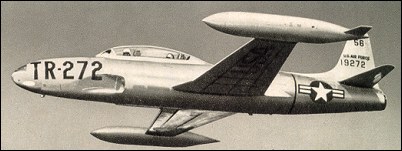
| Lockheed's P-80 Shooting Star has its own special niche in USAAF/USAF history. From it evolved a lengthened-fuselage two-seat trainer version, designated originally TF-80C. The first of these flew on 22 March 1948. In addition to the fuselage 'stretch', a second cockpit in tandem was provided with dual controls, the transparent canopy was extended to cover both cockpits and the armament of the F-80 was deleted.
A total of 128 TF-80C were built before the designation was changed to T-33A in May 1949. Adopted as the USAF's standard jet trainer, it remained in production for a further ten years. A total of 649 were also built for service with the US Navy and Marine Corps under the designation TV-2, later T-33B. Total production amounted to 5,691 aircraft (including those for the Navy): 1,058 for supply to friendly nations under the Military Assistance Program and the balance to the USAF. T-33A were also licence-built in Canada (656 as the Silver Star, with Rolls-Royce Nene engine) and Japan (210). Variants included small numbers modified as DT-33A drone directors and AT-33A armed close-support aircraft.
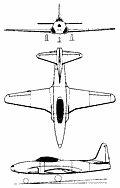 | A three-view drawing (530 x 827) |
| MODEL | T-33 |
| CREW | 2 |
| ENGINE | 1 x Allison J-33-A-5, 24.0kN |
| WEIGHTS |
| Take-off weight | 5900 kg | 13007 lb |
| Empty weight | 3810 kg | 8400 lb |
| DIMENSIONS |
| Wingspan | 11.9 m | 39 ft 1 in |
| Length | 11.5 m | 38 ft 9 in |
| Height | 3.6 m | 12 ft 10 in |
| Wing area | 22.0 m2 | 236.81 sq ft |
| PERFORMANCE |
| Max. speed | 965 km/h | 600 mph |
| Ceiling | 14700 m | 48250 ft |
| Range w/max.fuel | 2150 km | 1336 miles |
| ARMAMENT | 2 x 12.7mm machine-guns |
| Charles M. Brickett, e-mail, 12.11.2023 18:01 Why no mention of the T2V Seastar trainer which I flew at Forest Sherman field in Pensacola Florida. I was in the last class and the next class flew the North American T2J? reply | | Bob Martin, e-mail, 26.01.2018 22:08 Let's get back to the T-33 stories. I was a student pilot in Class 63-G at Laredo AFB. We started with 25; which included 3 Afgan students who had washed back; and two from Norway. We ended up with 13 Americans and one Norwegian student graduating. Six of us came in from OCS Class 62C. I still have both Annuals. The 63-G pilots annual also includes pictures of 63-H. I have some pictures of the 16 T-33 aircraft flyover and some Graduation Ball pictures of us and some of the Instructors. I also made the mistake of crabbing the nose wheel on my first taxi out and had to have the maintenance guys straighten it out. Most of us have passed on but I will gladly share pictures if anyone would care to have them. BTW, why no picture of a KC-135. I flew that for 9 years.
Please put T-33 Laredo AFB in Subject line otherwise I delete unknown Emails
Bob Martin rlwmartin@yahoo.com reply |
| Robert Daniel, e-mail, 28.12.2017 03:22 I can't find any info on two T-33's that collided near Crawford Texas in the early 1960's. There was one fatality. My brother witness the collision and saw the parachutes. He was on our street in Waco. My dad took us to the crash site. We were able to walk up to one the planes. The other plane was burning and they wouldn't let us near it. I remember two ejection seats sitting on the ground just like they sit in the plane. reply |
| Eric W Munson, e-mail, 20.08.2017 05:55 I am looking for information on crash of a T-33 trainer out of Perrin AFB (crash was 1.5 miles NW of base) on February 23, 1956. Pilot was George M. Munson (my uncle). I have a copy of the death certificate, but am just looking for anyone who might have any specific information. reply | |
| | Gary Quigg, e-mail, 19.03.2017 19:53 Part 1 of this post is to everyone.
Part 2 is specific to Michael Coleman's post from 2014.
I am a historian /archaeologist writing a report on a crash site approximately 6 miles from the center of the runways on Tyndall AFB. The remaining fragments from the crash on site are consistent with both Lockheed T-33 and F-94 aircraft. I did not locate a serial number on site, so I am narrowing the identity of the precise aircraft down by crash location. In anyone has any info of a crash site approximately 6 miles from the center of the Tyndall runways please email me at gfquigg@gmail.com. Thank you. Now for part 2: Michael Coleman if you ever check these comments please contact me at gfquigg@gmail.com. Thanks. reply | | Deborah Taylor, e-mail, 24.12.2016 00:51 I'm trying to see if anyone has any information about my father's(Capt. Craven P Almond)accident in the T33A (53-5207 per the accident report). December 30th 1954 while exiting the aircraft, the ejection seat went off and hit my father. He died a few days later in DC. One story has it that his parachute got caught on the lever setting off the ejection seat. The other story is that this was a defect in the plane which killed other pilots as well and he was the last to die from this defect. Does anyone have anything to add to this account. reply | | Jim Quinn, e-mail, 03.11.2016 02:11 I am one of several old veterans working on the restoration of a T-33, S /N 53-6132, for installation at our Veterans Memorial Park in the town of Dunlap, TN. The aircraft was formerly on display in Douglas, GA, but has been transferred by the USAF to us for restoration. I have two questions: (1) The aircraft has a very large stencil, TR-132, on the side. Obviously the 132 represents the last three digits of the S /N, but am I safe in assuming the TR was an abbreviation for training? (2) Does anyone know of a reliable source for parts, especially a canopy and tip tanks? The old bird has been sitting for many years... Thank you! reply | | Richard Lambert, e-mail, 24.09.2016 02:56 Researching T-33 Aircraft serial Numbers staioned at Richards Gebauer AFB in 1966-68. Hoping someone can give me these as was stationed there and worked on 7 i believe. reply | | Wally Leland, e-mail, 23.04.2016 08:28 I have over a 1000 hrs. In the T Bird, and enjoyed reading the comments of other T Bird pilots.
While flying out of Lowry AFB in the 60's, while stationed at the USAFA, Capt. Lou Andrews and I logged 4.2 hrs. In a T Bird. I doubt if any one else has come anywhere close to that.
We utilized the Mountain Wave off the Santa de Cristo mountains Southwest of Pueblo,Co. flying @ 12000 feet , crabbing into the westerly winds. On one leg of 20 miles we gained 1500 ft. @ flight idle, 115 Kts, 1 /4 flaps.
After two hours working the wave, we climbed up to 20 K, and contacted Lowry base ops to see if they would extend our flying period. They said there was no schedule for the next period, and gave us 2 more hrs.
When we landed after over 4 hours, the crew chief wanted to know why we had gone cross country, when we were only scheduled for a local flight. The only explanation we gave him was that operations had authorized a 2nd period.
We were restricted to 165 gallons in the tip tanks, and when we landed , we had a full fuselage tank a some fuel in the inboards.
Unfortunately Lou has " Gone West", but I do have the flight logged in my Form 5.
At the time, I was the only USAF pilot on orders to log flying time In Sailplanes ( Gliders ) . One month, I flew over 4 hrs. In a USAFA sailplane and logged that to meet my monthly flight requirement.
Lt. Col. James W. Leland, Retired, USAF reply | | Wendell Wilson, e-mail, 17.03.2016 22:27 I am trying to find information about my father 1st Lt Robert Gordon Wilson who died when his T-33 went down in France on March 22, 1959. He was stationed in England (we lived in Bury St Edmonds). He was with the 81st Supply SQ. I found on another site that his s /n was 53-5828 and crashed at Chaumont AB - not sure if this is correct. I was always told that his aircraft experience hydraulic failure and he had to stay with it to use up fuel and guide it to a safe crash site. For whatever reason he was not able to eject and attempted to parachute but was entangled with the rear stabalizer. I would love to hear from anyone that knew him or any details about his service. reply | | Charles Northway, e-mail, 09.01.2016 18:47 I was stationed at Greenville Air Force Base, Mississippi, an ATC base until 1961. I was there from 1957, until 1961. I worked in base operations, and got to know quite a few of the IP's who were kind enough to take me on Maint. flights with them. Had some interesting experiences inm the old T-Bird. Those who know the T-Bird, know it had a habit of having a cocked nose wheel at take off, which made for some interesting landings. I made two foamed runway landings with cocked nose gear, and one landing with no nose gear. My worst incident happened while sitting on the end of the active waiting for clearance. The IP ran the J-33 up, and we heard a loud explosion, and the whole aircraft shuddered. I turned around, and looked behind us, and the engine had exploded. The rear fuselage looked like some one had shot it full of big holes with a shot gun. It wasn't until a few days later thst it really began to sink in, and I thought, what if we had gotten off the ground and had this happen on climb out? I wouldn't be here writing this now. To low for the old ejection seats. We didn't know what zero-zero was back then. This would have been in about 1960. I had some great times in that old bird, though. She was tough, and reliable. reply |
| Larry Deal, e-mail, 11.08.2015 22:22 I was a plane captain on USMC T-33B at Headquarters Marine Corps, Flight Section, Andrews AFB from 1966-69. I had a taxi license and often did high power run ups to diagnose engine problems or insure proper operation after maintenance. Flew in back seat many times and got stick time often. It was a great trainer and enjoyed a long service history. reply | | Peter Makowski, e-mail, 28.07.2015 01:09 Left active duty as a Marine pilot at MCAS Cherry Point NC May 1963. Thereafter a Marine pilot friend of mine was involved in a fatal accident flying a TV-2 /T2V or T33B from Cherry Point NC. Allegedly an engine failure on takeoff with a Navy Flight surgeon ejecting safely; pilot did not eject Any where I can find an written accident report on this military accident. Peter Makowski reply | | George Horvath, e-mail, 03.06.2015 18:04 Trying to find the location of T-33 s /n 536146 I was crew chief on TR-146 at Keesler AFB 1959-1960. The T-33's were transferred to Eglin AFB in 1962. The bird was bright metal. The right flap was replaced and painted in 1960 due to damage. Great plane, easy to maintain. reply | |
| | Philip White, e-mail, 26.02.2015 18:46 Writing a paper on the Lockheed tv-2 shooting star and problems with the plane's performance such as inversions or problems which may have caused crashes. I'm particularly interested in a crash of a plane that killed Lt Cmdr Robert Bollinger, USN Res in June 1958 while on flt from Lewiston ID to Denver in the vicinity 40 miles northeast of mountain home, ID. Any info appreciated. reply | | John Tagnesi, e-mail, 15.02.2015 19:52 At England AFB in 1973, I was assigned to the Civil Engineers during the rated supplement phase of my career. My solo flight in the T-33 was very uneventful..until I turned on the runway and as I pressed the right brake to stop the turn and align on the runway, the brake pedal went all the way and NO right brake. As I continued the left turn and finally stoped in front of the RSU, I had to advised the tower and request a tow. To make matters even more embarrassing, I had to ride the aircraft during the towing process. All my friends in the RSU and tower came outside to wave and laugh at me. I dared the maintenance folks not to find some problems with the right brake..they did. reply | | Gordon Scott, e-mail, 14.02.2015 02:26 We used T-33's in Korea for radio-relay and weather-relay missions in '69-'70. I scheduled aircrew members for those planes as well as C-47 Gooneybirds and H-19 helicopters. I was a USAF E-4 and worked for 1Lt's Sluss and Lacky, great guy's.
One day Major Jones head of Stan /Eval came in and asked if I wanted to go up in T-Bird. It was a 2 hour blast of a ride. My only regret was I had no one take a picture of my getting in the aircraft---would love to have that picture today at my ripe older age of 68 :>) reply | | Will OConnor, e-mail, 29.01.2015 19:44 The Vintage Flying Museum in Fort Worth Texas is in possession of one of the T-33s that were built in the US, but transferred to Canada for the license-building of the Canadair CT-133 Silver Stars. Our T-33 has a Rolls-Royce Nene turbojet( unlike the standard Allison J-33), as well as Canadian avionics. It is in the final stages of restoration to airworthy status. reply | | steve, e-mail, 03.01.2015 02:38 My dad lost his life in the aircraft, March, 1955 on a training mission in southern Ohio. Would love any information available to anyone out there. Have library records of newspaper report from Portsmouth, Ohio. He was operating out of Wright Pat. reply | | Gary J. Hebbard, e-mail, 02.06.2014 02:06 Looking for a crash report or other details of a T-33A crash near Torbay, Newfoundland, Canada on 9 Jan. 1956 that claimed the life of Col. Carl W. Payne. Have found the crash site, talked to a witness but need more detail.
Thanks
Gary J. Hebbard reply |
|
Do you have any comments?
|
| 
COMPANY
PROFILE
All the World's Rotorcraft
|


 Robert Daniel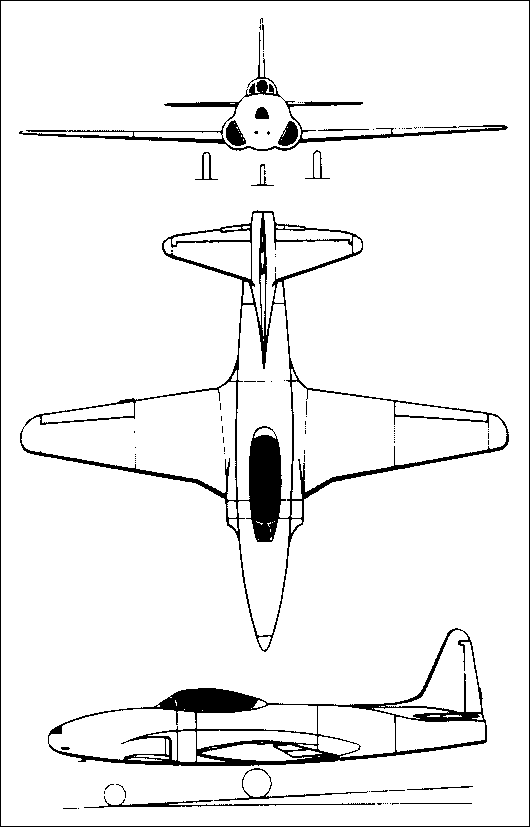


In 1952 I flew a T-33 together with another pilot from Los Angeles to Cape Cod (Otis AFB) with one fuel stop in Omaha. Each leg was 3:20 hrs plus a few minutes. Both times, after we landed, we still had fuel to spare. :-)
reply