|
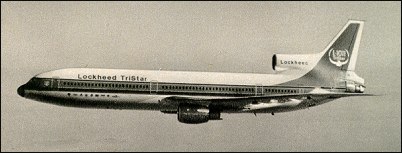
| The Lockheed L-1011 TriStar was the third widebody passenger jet airliner to reach the marketplace, following the Boeing 747 "jumbo jet" and the Douglas DC-10. In the 1960s, American Airlines approached Lockheed and competitor Douglas with a need for an aircraft smaller than the existing 747, but still capable of flying to distant locales such as London, the Caribbean, and Latin America from company hubs in Dallas/Ft Worth and New York. Lockheed answered the call with the TriStar. Ironically, American Airlines never flew the "Ten Eleven," purchasing many DC-10s instead.
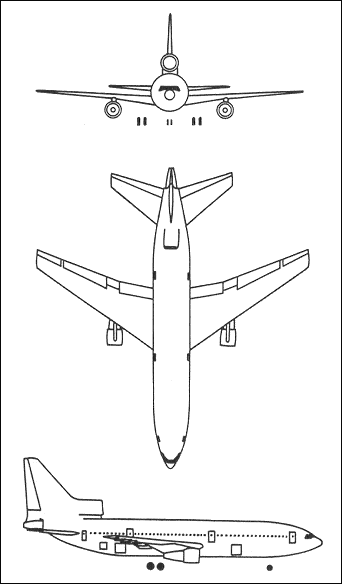
First flown on November 16, 1970, the twin-aisle TriStar was considered a technological marvel of its day, featuring low noise emissions, improved reliability, and efficient operation. The main visible difference between the TriStar and DC-10 is in the middle/tail engine; the DC-10's engine is external for more power, while the TriStar's engine is integrated into the tail through an S-duct (similar to the Boeing 727) for improved quietness and stability. Although the TriStar's design schedule closely followed that of its fierce competitor, the DC-10, Douglas beat Lockheed to market by a year due to delays in powerplant development. Rolls-Royce, the maker of the TriStar's RB211 turbofan engines, had filed for bankruptcy, halting L-1011 final assembly. The British government did not approve the large state subsidy used to restart Rolls-Royce operations until after the U.S. government had guaranteed the Lockheed loans previously provided to Rolls for the extensive engine contract. (The UK Goverment also took the contentious step (for a Conservative administration) of taking the aero-engine side of RR into public ownership, to maintain national defence capability). The first TriStar was finally delivered to Eastern Airlines on April 26, 1972.
Designed for a maximum seating of 400 passengers, the TriStar utilized a new engine layout: in addition to Rolls-Royce turbofan jet engines on each wing, a third engine was located dorsally below the vertical stabilizer. Manufactured in Lockheed facilities in Palmdale, California, the TriStar faced brisk competition with the Boeing 747 and, even more directly, the Douglas (later McDonnell Douglas) DC-10/MD-10, which it closely resembled. The TriStar had a better safety record than the DC-10, and Trans World Airlines heralded the TriStar as one of the safest airplanes in the world in some of its promotional literature in the 1980s when concern over the safety record of the DC-10, which was flown by most of its competitors, was at its peak. However, the DC-10 outsold the TriStar nearly two to one, partly because of the TriStar's delayed introduction.
A longer-range variant of the standard-length L-1011 was developed in the late 1970s. Designated the L-1011-500, the fuselage length was shortened by 14 feet (4.3 m) to accommodate higher fuel loads.
Lockheed manufactured a total of 250 TriStars, ceasing production in 1984. Lockheed needed to sell 500 planes to break even. Failing to achieve profitability in the civilian airliner sector, the TriStar was to be Lockheed's last commercial aircraft. Airlines played Douglas and Lockheed off each other, driving the prices of both planes down, and the end result was Douglas' merger with McDonnell and Lockheed's departure from the commercial aircraft business.
| CREW | 2-3 |
| PASSENGERS | 256-345 |
| ENGINE | 3 x Rolls-Royce RB-211, 180.5kN |
| WEIGHTS |
| Take-off weight | 185500 kg | 408960 lb |
| Empty weight | 102000 kg | 224873 lb |
| DIMENSIONS |
| Wingspan | 47.4 m | 156 ft 6 in |
| Length | 54.0 m | 177 ft 2 in |
| Height | 16.9 m | 55 ft 5 in |
| Wing area | 312.1 m2 | 3359.41 sq ft |
| PERFORMANCE |
| Max. speed | 965 km/h | 600 mph |
| Range w/max payload | 5000 km | 3107 miles |
| Eric Krask, e-mail, 11.02.2018 01:39 Turn off the DLC and it flew like a real airplane. Almost as good as a DC-10. reply | | carol smith, e-mail, 19.07.2017 00:57 Just see a Tristar in an old film, recognised it straight away. No technical knowledge but a great aeroplane. Always preferred a Tristar when I was younger to take me to holiday destinations - safety record great, the best in handling turbulence and what a great looking aeroplane it was. reply | | J Melgar, e-mail, 08.12.2016 01:26 I was F /E of the version -200 plane, never flight before such a aircraft wonderful and nice to operate. I flew in AeroPeru, airline in South América by 1980-84. reply | | Mike Epstein, e-mail, 06.08.2016 00:22 I worked on the L-1011 design on landing gear loads. I remember our group being asked to do calcs for a special purpose L-1011 for one of the Arab Emirate countries ... They wanted to strip out the first class section and install a throne. reply | |
| | Dfens, e-mail, 27.01.2016 16:55 Max speed is Mach 0.95 which it would do in level flight. reply | | capt w kilburn ret a/c, e-mail, 05.09.2015 00:49 for andy
I flew both models up to a height of 43000 ft. limited by fuel temps. reply | | GMoran, e-mail, 19.04.2015 22:28 My first flight ever was in 1980, TWA ten eleven, from LAX to EWR, what a ride, with access to the captain voice, calling her "heavy" since then I flew mostly TWA, flights 15 from JFK at 8:15 am and 840 from LAX every other month, I flew the TWA 747 from JFK to LAX several times but it wasn't the same as the 1011, those days along with the aircraft are gone, but I'm very proud to had flown in one this exceptional marvels. thanks to American creativity reply | | Patrick Chandler, e-mail, 10.09.2014 14:04 Can anybody please help me with the following: I remember going on holiday from London on a Tri Star and I thought I was told that the aircraft had a facility on board with weigh each passenger and luggage as it was put on board, is this correct. Kind regards Patrick reply | | George Haloulakos, CFA, e-mail, 25.06.2014 21:40 To learn why the L1011 -- the most advanced tri-jet of its era -- did not succeed commercially, please see chapter 4 of my new book. [An alternative outcome is quantified in great detail had Lockheed opted for a different strategy.]
HIGH FLIGHT
Aviation as a Teaching Tool for Finance,
Strategy and American Exceptionalism
By George A. Haloulakos, MBA, CFA
ISBN: 9780-1007-2738-0
Order your copy online at: ucsandiegobookstore.com
Or by phone: 858-534-4557
"Partial proceeds support aviation heritage" reply | | Andy, e-mail, 27.03.2014 11:35 what is the maximum height for this plane in the air?is it more than 35,000 feet? thanks. reply | | Andy, e-mail, 27.03.2014 11:35 what is the maximum height for this plane in the air?is it more than 35,000 feet? thanks. reply | | Merle English, e-mail, 05.06.2013 07:17 A very solid acft. I was A&P for EAL and worked at the 'Magic Kingdom' in Miami then went to Saudia Air for 'D Checks' ,finally ended with UAL at Ohare working DC-10's & that is where you understand how solid and safety minded Lockheed was. The odd thing is if you wanted to figure out where ,say the water tank was on the DC-10 just remember that the L-1011's was on the right side and then look on the opposite side on the DC-10, Oh the L-1011's 'S' duct for #2 was an awesome design, we had problems with the RB-211, the fan thrust bearing reply | | mike porter, e-mail, 18.11.2012 02:05 I was a scab for eastern airlines right out of tech school and I loved working the line on this aircraft. I removed parts from the plane that went down in the everglades and heard some weird stuff on that dark night. reply | | larry volmer, e-mail, 30.03.2012 06:24 I work for lockheed for 31 years and had my hands on all the l 1011 that were built , I was a cabin firnisher sr . may good time and good workers , to bad it could not have lasted , there were talk of a two eng plane -500 . to everyone from the jungel to the finial line , to flight line thank you for all the fun . reply | |
| | Rob M, e-mail, 17.11.2011 01:17 I was a flight service manager for TWA and usually flew on the L-10's. They were quiet, comfortable, and for the most parts us flight attendants LOVED working on the L-10. I'm coming back to KC next year and would love to see our beloved L-10 at the Airline History Museum in KC! :) reply | | Larry, e-mail, 20.02.2011 14:18 I worked as mechanic for TWA for 31 years and this old girl was my favorite. In the early '70s we once had a 1011 suffer a catastrophic fan hub failure over Grand Junction, CO, losing not only that engine, but two hydraulic systems as well. The fuselage was peppered from broken fan pieces. The old girl made it easily and safely back to earth and was ferried to LAX for repairs. That aircraft (if I remember correctly was 11003) flew for years and years after that for TWA. reply | | Adil Ali, e-mail, 12.02.2011 06:02 I remember back in the 80's when i was growing up that the aircraft which stood out most was the Tri Star L10-11, flying in service with BWIA (British West Indian Airways out of Port of Spain, Trinidad). I first flew on an L10-11 as a passenger aged three (3) on an Air Canada flight back in the days when they permitted in-flight cockpit visits during the enroute. The memory stuck with me 'till today some 28 yrs later and I am now finishing up my multi-ratings and commercial. What a plane! For visitors to the Caribbean there is a full-hull walk in model on display at Chaguaramas (old WWII US Base) in Trinidad & Tobago, cockpit still (fairly) intact! reply | | nader alotaibi, e-mail, 21.12.2010 22:36 L1011 WAS THE BEST ACFT ON IT,S TIME , BUT THE ENGINES WAS
GAVEN ALOT OF PROBLEMS TO OPERATORS, TURBINES BALDES FAILER
, HOC ,EGT AND ATHER GROUNDING AITEMS
AS MAINT PERSONAL, I LOVE AND MISS WORING IN L1011
DO NOT THINK I AM OLD, I WORKED ON IT MORE THAN 12 YEARS reply |
| Gary B, e-mail, 05.12.2010 23:34 The first commercial airliner to fly roll out-take off-fly from LAX to St. Louis-and landing on all hands-off computer controlled flight! Only problem was the accountants, they didn't want to make a profit. Break-even was 300 aircraft and we stopped at SS 255. reply | | Herb Fischer, e-mail, 20.11.2010 03:50 I have over 30,000 hours over 50 years in all kinds of airplanes. As far as transports go, the L-1011 is my choice, hands down.
I only flew the -500 with RB-524 B-3 and B-4 engines. The B-3's had a bit of a problem with the labrynth seals on one set of bearings but RR corrected that on the B-4 and it was a great engine. Those three spool RB's give you response like a Turboprop!
The airplane was magnificent. It did exactly what the charts promised (Lockheeds usually do) and more- the inexplainable feeling that you are one with this big piece of nachinery. You know that it isn't alive, but you feel that it is and that the two of you are cooperating.
Hey, I'm getting carried away.....
Thinking back to an afternoon after a meeting at DFW years ago- Pilots from Pan Am, Eastern, TWA- sitting in the back of a van drinking beer- the subject of conversation....
What a great airplane the L-1011 is.... reply |
|
Do you have any comments?
|
| 
COMPANY
PROFILE
All the World's Rotorcraft
|




Is this Nader from Saudia in Riyadh ? I know this message of yours is almost eleven years old but I just happened to find it on this Eastern Airlines Memorial site. --- John --- August 2, 2021
reply