|
| Development of the U-2 began in the spring of 1954 to meet a joint CIA/USAF requirement for a high-altitude strategic reconnaissance and special-purpose research aircraft. It took place in the Lockheed 'Skunk Works' at Burbank, California, where - after acceptance of the design in late 1954 - two prototypes were hand-built in great secrecy by a small team of engineers. The aircraft's true purpose was cloaked under the USAF U-for-Utility designation U-2, and the first flight took place on or about 1 August 1955.
At about the same time US President Dwight D. Eisenhower was proposing his 'Open Skies' policy, one of mutual East/West aerial reconnaissance of territories. President Eisenhower hoped that his policy would reduce tension between East and West, thus preventing the growth of the nuclear arms race. Unfortunately the Soviet Union would have nothing to do with this proposal. Consequently 'Kelly' Johnson's new 'spy plane' assumed greater importance. The prototypes were followed by production of about 48 single-seat U-2A and U-2B with differing power plant, and five two-seat U-2D. Some U-2B were converted later to U-2D standard. An additional batch of 12 U-2R was ordered in 1967. A new version, known as the TR-1, is currently in production as a tactical-reconnaissance aircraft, equipped with a variety of electronic sensors.
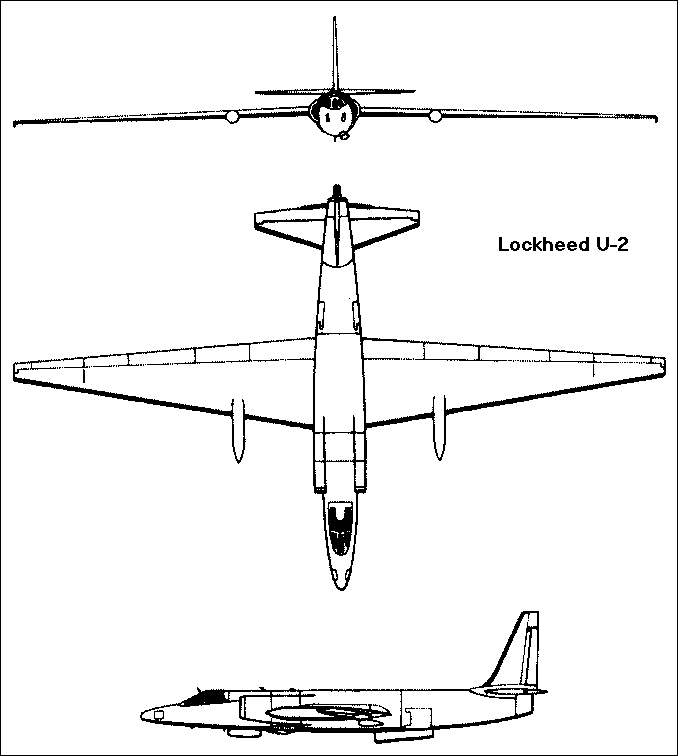
The requirement for high altitude and long range posed enormous problems: the former needed an aircraft with low wing loading, the latter large quantities of heavy fuel to confer the necessary range. Therefore the U-2 is of very lightweight construction, dispensing with conventional landing gear and pressurisation to save extra weight, and having wings of large area. Landing gear is of bicycle type with single wheels fore and aft, and balanced on the ground by wing-tip 'pogos' - a strut and wheel device which drops away when the U-2 becomes airborne - was selected. The pilot is accommodated on a light-weight seat, dressed in a semi-pressure suit with his head enclosed in an astronaut-type helmet, and forced to breathe pure oxygen for his survival. A medium-powered turbojet is adequate to lift this lightweight aircraft, and long range is possible by shutting it down and gliding for long periods.
In addition to photo and electronic reconnaissance, U-2 were used for weather reconnaissance, high-altitude research, measurement of radiation levels, and for the tracking and recovery of space capsules. They were used for reconnaissance during the Cuban crisis, in Vietnam and during the Arab-Israeli conflict.
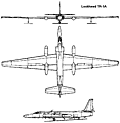 | A three-view drawing (752 x 771) |
| MODEL | U-2C, on service with NASA |
| CREW | 1 |
| ENGINE | 1 x Pratt-Whitney J75-P-13B, 7711kg |
| WEIGHTS |
| Take-off weight | 10225 kg | 22542 lb |
| DIMENSIONS |
| Wingspan | 24.38 m | 80 ft 0 in |
| Length | 15.24 m | 50 ft 0 in |
| Height | 4.57 m | 15 ft 0 in |
| Wing area | 52.49 m2 | 565.00 sq ft |
| PERFORMANCE |
| Cruise speed | 740 km/h | 460 mph |
| Ceiling | 27000 m | 88600 ft |
| Range | 4635 km | 2880 miles |
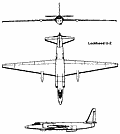 | A three-view drawing (678 x 756) |
| Mark Cooke, e-mail, 15.02.2025 23:36 I am looking for info on the seats used in the first U-2’s. Before ejection seats were installed. For a modelling project. Thanks. reply | | Gary Halbert, e-mail, 29.03.2023 19:58 This is my second entry in this question and answer section of comments (see my first entry above: 26.02.2012).
I went TDY to Bien Hoa AB in October, 1967 on the rotation of a U2; we would rotate every four months. I was the Com /Nav radio rep for the group.
I need help finding proof of my TDY to Bien Hoa - the VA is saying I need proof in order to complete my service record. I checked my DD-214 for that year, nothing to prove my time there. I did not keep my TDY orders (who does?). Anyone out there who could connect me with someone or could offer up any suggestions? Please. Thanks! reply | | Gramps, e-mail, 18.05.2017 00:16 When was the last U-2, or variant, made. One of my books looks like maybe 1979. Question 2: Would it be appropriate to call it a "Lockheed-Martin". My opinion is no unless someone has a copy of a Kelly Johnson paycheck from Martin. reply | | mike penton, e-mail, 06.08.2015 03:01 mike penton, I was in sferics shop from 70 and left early 73, I workrd with boot, ralph owen. so long ago cant remember others, went tdy to florida and u tapo saw owen a couple years ago lives in tnn. reply |
|
| | TONY BEVACQUA, e-mail, 17.03.2015 20:30 The U-2 came from D-M to Beale in 1976, not 1974. Good stuff here! Thanks. reply | | tom ament, e-mail, 16.07.2014 05:12 I am looking for some color photos of the 68 or 69 el camino chase cars. I want to build a tribute el camino case car but not enough pictures to go by yet. Any hwl[ will be appreciated / Am also interested in the on the doors reply | | chris wanstall, e-mail, 12.01.2014 04:42 hi, does anyone have any drawings out there of a U2 that i could use to build an r /c model of the plane scaled to about 6ft wing span? reply |
| Edward Bell, e-mail, 30.12.2013 23:06 In the latev 1950's I was travelling from Cambridge to London on a road which passed close to an USAF base in Eastern England. A U2 crossed our path in its landing approach. I am 90% sure it wal painted black and - here's the thing - that it had a butterfly tail (Beechcraft Bonanza-style). Did I imagine this detail about the tail? reply | | Michael Warren, e-mail, 10.10.2013 21:23 Air Force Vet 1969-1973. Stationed Davis Monthan AFB. TDY Utapau Afb Thailand Worked U-2 & C-130 w / Unmanned Drones 100th AMS. I have a question. I'm putting patches on Motorcycle Jacket. I'm looking for any patches at that time or what they may have looked like. I have the SAC patch. Was there a patch or logo for the 100th AMS. Was there a patch for the U-2 or C-130. Was the U-2 at that time referred to as Dragon Lady ? Can't remember. 40 years ago. Appreciate any help... reply |
| Bwana, e-mail, 11.02.2013 19:05 No, we didn't shut the engine down to "extend range".
Yes, the aircraft, both C-models and R's and TR's were pressurized. But only to about 29,000 cockpit pressure.
The partial pressure suit (s-100) was abandoned when we went to the R-model because the larger cockpit would accommodate the bulkier suit.
The maximum altitude for the aircraft is always about 10 feet higher than the public believes. reply | | John Joss, e-mail, 14.01.2013 20:15 I had the privilege of flying in the CT-2 out of Beale AFB in December 1976 with (then) Captain Denny Gagen, writing an article for FLYING (April 1977). Denny went on to work for NASA in Houston, I believe--a kind and patient instructor pilot.
The aircraft was difficult to land, partly because the straight, untwisted wing necessary for high-altitude flight did not give a 'root burble' when approaching the stall and partly because the bird liked to float in ground effect. Small bumps were sweated onto the wing leading edge to help provide low-speed feel. The wing also featured, for the first time (as far as I know) a negative flap position to help the a /c accomodate momentary high-G effects, called 'gust control,' because the U-2 was not a particularly rugged aircraft. This feature was later adopted in high-performance sailplanes as a way to reduce drag and permit higher average airspeeds in competition.
The U-2's pressure-suit environment is not particularly comfortable. I have deep respect for the men and women who flew the bird routinely. The pilots of Beale's Ninth Strategic Air Wing were a great group.
Because of the similarity between flying the U-2 and flying sailplanes, I proposed that Beale acquire a few Nimbus sailplanes, at the time the highest-performance Open-class ships, with a Maule towplane, to provide very low cost practice in long, slow, flat approaches so different from USAF techniques in fighters. No response. reply | | Norman Dubay, e-mail, 04.10.2012 06:12 I'm looking for information on early (u-2a) cockpit colors. From what I've found is the first batch of U-2s were procured by the CIA with the balance procured by the air force. I have a couple of photos with what appears to cockpit colors of interior green. I was wondering if this was true for the first batch and the follow ons were done in an aircraft gray. Any thoughts? I'm also looking for info on Rudolf Anderson's U-2F at the time of the shoot down. Did it have the slipper fuel wing tanks on and the the sugar scoop at the end of the tailpipe. Please contact me at ptolemax@hotmail,com. Thanks, Norm Dubay reply | | Richard, e-mail, 14.07.2012 15:26 While I was in India during the time of the Sino Indian & Pakistan Indian wars I heard a story that a bomb had been put in Garry Powers aircraft while at a Pakistan air base, this bomb was designed to blow off the tail to stop the aircraft gliding and allow the aircraft and pilot to be captured this was done by a Communist agent who was a travelling circus owner ?? reply | | oswaldo sanviti, e-mail, 06.07.2012 02:00 what is the naca of this airfoils? reply |
|
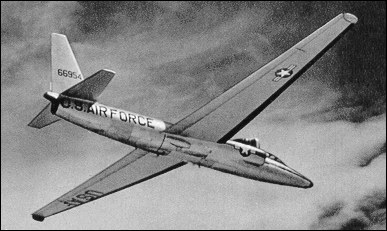
| | Gary Halbetrt, e-mail, 26.02.2012 00:55 I worked with the U2 from 1965-1968 at 100th SAC; Davis Monthan AFB, AZ. I was attached to the Com /Nav group and maintained the radio equipment. I remember launching the bird by hand, holding the wing tip up as it rolled out w /o the pogo's. I also built the UHF radio equipment into what we called the Chase vehicle. We used a 1967 Chevy ElCamino with the big block 396 cu V8 engine. The car would be driving on the runway as the U2 landed /touched down; the driver of the ElCamino would talk with the pilot, giving him instructions as to how far off the deck he was and when he touched down - he assisted the pilot as he landed. I went to Viet Nam in support of the U2 in Oct of 1967. I also remember when Gary Powers would fly our U2's back from major structural changes /modifications at the LockHeed factory, I guess he was employed with LockHeed he told us the real story of his Russia experience! Great times! reply | | Glenn Chapman, e-mail, 14.12.2011 06:10 One of you asked about the U-2 in the picture. I worked them from 1958-1966. Five "spare parts birds" were built after the contract. They were 56-6951, 952, 953, 954, and 955. The one in the picture is 56-6954. 955 crashed 14 Aug 1964. Shi Hai Sheng survived. 951 crashed 19 October 1966. Davis-Monthan. The one in this pix crashed 31 May 191968. 952 crashed 18 Nov 1971. All three survived. 953 converted to U-2CT, one of only two trainers eve built for original birds. reply | | Glenn Chapman, e-mail, 14.12.2011 05:59 I worked the U-2 in the 4080th from 1958-1962. Couple comments here. One of the commenters asked about nicknames for the bird. "Dragon Lady" was the original, then from us guys, "The Deuce, "The Useless Deuce, "U-Bird." Next comment was for Ta-183. It was a great bird, although you probably have never seen one, and I was on the launch crew for Rudy. Get it together! Without the Deuce in 1962, you would now be speaking Russian! reply | | DM brown, e-mail, 15.11.2011 21:49 Yep I was a Sferics person 73-76 Where is Little League? Red Neck Ray? Ruddie (rudolph) died a few years ago. Z is out in Gridley. Is Boots around any more? and David is he still playing with hit miss? Dickie Destructo... the name says it all. Thank all of you for giving me many great memories. I forgot Bobb and Weave.. Did he ever make it back from Utapao? reply | | norris barnes, e-mail, 24.09.2011 05:25 i was just wondering does the U-2 have any nick names?if some one could e-mail me and let me know it would be very helpful.thank you reply | | John C Spinks, e-mail, 13.06.2011 03:18 Jet Technition on the U-2 and u-2R at DMAFB 1967 to 1970 with 100SAC tdy veitnam 2 tours . as they say we all worked together to get the bird up everyday, During Inspections aor engine chsnges we all worked to take the plane apart and remove engine and do any update or write ups. Benin Hoa also the 130 with drones. even during the TET offenses we flow every day. reply |
|
Do you have any comments?
|
| 
COMPANY
PROFILE
All the World's Rotorcraft
|


 chris wanstall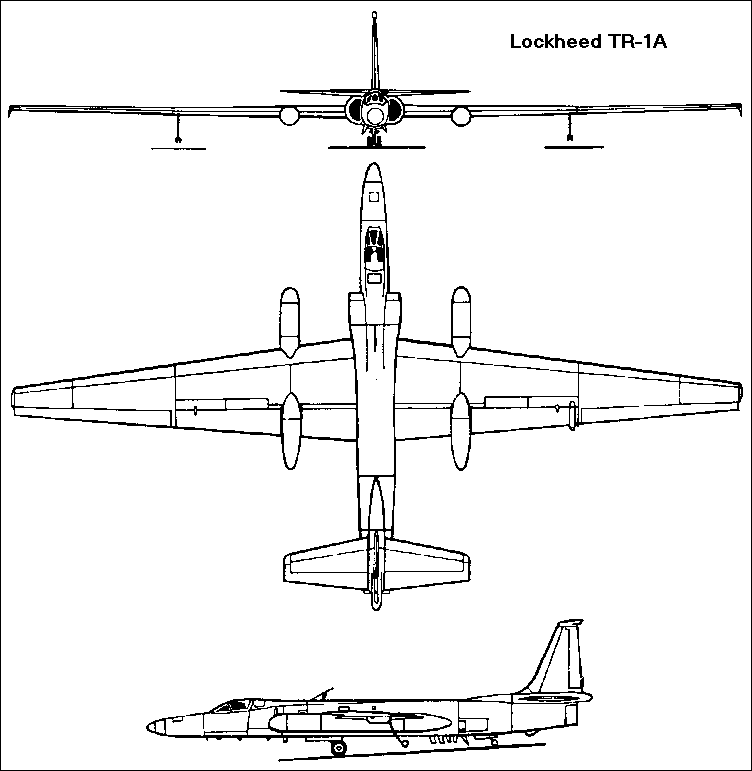


I left 100 sferics shop in 1968 and went to 100 AMMS sperics. Did you know Unger, Bochino, Weaver, Paul (had a green 68 GTO), Dutton, I think Thompson was shop cheif? Most of the guys I new got early outs to go back to college.
reply