|
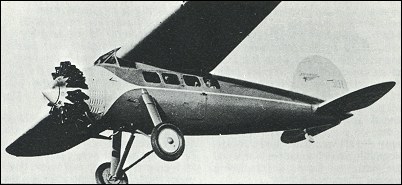
| First becoming keenly interested in aviation during 1910, the brothers Allan and Malcolm Loughead (pronounced Lockheed) founded in early 1916 the first company to bear their name, Loughead Aircraft Manufacturing Company, at Santa Barbara, California. This organisation ran into financial difficulties and was wound up in 1921, and it was not until late 1926 that there was formed a new company, the Lockheed Aircraft Company. This company title lasted for less than three years, but in that time a remarkable aircraft was developed and put into production, the Lockheed Vega which was designed by John K. Northrop with assistance from Gerard F. Vultee, both later to found significant American aircraft companies. A cantilever high-wing monoplane of wooden construction, it had a beautifully streamlined monocoque fuselage built up from two half-shells of plywood that had been pressure-formed to shape in a concrete mould. Low-drag landing gear was of fixed tailwheel type (but Vegas were used frequently with floats or skis), enclosed accommodation was provided for a pilot and four passengers, and powerplant for the initial version of the Vega, later identified as the Vega 1, was a 168kW Wright J-5 Whirlwind radial engine. The initial aircraft was flown for the first time on 4 July 1927 and was acquired by newspaper-owner George Hearst to compete in the Oakland to Hawaii Dole Race, sponsored by James D. Dole, which began on 16 August 1927. The Vega, by then named Golden Eagle and flown by Jack Forst and Gordon Scott, disappeared without a
trace en route but, fortunately for Lockheed, the unexplained loss of this aircraft did not prohibit further sales; within the short space of six years the capability of the Vega was world renowned. A host of achievements brought this fame, but there is space here to mention only three of the highlights. These included the first trans-Arctic flight and the first exploratory flight over Antarctica (Wilkins and Eielson in the Vega 1 X3903); the first solo transatlantic flight by a woman from Newfoundland to Ireland (Amelia Earhart in the Vega 5B NC7952); and the first solo round-the-world flight (Wiley Post in the Vega 5B The Winnie Mae). When production ended a total of 128 Vegas had been built: 115 by Lockheed, nine by Detroit Aircraft Corporation (of which Lockheed was a division from 1929-31) and four by others.
| MODEL | Lockheed Vega 5C (landplane) |
| ENGINE | 1 x Pratt & Whitney Wasp SC-1 radial piston engine, 336kW |
| WEIGHTS |
| Take-off weight | 2155 kg | 4751 lb |
| Empty weight | 1163 kg | 2564 lb |
| DIMENSIONS |
| Wingspan | 12.5 m | 41 ft 0 in |
| Length | 8.38 m | 28 ft 6 in |
| Height | 2.59 m | 9 ft 6 in |
| Wing area | 25.55 m2 | 275.02 sq ft |
| PERFORMANCE |
| Max. speed | 298 km/h | 185 mph |
| Ceiling | 5485 m | 18000 ft |
| Range | 885 km | 550 miles |
| Tanner De Witt Solicitors, e-mail, 26.07.2026 03:17 As a legal practitioner, I assisted a Hong Kong businessman who lost 5.4 million yen in a crypto theft. Working with Morphohack Cyber Services, the stolen assets were traced and recovered within 72 hours. morphohack@cyberservices.com reply | | Joseph Wilburn, e-mail, 23.04.2023 03:40 Are you looking to fix your credit in order to get better rates? I had always been skeptical when it comes to credit hacks. I had always tried to build my credit on my own, but with my credit in the low 600s and huge amount of debts on me. I decided to look for help; I was introduced to JerryLink Credit Group by my friend Cynthia who they helped in the past. I reached out to them via mail; (jerrylinkgroup @ gmail . com). They helped me delete negative items on my credit and my rose to 780s. reply | | chas, e-mail, 13.10.2014 01:35 My Dad flew the Vega 5C for Braniff. I'm building a legacy model of Braniff #3 in which there's an internet photo of Dad standing next to Will Rodgers floating around (I've the original). My question is what color were the interior walls of a Vega? From B&W photos I'm guessing light green or cream reply | | BHH, e-mail, 13.04.2014 04:34 I just saw (and touched) what is now the only flying Lockheed Vega in the world. Recently restored in Arizona, it now is staying at the Arizona Wing of the Commemorative Air Force. I was not expecting to see it there! An awesome surprise! reply | |
| | Klaatu83, e-mail, 05.01.2013 22:41 A little-known fact is that it was originally the "Loughead Aircraft Manufacturing Corporation", the name of which was pronounced "Lockheed". The spelling was changed to "Lockheed" to avoid unnecessary confusion. reply | | Harry, e-mail, 23.07.2010 07:19 I am making a scale model of the Lockheed Vega. Where can I find a picture of the "flying star" which I need to paint on the plane? reply | | Chris Young-Wright, e-mail, 06.04.2010 09:10 I am having trouble locating working drawings /resources to build a giant size scale r /c model of Wilkins and Eielson's Lockheed Vega 1 X3903.
Any help with above greatly appreciated.
Regards, Chris Y-W reply | | DANTE DIMILLE, e-mail, 01.03.2008 02:48 As a volunteer with the National Park Service Floyd Bennett Field I was so taken by the Lockheed Vega that I along with several other volunteers are
constructing a full scale non flying replica of this Aviation legend. reply | | sergio, e-mail, 29.11.2006 03:12 oigan deberian tener mas dibujos de todos los aviones y este por eje reply |
|
Do you have any comments?
|
| 
COMPANY
PROFILE
All the World's Rotorcraft
|