|
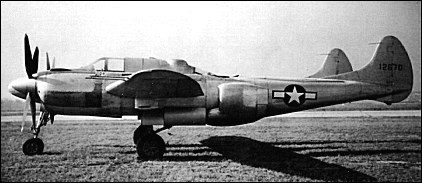
| The Lockheed XP-58 Chain Lightning resulted from a US Army contract, of 27 April 1943, which tasked Lockheed to build 'one (1) airplane, pursuit, fighter, two-engine, two-place, known as the XP-58, complete and conforming to the contractor's specifications'. The big, twin-boom XP-58 'convoy fighter' followed in the tradition of the P-38 Lightning and experimental XP-49 but had almost nothing in common with them - not dimensions, not components, not performance. The XP-58 owed its origin to Colonel Elliot Roosevelt, son of the President, who almost alone created the notion that a brute-sized, awesomely-armed escort fighter was needed. Roosevelt, however, really wanted Howard Hughes, not Lockheed, to build it.
The first of two XP-58s began taxi tests in 1943 and took to the air very belatedly on D-Day, 6 June 1944. The second airframe was never fully completed but was trucked in parts to the super-secret test centre at Muroc Dry Lake, California. By the time Howard Hughes' competing machine, the XF-11 reconnaissance craft, flew in 1946, the 'convoy fighter' idea had been dropped and the sole flyable XP-58 was a relic, abandoned to the elements after being moved to Wright Field, Ohio.
Its first flight was a 50-minute shakedown which took the XP-58 from the manufacturer's Burbank plant to Muroc. From 6 June to 8 September 1944, Lockheed pilots put 19.3 hours on the airframe. On 22 October 1944, it was ferried to Wright Field where it performed well in tests but, because of the cost of continuing a marginal programme with a 'one-off' machine, even with a second for spare parts, the programme was terminated in 1945. Derelict at Wright Field as late as January 1946, the Chain Lightning was scrapped in 1947.
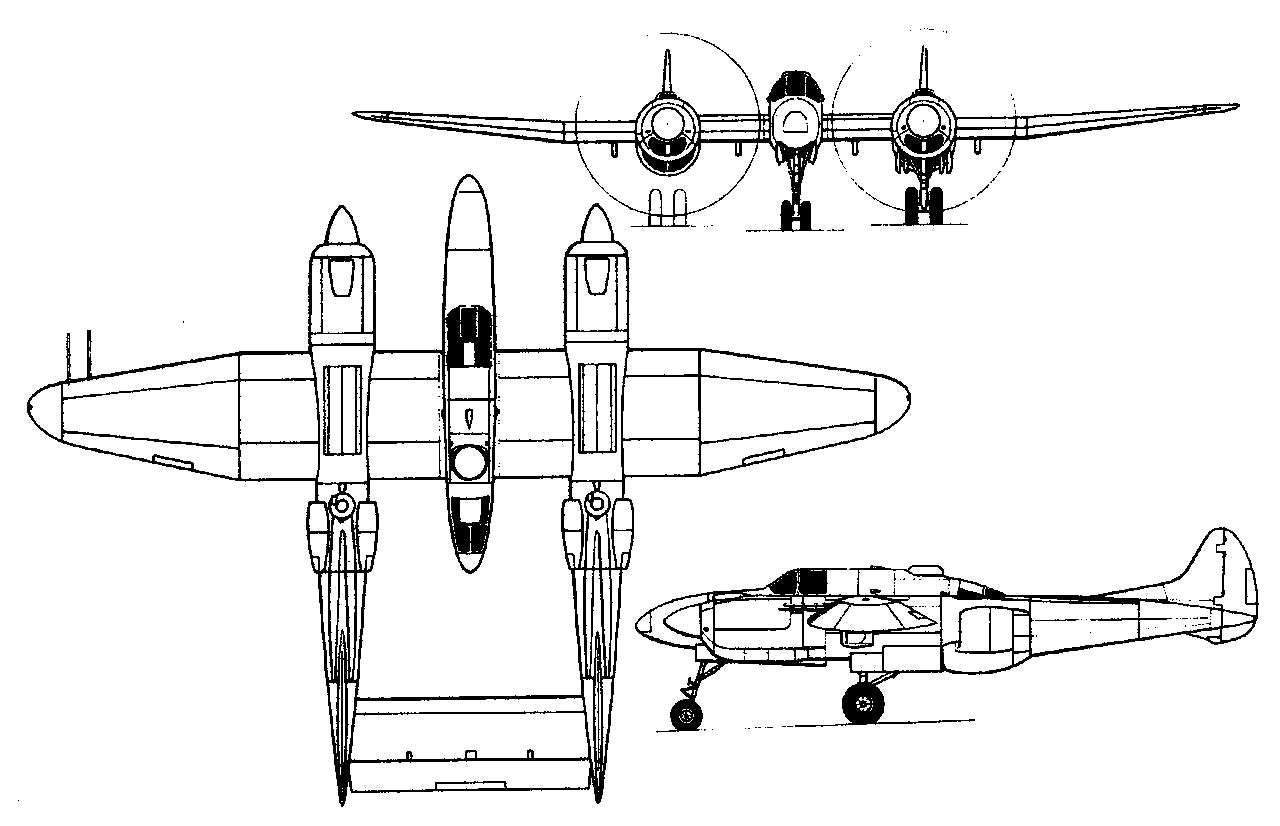
 | A three-view drawing (1280 x 826) |
| CREW | 2 |
| ENGINE | 2 x Allison V-3420-11/13, 1950kW |
| WEIGHTS |
| Take-off weight | 17770-19500 kg | 39176 - 42990 lb |
| Empty weight | 14340 kg | 31614 lb |
| DIMENSIONS |
| Wingspan | 21.33 m | 70 ft 0 in |
| Length | 15.07 m | 49 ft 5 in |
| Height | 4.88 m | 16 ft 0 in |
| Wing area | 55.74 m2 | 599.98 sq ft |
| PERFORMANCE |
| Max. speed | 700 km/h | 435 mph |
| Cruise speed | 455 km/h | 283 mph |
| Ceiling | 11640 m | 38200 ft |
| Range | 2000 km | 1243 miles |
| bombardier, e-mail, 21.10.2011 12:09 That plane was armed with four 37mm guns. reply | | Ralph Irish, e-mail, 08.05.2011 04:20 Re: the comments: "abandoned to the elements" and "the Chain Lightning was scrapped in 1947"
Does this mean that the airframe /aircraft no longer exists? Or is it somewhere at Wright-Patt, waiting for something to happen 64 years later? reply | | Klaatu, e-mail, 07.05.2011 15:36 The Chain-Lightning was too big to have been an effective day-fighter, and the AAF already had the Northrop P-61 Black Widow in production to fulfill the night-fighter role. The twin-engine long-range escort fighter role was fulfilled by the P-82 Twin Mustang, which entered production just after the end of the war. As for the Hugh's F-1, that was not a meant to be a fighter at all, but a long-range, high-performance photo-reconnaissance plane. reply | | Kadesh, 16.02.2011 18:50 Looks a bit like the Black Widow, wouldn't you say? reply | |
| | Federico, e-mail, 27.01.2011 17:15 Strange airplane. It was really too big to be an effective escort fighter. Maybe it could have been a good night fighter, or at least a reconaissance /attack aircraft... reply | | Dan Harrison, e-mail, 12.03.2010 08:49 My father Neil Harrison was project engineer on this airplane. The government kept changing wht engine he could use and every change ment redesign. This slowed the design process and the war ended andthe project closed.
Dan reply | | Dan Harrison, e-mail, 12.03.2010 08:48 My father Neil Harrison was project engineer on this airplane. The government kept changing wht engine he could use and every change ment redesign. This slowed the design process and the war ended andthe project closed.
Dan reply |
|
Do you have any comments?
|
| 
COMPANY
PROFILE
All the World's Rotorcraft
|