|
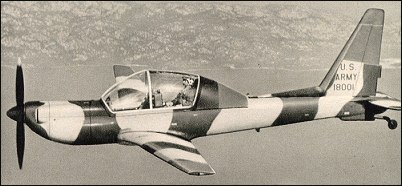
| Faced with the military requirement for a quiet observation aircraft, Lockheed developed the two-seat Q-Star. Two QT-2s flew in August 1967 and were fitted subsequently with night sensors and taken to Vietnam for evaluation under operational conditions.
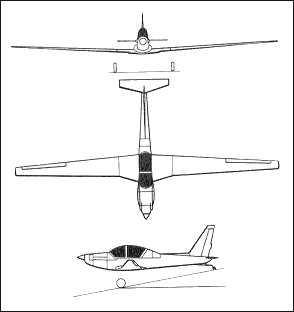
Potential of the Q-Star was such that Lockheed produced the refined YO-3A version for the US Army, still based on the Schweizer SGS 2-32 sail-plane but with low wings and the wing roots
extended forward to accommodate the retractable landing gear. Power was provided by a heavily modified 156.5kW Continental flat-six engine. The YO-3A was deployed in Vietnam for more than a year.
| CREW | 2 |
| ENGINE | 1 x Cont. IO-360, 154kW |
| DIMENSIONS |
| Wingspan | 17.4 m | 57 ft 1 in |
| Length | 9.2 m | 30 ft 2 in |
| Wing area | 17.0 m2 | 182.99 sq ft |
| Clarence L. Putnam, e-mail, 17.07.2015 04:55 I was a UH-1C and UH-1M aircraft commander in the Sidewinder Gunship Platoon of the 117th Assault Helicopter Company flying out of Plantation AAF,Long Binh, III Corp RVN
July 70 to July 71. From March 71 to July 71 we provided fire support for YO-3A flying out of Long Thanh North. Since we mainly flew nights we were usually the only gunships readily available around 3AM to 4AM when we would usually be called for support by YO-3A. They would be orbiting at around 2500 feet under radar control and provide us with 12 digit coordinates for moving lights in the jungle which at times were just artillery fires, however, we would role in at their direction and expend our rockets and miniguns. Never really knew the results. reply | | mike turner, e-mail, 20.03.2015 01:15 I believe that aircraft as seen by LYNN COFFELT / 01.03.2011 was once owned /operated by Carl Strever who operated STREVAIR airport on the north end of Camano airport. It has since been turned over to the Museum of Flight in Seattle. reply | | Mark Stevens, e-mail, 27.01.2015 05:28 The development of this A /C was thanks to MG (Ret.) Ed Browne, Melbourne, FL. He would be a great guy to talk to. He was also the man who brought the AH 64 Apache on line. From conception to birth. reply | | Monte Hodges, e-mail, 01.12.2012 01:57 I first saw and started working on the YO-3A in 1978. I worked at Ames Research Ctr. Moffett Field, Ca. NASA flew the aircraft doing air noise studies on several different types of aircraft. When Moffett Field was shut down the aircraft was transferred to Dryden Flight Research Ctr next to Edwards AFB, Ca. NASA still has the aircraft parked in a hanger but doesn't fly it anymore. I was the crew chief on this aircraft off and on for about 27 years. reply | |
| | Stan Treanor, e-mail, 04.12.2011 00:13 Around Tet in 1968 I was flying 01 birddogs out of Vinh Long, Vietnam with the 199th. One day I was asked to fly down to what I remember as Soc Trang to consider flying a new type of aircraft. It was a YO3. I remember being told I would be doing surveillance along the Ho Chi Minh Trail at night at very low altitudes. The mission didn't bother me, but I was also asked to add two more years to my three year Army commitment. I told them No Thanks! In April of 68, I was shot down in my 01 and medvac back to Texas. I wrote my Grandmother about the aircraft I had seen and she showed it to my uncle who was a VP at Lockeed.....and I believe had some oversight of the YO3 project. reply |
| Poostains, e-mail, 23.10.2011 18:14 I ate a lot of chicken in this plane. reply | | Clyde Cummings, e-mail, 16.07.2011 01:47 Young AF NCO assigned to run comm van on ramp at Binh Thuy 69-70 and grew to appreciate YO-3A especially after 105 MM rockets dropped in on us from sampams in Mekong..Yo-3A was up and found source..could be 50 feet overhead and you would never hear it pass, just a shadow as it crossed in the moonlight.. reply | | Ray Hardee, e-mail, 14.06.2011 01:21 A QT-2 operated by NASA Dryden was at the air show in Joint Base Lewis-McCord in July 2010. The first question I asked about was the long pipe running down the side, and was told it was the muffler. They said it was being used to take atmospheric samples. reply |
| Johnnie Byram, e-mail, 21.05.2011 08:34 I was the Detachment Sgt for the ASD that operated the Vung Tau AAF in 1970-71. We had a YO-3A come in to the airfield to get a canvas sock (for the wooden prop)prefabed at the maintenance shop there. My controllers had to clear the air space for his take off before he cranked the engine, due to overheating on any extended delays on his take-off.The aircraft used all of my runway to get airborn and was only about 60 feet in the air when cleared the end of the runway. You only heard the wind over the wings until he was well past your position. Then you could hear the low sound of the engine and this was at full take-off ower. All due to a muffler /exaust that ran completly down the right side of the aircraft. It was something I never forget. reply | | Lynn Coffelt, e-mail, 01.03.2011 08:46 There was (is?) one sitting on the ramp at Skagit Regional Airport, Burlington, Wa.
I took a couple of pictures of it during an air show there a couple of years ago.
No one I talked to knew much about it's presence there. It appeared almost airworthy. One departed friend said he had heard it flying there a number of years ago, and he said there was a little flutter from the propeller. reply | | Walter Pool, e-mail, 22.02.2011 07:36 I was a forward air controller based at Binh Thuy from Jan to July 71. The army had the YO-3A based there but we really didn't interact much with them so other than walking past them to get to my O-2A we just considered them a curiosity. reply | | ERIK FORBERG, e-mail, 10.02.2011 18:59 This aircraft was also known as the "Paper Airplane" due to its quietness. In '83 or '84 while on the playground at school, I saw one of these fly over, and even as a fourthgrader, remarked on how I could hear the air flowing over the wings, and not the engine. I told my father about it and he told me about the "Paper Airplane" and his involvement with it as part of the Army's chemical warfare research and developemnet unit. reply | | Jim Johnson, e-mail, 07.02.2011 01:48 Saw one of these on the ramp at Bin Thuy while driving 130's in 1970 or 71. Took a bunch of photos — no one bothered me at all. Unbelievably quiet, but it started life as a sleek Scweitzer glider, and they had a huge muffled exhaust pipe running the length of the fuselage along the right side. Interesting adaptation. reply | | Stephen Pointer, e-mail, 30.01.2011 23:32 I saw one of these aircraft disassembled at the then under-construction flight museum at Travis AFB in October 1986, while in transit to Osan AB, ROK. Got into a little bit of hot water from the AP's for wandering around the museum site, but one of the AP's took pity on me when I told him of my nerdly interest in airplanes, and he let me wander around freely INSIDE the museum site. Came across this bird, and had NO CLUE what it was until I ran across this site. Only took 25 years to find out. reply | |
| | dan bowen, e-mail, 13.12.2010 16:11 I flew the YO-3A in Vietnam from May 1971 until Oct- 1971 at which time the aircraft was removed from service. Based in Binh Thuy Air Force Base, I fellow aviators were Captain Bob Shrock and Warrant Officer Larry Vetterman. reply | | Dave Pendleton, e-mail, 02.11.2010 19:01 There were at least 2 maybe 3 of these planes in disassembled state at NAS Point Mugu in the mid '80s. They were sitting on the flying club flight line then they dissappeared. Why doesn't the Border Patrol have some operating on our southern border? reply | | charles scholes, e-mail, 09.06.2010 04:49 Funny thing...tonight I was telling my daughter about my second tour in Soc Trang with the 82 Med. and about this strange aircraft that showed up around Tet. She found it very interesting. Then I find this websight. Brings back a lot of memories. Thanks !!! reply | | Earl Kelly, e-mail, 26.04.2010 19:38 I served also at Long Thanh north with an Aircraft Direct Support maintenance unit.I was in charge of the Tech Supply section providing supply support to the Y0-3 affectionally called the "YO-YO".I had the opportunity to sit in the observers seat and I was amazed at how loud it was in the cockpit(sounded like a roller rink)and how silent it was in flight.When leaving for night missions over our perimeter all one could hear was the whoosh of wind over our heads-that's how silent it was 100 feet above us. reply | | Pat Dwyer, e-mail, 06.03.2010 22:05 I had the privilege, starting in late February 1968 --during the Tet Offensive-- of working on the QT2PC while I was stationed with the 3 combined U.S. Army Signal Detachments at Soc Trang Army Airfield (STAA)in the "IV" Corps deep in the Mekong Delta, working with Lockheed reps Dale Stith and the late Wilbur Curtis (Dale and I attended his funeral in Palo Alto several years ago) as well as the multi-force flight and ground crew which was designated 'Operation Prize Crew,' an apt description of the mission, its equipment and its people.
Perhaps because of the passage of 42 years, the 'hangarage' of the 2 craft was mis-located: they were both kept in the 121st Assault Helicopter Company's hangar, NOT the 336th's hangar, under tarps during the day to keep the curious eyes of the local /native daytime workforce from SEEING what we were hiding. Enough people in town (Soc Trang is the capital of Ba Xuyen Province)had heard about or even seen a silent --actually, VERY QUIET, since even the rush of air over a glider's wings causes wind-noise-- fly overhead, most easily seen if the craft flew between a bright moon and observers on the ground...otherwise, virtually silent at + /- feet overhead. That might also be the genesis of its nickname: "Bat Plane." The fact that there were TWO of them must have been a real conundrum for those on the ground who really weren't sure what they had seen, or THOUGHT they saw.
Being a glider when it was built, and despite the addition of the motor, prop, and many modifications, the original 2" wooden wheels, one on each wingtip were left as-is, necessitated ground crewmen to hold the craft level, once it had been pushed out to the appropriate end of the east-west runway and the pilot and observer had entered and latched down the cockpit. After the motor had run up to takeoff speed and tower clearance had been granted, the 'lucky 2' ground crew would attempt to maintain the craft level as it began its takeoff roll, running alongside, wingtip in hand, until the QT2 was going faster than we could run (I had the 'honor' a few times)and able to keep itself more or less wing-off-ground until they were airborne. Repeat above operation in reverse upon landing.
All in all, this was an example of how a private company, Lockheed, can team up with the Government DARPA, DoD, the CNO, et al.)and cut through red tape, while letting loose the combined talents and imagination to "adapt, improvise and overcome" in producing a use-specific aircraft from an aircraft never designed to do what it wound up doing, and starting the process that has grown into myriad and diverse systems of weapons and technology.
www.prizecrew.org -and- www.quietaircraft.org sites have many pictures, bios, timelines and legend-and-lore straight from the horse's... mouth! reply | | Ken Long, e-mail, 10.02.2010 23:39 The 2-32 that was a converted back from a Lochkeed QT-2 mentioned above by Pat Doyle recently survived a midair collision. The Pawnee towing it was struck midair by a Cirrus SR20 on 2 /6 /2010. Unfortunately the occupants of both those aircraft died. The 3 aboard the 2-32 survived unharmed as did the glider. I have lots of time in that glider and was one of many that participated in its restoration. Ken Long reply |
|
Do you have any comments?
|
| 
COMPANY
PROFILE
All the World's Rotorcraft
|


 Ray Hardee

The aircraft was actually a QT-2PC, forerunner of the YO-3A
reply