|
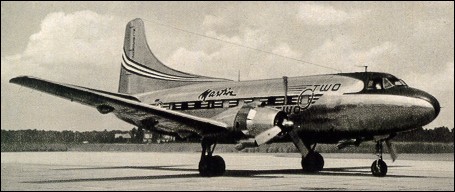
| Attempting to gain a share of the post-World War II demand for civil airliners, the Glenn L. Martin Company flew on 22 November 1946 the prototype of a twin-engine 36/40-seat transport designated Martin 2-0-2. The first of these entered service in October 1947, but the loss of a 2-0-2 in 1948 as a result of wing structural failure led to modification of other in-service aircraft and production of this version was brought to an end. The prototype of an improved Martin 3-0-3 had been flown on 20 June 1947, but with a need to redesign the wing structure it was decided instead to develop a new Martin 4-0-4. This incorporated the wing structural revisions and introduced a pressurised and slightly lengthened fuselage, accommodating as standard a crew of three or four and 40 passengers. When production ended in early 1953 a total of 103 had been built, this number including two supplied to the Coast Guard as staff transports under the designation RM-1G (later RM-1Z and finally VC-3A); they were subsequently transferred to the US Navy.
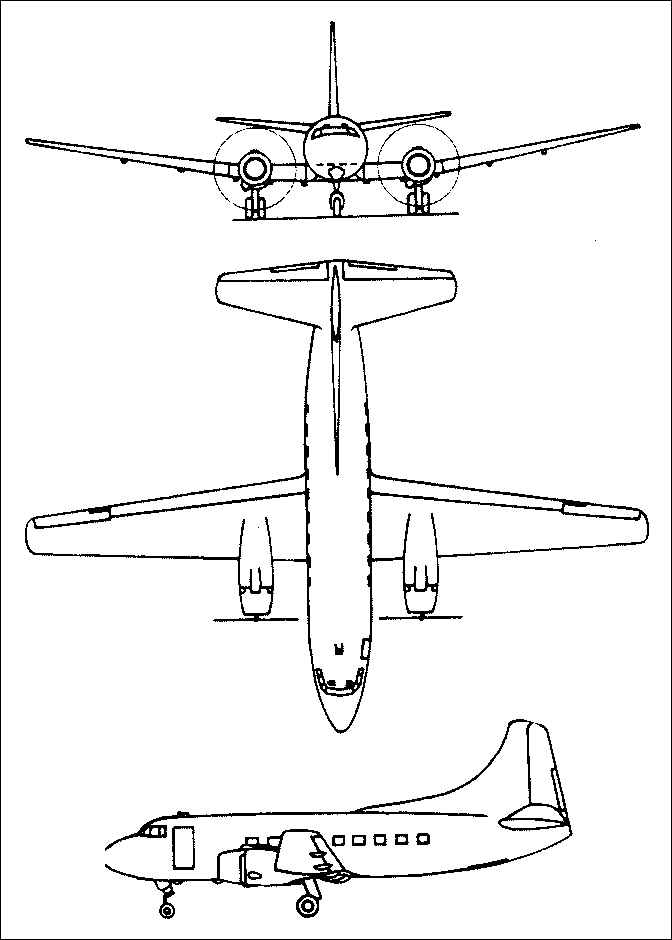
 | A three-view drawing (672 x 940) |
| MODEL | Martin 2-0-2 |
| ENGINE | 2 x 2400hp Pratt Whitney R-2800 CB-16 |
| WEIGHTS |
| Take-off weight | 19504 kg | 42999 lb |
| Empty weight | 10659 kg | 23499 lb |
| DIMENSIONS |
| Wingspan | 28.42 m | 93 ft 3 in |
| Length | 21.74 m | 71 ft 4 in |
| Height | 8.66 m | 28 ft 5 in |
| Wing area | 80.27 m2 | 864.02 sq ft |
| PERFORMANCE |
| Cruise speed | 499 km/h | 310 mph |
| Ceiling | 6705 m | 22000 ft |
| Range | 3220 km | 2001 miles |
| GrahamClayton, e-mail, 25.11.2023 05:09 What was the reason for the unusual model names (2-0-2, 3-0-3 & 4-0-04)? reply | | IVAN MARINOV, e-mail, 12.03.2016 00:19 THE CHILEAN NATIONAL AIRLINE (LĖNEA AČREA NACIONAL-LAN)
FLEW THE MARTIN 2-0-2 BETWEEN 1947 AND 1959. DESPITE THE
NEGATIVE COMMENTS ABOUT THIS AIRCRAFT, LAN USED THEM MOST
SUCCESSFULLY IN THEIR ROUTES (INCLUDING OVER THE ANDES TO
BUENOS AIRES AND MONTEVIDEO). I FLEW A LAN 2-0-2 IN 1953
AND I LOVED IT! ... INDEED, A BEAUTIFUL PLANE! reply | | BOB LANG, e-mail, 20.12.2014 15:21 IF YOU FLEW CONNIES, THE MARTIN WAS ITS MATE RUGGED AIRPLANE reply | | craig christensen, e-mail, 21.11.2014 01:43 My father worked for NWA and flew the 202's He liked them reply | |
| | Arthur Devlin, e-mail, 03.11.2012 21:05 I just read the comments. I remember that, when the 202 ceased production in the US, they were still flying them in South America. Anyone got any info on this fact? reply | | Arthur Devlin, e-mail, 03.11.2012 21:02 As a child my father Robert W. Devlin worked for Glenn L. Martin Co. I believe he was one of the engineers and test pilots of the Martin 202. If anyone remembers him or their father knowing him, I would appreciate a shout out e-mail. Thanks. reply | | John Breslin, e-mail, 05.01.2011 15:25 NORTHWEST AIRLINES FLEW THESE AND I WORKED IN DCA AND I WAS IN STP WEHN THEY WEE GROUNDED ANDALL OF THE REMAINING 202 WERE SENT TO HOLMAN FILED THE OVER HAUL BASE
I SURE LIKE HE AIRCRAFT JB reply | | jack w austin, e-mail, 01.03.2010 16:19 A beaut of an aircraft. I wish the 202 and the DC3 were still the flagships of the fleet, well maybe the connie. reply |
|
Do you have any comments?
|
| 
COMPANY
PROFILE
All the World's Rotorcraft
|