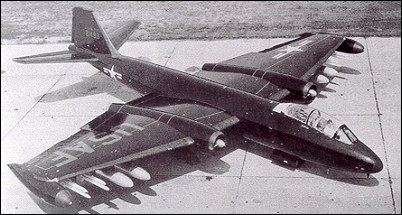
The beginning of the Korean conflict on 25 June 1950 and the shortcomings of the weary Douglas B-26, a World War II production originally known as the A-26, accounted for the urgent procurement of a light tactical bomber. The new bomber became the Martin B-57, a by-product of the English Electric Canberra, the first British-built jet bomber, initially flown in 1949.
Adaptation of a foreign-made aircraft to American mass production methods, as well as the use of different materials and tools, could present many difficulties. Another problem, perhaps more critical, centered on the Wright J65 turbojets, due to replace the Canberra's 2 Rolls Royce Avon turbojet engines. The J65 was the U.S. version of the Sapphire, a British hand-tooled production currently scheduled for manufacturing by the U.S. Curtiss-Wright Corporation. The Air Force was fully aware of these potential pitfalls, but had no better option. It had an immediate requirement for a light jet bomber, with a 40,000-foot service ceiling, a 1,000-nautical mile range, and a maximum speed of 550 knots. The new bomber had to be capable of operating from unimproved airfields, at night and in every kind of weather, with conventional or atomic weapons. High altitude reconnaissance was another must. For such purposes, the B-45 was too heavy; the Navy AJ-1, too slow; and the Martin experimental B-51's range too short.
As a result of the outbreak in Korea, the Air Force reached a final decision. The desire for a night intruder was so strong that it took just a few days to set in motion the informal production endorsement of February 1951. Because of its experience with the XB-51, the Glenn L. Martin Company was recognized as the most qualified contractor to assume the domestic production of the British aircraft and to deal with the likely
engineering difficulties involved in manufacturing a high-performance tactical bomber.
While the Air Force did not expect the B-57 venture to be free of problems, it did not foresee their magnitude. Testing of the 2 imported Canberras revealed design faults that could affect the safety, utility, and maintenance of the future B-57. Then, one of the British planes crashed; Martin's subcontractors could not meet their commitments; and the J65 prototype engines consistently failed to satisfy USAF requirements. In June 1952, further test flights had to be postponed for a year because of continuing engine and cockpit troubles. As a result, the Korea-bound B-57 did not fly before 20 July 1953, just 7 days before the conflict ended. Production of the crucial RB-57 was also delayed. The reconnaissance version entered service in mid-1954, after testing again confirmed that the more powerful J65 engines, added equipment, and other improvements had increased the aircraft's weight, in turn reducing the speed, distance, and altitude of both the B-57 and the RB-57.
Even though the Douglas B/RB-66s, on order since 1952, were expected to satisfy the tactical bombardment and reconnaissance requirements of the near future, the Air Force handled the disappointing B/RB-57 program with caution. The program was reduced, but there was no talk of cancellation. In keeping with procedures that unfortunately appeared to have become almost customary, steps were taken to ensure that the deficient B/RB-57s would be operational. This turned out to be expensive; later and considerably improved models still carried flaws, but in the long run the program's retention proved sound. In 1955, the B/RB-57s justified their costs when they served overseas pending the B/RB-66 deliveries which, as predicted, had fallen behind schedule. In 1956, much-needed RB-57Ds joined the Strategic Air Command, and various configurations of this model satisfied important special purposes.
Delivered too late for combat in Korea, the RB-57 in May 1963 and the B-57 in February 1965 began to demonstrate under fire in Southeast Asia the basic qualities justifying the Canberra's original selection. In 1970, other reactivated and newly equipped B-57s, known as Tropic Moon III B-57Gs, were deployed to Southeast Asia, where they made valuable contributions until April 1972. Finally, WB-57Fs, either modified RB-57Fs or former B-57Bs, were still flying high-altitude radiation sampling missions in 1973. Concurrently, EB-57Es, and related adaptations of the versatile B-57, continued to play significant roles, with no immediate phaseout in sight.
Martin B-57 Intruder on YOUTUBE
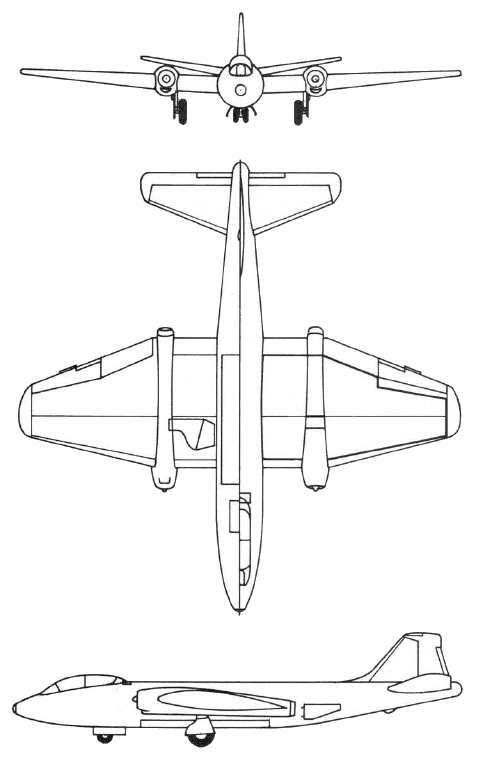
3-View
A three-view drawing (478 x 762)
Specification
MODEL
B-57B
ENGINE
2 x Wright J65-W5, 3266kg
WEIGHTS
Take-off weight
24950 kg
55006 lb
Empty weight
11790 kg
25993 lb
DIMENSIONS
Wingspan
19.51 m
64 ft 0 in
Length
19.96 m
66 ft 6 in
Height
4.75 m
16 ft 7 in
Wing area
89.8 m2
966.60 sq ft
PERFORMANCE
Max. speed
937 km/h
582 mph
Ceiling
14600 m
47900 ft
Range
3700 km
2299 miles
ARMAMENT
8 x 12.7mm machine-guns or 4 x 20mm cannons, 2700kg of bombs
I was a crew chief in the 13th Bomb Squadron at Ubon RTAFB from Sept. 71 until the 13th deactivated and left Ubon on April 12, 72. I was on the mobility team that helped ferry the ten B-57G's back to the states in an interesting island hopping adventure across the Pacific. We turned them over at Forbes AFB KS. The 13th lost one G model to a mid-air collision in 1970 over Laos but the aircrew were rescued the next day. The pilot was the CO Lt. Col. Paul Pitt. Anyone associated with the 13th during this time frame may contact me at my e-mail address.
To Darold Davis. I think I remember you as well you can reach me at dualds@att.net. Will never forget our shop at Johnson. Still make French toast the way we made at the Sarges house.
Worked as a hydraulic /pneumatic guy on them at Johnson AB in Japan 58-60. Loved working on them cause everything was easy access except the dive flap actuators. saw the crash of one trying a one engine landing after test flight. will never forget it. The trips to K-8 were a blast going out over the sea wall to get a drink. using 5606 for sun tan oil and the good bread at the mess hall in K-8. Typhoons in tiawain and at Johnson and our crazy squadron commander. some good memories
Reply to James Able: "The crew chief didn't make sure the starter chuck flipped back" ???? What are you talking about? I was a crew chief on B57Es, EB57B&Es from late 1957 to early 1962 and spent the last of my career as a B57 technical instructor on the last squadron of EB57s in the USAF at Malmstrom AFB. They were retired summer of 1979. I never heard of a starter chuck on the J65-W5 engine.
Ike Larkey was the program officer for the initial acquisition from the Australians. Ike's previous assignment was commanding night intruder missions into Korea from Japan with the 8th Special Ops. After this acquisition, Ike was made head of Bomber Acquisition in the Air Materiel Command at WPAFB. One of his reports was Gen. Ed O'Connor who was program officer for the B-52, a platform that has served the country well.
After hearing of the explosion at Bein Hoa on 5 /16 /1965; I can say the crew chief did not make sure the starter clutch flipped back; thus, the starter hung up and caused the starter to break apart.Captain Art Jeppson flew my plane (554268) at Stewart AB in NY.He was in the plane. Also; I understand the 554268 was also lost in that explosion that started the explosion.
Reply to Ronald Ostendorf: I was a B-57 crew chief at Randolph A.F.B. back in 1955. I can't remember the date or the pilot that was killed but can remember the details of a B-57 that crashed in that time period. We had dispatched 2 B-57's on a training mission (a student pilot in one plane and an instructor in the other) but only one plane returned from the training flight. I met the arriving plane and after climbing to the opened canopy I noticed the instructor pilot was very shaken up and couldn't shut the engines off. I helped him with shut down and asked him where the plane with the student pilot was. He said the other plane had crashed due to a pilot error. The student was flying as a simulated flame out with one engine (#2) at idle when he made a rt. bank causing the plane to roll to the rt. side and go nose down. The instructor pilot told the student to reduce power to the #1 engine and level the plane out but the student got nervous and instead applied 100% power to the #2 engine while still in a dive and crashed without ever trying to level the plane out. I don't remember either pilots names or even if this was the same time frame but could have very well been the same one as we had many B-57's at Randolph A.F.B. for training. The B-57 was my favorite plane to crew chief on through my 6 year career. I hope this might give you some information you are seeking about your brother.
I was Crew Chief in the 90th Bomb Squad. 1959-1961 @ Johnson and Yokota A.B. Japan. I do remenber the TDY'S to K-8 and also Robert Manns and Chuck Ramsey. I worked with some of the Post 8th guys at Lockheed Flight Test in Marietta Ga. I sometimes wonder how many are still living.
That was killed not filled..they had some long wing before I got there. I never saw one. We had a couple of EB-57 As. I think most were Ds and Es, but I think some were Bs and Cs . It has been a while so don't hold me to that. They had ejection seat mods done which caused a problem for the A models an that got rid of them.
I was a aircraft electrician in the 4677th DSES at Hill and Malstrom from 1971 - 1973..I've read some things about the B-57 that I didn't know. They had just lost one in the Salt Lake when I got there. Then one crashed after takeoff , caused a forest fire, and the last trying to land on one engine. All were filled, not all were from our squadron .
Nav in the 8th '60-63. I've logged time in 29 A.C but the 57 was my favorite. Probably because I had the best 57 driver on the planet- Chuck Ramsey-- I've got models of Yellow A (925)[2} & R (879) in which we won "Top Gun". Both destroyed at Bien Hoa I understand. We went to K8 regularly and often. Through a method not admitted to,we determined that low-level over water should not be below 55' --due to the cant of the engines, flying below that resulted in a "wake" on the water very visible from the air. Lots of great memories from that tour. Thanks, Chuck!
I'm planning to vertically lift a museum EB-57 with a CH-53. I need to know where best to place the straps on the EB. Does anyone have any corporate knowledge?
I was regular AF and was sent to an AF Radar Squadron on a Kansas ANG base at Hutchinson, Ks in Sept. 1961. The KANG had RB-57s there and sometime either summer of I think '63 one crashed a few miles south of the base. Col Boggs was the ANG commander, but the 125 or so AF guys really had little to do with them other than they covered the main gate. Still enjoyed being up on one of the radar towers and watching those guys fly.
1955-56 at Blytheville AFB, Arkansas. Flew as a Navigator-bombadier. Had around 250 hours. Airplanes were brand new and full of growing pains. But, after several years in the B-26 Intruder, the switch to the B-57 was easy and the airplane was sound. At the time few others operated at our altitudes and our only limitation was no pressure suits, so although the airplane could climb directly to 45,000 and seek above that we were limited to below 45,000 and obeyed that dictate mostly. In 1955, experience at high altitudes, jet streams and related gear was still a frontier. At low-level the airplane was a winner and had lots of loiter time for route recce and quick acceleraion when required. It too proved its combat capabilities in Vietnam.
With reference to Ed's comment, I witnessed the 1964 Beavercreek High School, Ohio crash of the fuselage of the 57 in question. The plane's wings and engines had come off at closse to 50,000 feet. the crew ejected and survived. The crash broke a window or two in the school. The plane hit nose first at an angle in a three-sided court yard. Miraculous!
Following up on my earlier post about two special B-57Es that were stationed at Andrews Air Force Base in the early 1960s as VIP-taxis under "Project Flagstaff": I have recently learned that at least 7 B-57Cs and 4 B-57Es were at Andrews at various times during the years 1956-1962, under something called "Star Flight". I have been unable to find anything about Star Flight, other than it was operated by the 1001st Operations Group. Was this a precursor to Project Flagstaff? Project Flagstaff had only two B-57s, while Star Flight apparently had as many as eleven, possibly even more. Can anyone give any information on Star Flight?


 P. Hill



Col Pitt became our 4677th Squadron Commander succeeding Col George Cap
reply