|
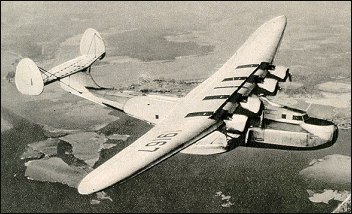
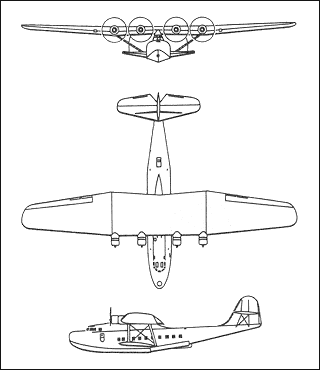
| The Martin 130 was a large four-engined monoplane flying-boat designed for transoceanic services. Three were built for Pan American Airways in 1935 and on 21 October 1936 began operating over the Pacific from San Francisco to Manilla, Philippine Islands. Two were impressed by the US Navy in 1942.
The hull was of advanced design and the result of exhaustive testing of models. Lateral buoyancy was provided by stub wings or 'seawings' instead of the conventional sponsons or outboard stabilising floats. Accommodation was provided for a crew of four and 36-48 daytime passengers or 18 sleeping bunks for night flying.
| CREW | 6 |
| PASSENGERS | 46-48 |
| ENGINE | 4 x P+W "Twin Wasp", 610kW |
| WEIGHTS |
| Take-off weight | 25590 kg | 56417 lb |
| Empty weight | 13160 kg | 29013 lb |
| DIMENSIONS |
| Wingspan | 39.7 m | 130 ft 3 in |
| Length | 27.3 m | 90 ft 7 in |
| Height | 7.3 m | 24 ft 11 in |
| Wing area | 215.0 m2 | 2314.24 sq ft |
| PERFORMANCE |
| Max. speed | 290 km/h | 180 mph |
| Cruise speed | 265 km/h | 165 mph |
| Ceiling | 5200 m | 17050 ft |
| Range w/max.fuel | 5150 km | 3200 miles |
| fred nienaber, e-mail, 12.12.2010 03:28 My father, Jewell Nienaber, began with PAA in 1935. I was born in Oakland in 1941; he was F /O on the 'Clippers', flying Sfo Bay-Honolulu-Midway-Guam-Hong Kong. I recall him telling me that it took 21 hrs to Honolulu and the cruise speed was 104 kts (could i be mistaken?), much slower than the 165 reported above. The 'China Clippers' were the Martin 130, Sikorski 42, and Boeing 314. reply | | Richard Gardiner, e-mail, 27.09.2010 20:56 My grandfather, George Tharratt, was one of the preliminary designers of the M130. Glenn L. Martin brought him over from England as a hull designer when Martin obtained the Military contract to build a "flying boat" troop transport. The military contract was canceled and never took delivery of the one built. Pan American ordered the reconfigured M130(M156) after obtaining the U.S. Post Office contract to deliver mail to the Pacific Rim. reply | | Robert L. Willett, e-mail, 25.02.2010 21:07 Any number of aircraft were labeled China Clippers but the first was the Martin 130 which left California on November 22, 1935 bound for Honolulu and points west. It carried the first airmail to be flown across the Pacific. Its pilot was Pan Am veteran Edward Musik, later killed in a Samoan Clipper S-42 crash. reply | | capt mitchell, e-mail, 09.09.2008 19:58 somewhat of expert onthe martin 156 the photo is not the martin 130, but of the 156 reply | |
| | Al LaPorte, e-mail, 29.04.2008 02:44 The photograph shown is of a Martin Model 156. This aircraft was built subsequent to the M130 and was intended to be a successor aircraft to the M130. Only one was built and it was sold to the Russians in 1937. The sale included a complete set of production drawings as the Russians intended to mass produce the aircraft. WWII and invading Germans ruined their plans. The single type was used by the Russians for troop movements during the war. It is distinguishable from the M130 by the twin tails structure. Your 3 view drawing of the M130 is correct. reply |
|
Do you have any comments?
|
| 
COMPANY
PROFILE
All the World's Rotorcraft
|